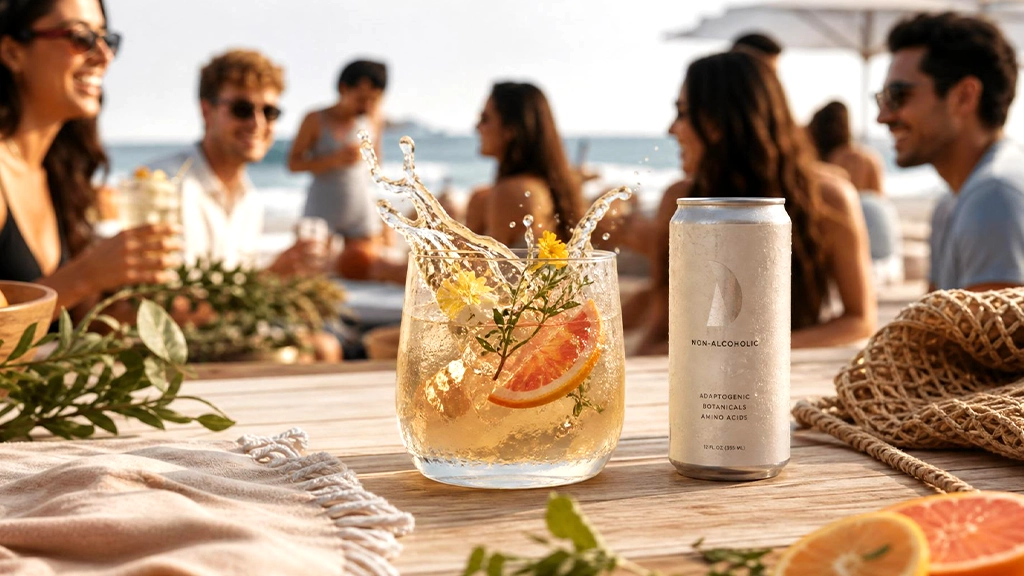
Functional non-alcoholic beverages that mimic the taste and experience of alcoholic drinks (often called “zero-proof spirits”) are an exciting and rapidly growing area of the beverage industry. The transition in the global beverage landscape is driven by the changing consumer lifestyle preferences. They seek healthier, more mindful alternatives to traditional alcoholic drinks. These drinks comprise various types of functional ingredients such as plant-based botanicals, adaptogens, and other nootropics that give them added wellness-oriented effects and unique taste and aroma profiles.

This is primarily a function of shifting lifestyles, rising health concerns, and trends like the “sober curious” movement. Consequently, functional non-alcoholic beverages are being substituted for alcohol in many instances and are transforming drinking culture by combining the elements of enjoyment with wellness.
Market Dynamics & Consumer Shift
The market for functional non-alcoholic beverages has grown from a niche segment to a mainstream growth category. The main reason for this growth is consumers’ desire to reduce their alcohol consumption proactively for reasons related to health, lifestyle, and productivity. Millennials and Gen-Z are among the largest demographics of consumers leading this movement. Consumers within these demographics want “no-lo” beverages that meet their wellness objectives and enable social interaction.

However, there is an additional layer to the transition. The category is no longer simply substituting alcohol; it is generating a completely new category. Consumers are not just replacing alcohol; they are looking for ways to enjoy a drink that gives them functional advantages, allows for more flexibility regarding when they consume it, and does not have the physical or cognitive tradeoffs associated with alcohol consumption. Brands that are well-positioned to succeed in this category are those that do not position themselves as substitutes for alcohol but as enablers of a more controlled and enjoyable social experience.
Additionally, global initiatives like public health campaigns and regulations aimed at reducing alcohol consumption are contributing to consumers adopting functional non-alcoholic beverages. Although the current valuation of the global functional non-alcoholic beverages category is approximately $13 billion, the category is expected to grow due to increased consumer interest and institutional support.
Another equally important shift influencing this new market segment is the emergence of two competitive paths. Some brands continue to develop products that replicate the sensory characteristics of alcoholic beverages. Other brands are developing products that provide specific functional features such as improved mood or relaxation. Depending on which path they select, this could potentially lead to different sets of alternative products competing with each brand. If companies try to utilize both sensory replication and functional features simultaneously, they risk diluting their branding and therefore highlighting the need to define what their value proposition is.
Product Innovation & Formulation Science
Technological advancements in dealcoholization processes, ingredient science, and controlled fermentation are driving product innovation in this category.
Traditional alcohol removal techniques, like distillation, result in the loss of flavor compounds critical to aroma and complexity, while also introducing undesirable “cooked” flavors due to thermal processing. As a result, new approaches like reverse osmosis and pervaporation offer a means of selectively removing ethanol without compromising flavor.
Formulation strategies also significantly influence product developers in creating complexity in beverages. Herbal extracts, spices, botanicals, and adaptogenic plants have been utilized to add layers of character and complexity to alcoholic beverages. When combined in certain proportions using controlled fermentation conditions, bitter, acidic, and aromatic compounds are transformed into naturally occurring flavor molecules at low levels of ethanol production.
While these technological advancements are enabling rapid product development, they are unlikely to remain a long-term source of differentiation. As standardization occurs throughout the industry, competition is expected to move toward novel formulations, unique combinations of functional ingredients, and the ability to transform scientific knowledge into distinctive consumer experiences.
Sensory Experience & Product Differentiation
The success of functional non-alcoholic beverages is strongly tied to their ability to replicate the multisensory experience of alcohol, including taste, aroma, mouthfeel, and the characteristic “burn.”
Dealcoholized beverages typically lack many volatile compounds, such as esters and terpenes, which contribute to fruitiness and floral notes. Without careful attention to preserving these components, dealcoholized beverages tend to have flat flavor profiles. Furthermore, many people associate a burning sensation in their throat after drinking an alcoholic beverage with the stimulation of their trigeminal nerve, specifically through activation of receptors or signal detectors, namely TRPV1 and TRPA1.
To address this, non-alcoholic formulations are increasingly designed to target similar sensory pathways. Ingredients such as ginger and capsicum help recreate warming sensations, while acids, bitters, and carbonation enhance taste perception. Volatile botanicals and texturizing agents further contribute to restoring aroma and mouthfeel, enabling a more complete sensory experience.
As a result, differentiation in this category is no longer about mimicking alcohol alone, but about delivering a balanced and intentional sensory experience that feels complete in its own right.
From Sensory to Functional: The Players Driving the No-Lo Revolution
This evolving landscape is also reflected in how different players are approaching the category. While some are focused on replicating the sensory familiarity of traditional alcoholic beverages, others are building around functional benefits such as mood enhancement and relaxation. At the same time, a few are carving out space through lifestyle-led positioning and occasion-specific offerings. Together, these varied approaches highlight that the market is not moving in a single direction, but is instead expanding across multiple strategic pathways.
Key Players in Functional Non-Alcoholic Beverages Industry

Commercial Realities & Regulatory Landscape
The category continues to face a combination of technical, commercial, and perceptual challenges. One of the most notable is the persistent taste gap, as dealcoholization processes remove key volatile compounds essential for aroma and complexity. In parallel, advanced production technologies increase cost structures, often resulting in premium pricing.
This creates a structural tension within the category. While premium pricing helps signal quality, it also raises expectations around both sensory sophistication and functional effectiveness. At the same time, the absence of alcohol, which has traditionally been associated with value and experience, can create a perception gap, making it essential for brands to clearly justify their positioning.
In addition to pricing challenges, regulatory considerations are becoming increasingly relevant.
As functional ingredients such as adaptogens and nootropics become central to product differentiation, scrutiny around health and wellness claims is expected to intensify. This is particularly significant in markets with evolving or fragmented regulatory frameworks, where the boundaries between food, beverage, and nutraceutical categories are not always clearly defined. In this environment, credibility, transparency, and evidence-backed claims are likely to become key competitive levers.
Go-to-Market Evolution & Emerging Opportunities
Beyond product innovation, penetrating and leading in the functional non-alcoholic beverages market is being redefined by how effectively brands establish new consumption rituals. Unlike traditional alcoholic beverages, which have benefitted from years of deeply embedded social norms, manufacturers of functional non-alcoholic beverages must actively create their own context for consumption. This is driving a shift toward experience-led strategies, including integration into social venues, collaborations with mixologists, and alignment with broader wellness and lifestyle ecosystems.
At the same time, several high-potential opportunity areas are beginning to emerge. These include the development of occasion-specific formulations tailored to distinct use cases, the use of controlled functional ingredient combinations to deliver predictable effects, and the exploration of hybrid beverage formats that combine functionality with fermentation or nutritional benefits. Additionally, emerging markets present a significant growth frontier, although success in these regions will depend on the ability to balance affordability, localization, and regulatory compliance.
Future Outlook
Although significant challenges exist today in achieving widespread adoption of functional non-alcoholic beverages, prospects for future innovation appear strong. Advances in precision fermentation, flavor encapsulation, and botanical extraction technologies will continue to improve manufacturers’ abilities to create targeted sensory designs that help bridge the gaps between traditional alcoholic and modern non-alcoholic drinking experiences. As these technologies advance and consumers become familiar with this category as a whole, we anticipate that non-alcoholic beverages will evolve from being niche products to more mainstream options.

However, in the long term, it appears unlikely that technology alone will determine leaders in this category. As capabilities begin to converge for all participants, manufacturers will start relying more on their brand equity, consumer trust, and the emotional resonance they create through experiences, extending far beyond their individual product(s).
Conclusion
Functional non-alcoholic beverages are steadily evolving from alternatives to alcohol into a broader platform for mindful, flexible, and experience-driven consumption.
Their future will not be determined by how closely they replicate alcohol, but by how effectively they redefine what consumers expect from a drink; shifting the focus from substitution to enhancement, and from restriction to intentional choice.