

A single FTO search can yield 400 documents, and if each one is read for fifteen minutes that amounts to 100 hours before any infringement question is even raised. That has always been the real cost of freedom to operate (FTO) work, and AI in FTO search is now changing that math. In July 2026, the World Intellectual Property Organization (WIPO) introduced an AI-assisted search feature in PATENTSCOPE that translates natural-language instructions into structured patent-search queries, and commercial tools now rank and cluster document sets automatically.
The practical gain comes from how analysts use these tools: AI handles the searching and screening at a scale no team could match by hand, and the analyst checks every result before it goes into a report.
This article explains what AI in FTO search can do well, and where the validation and the decision must stay with a patent professional.
What AI in FTO Search Can Do?
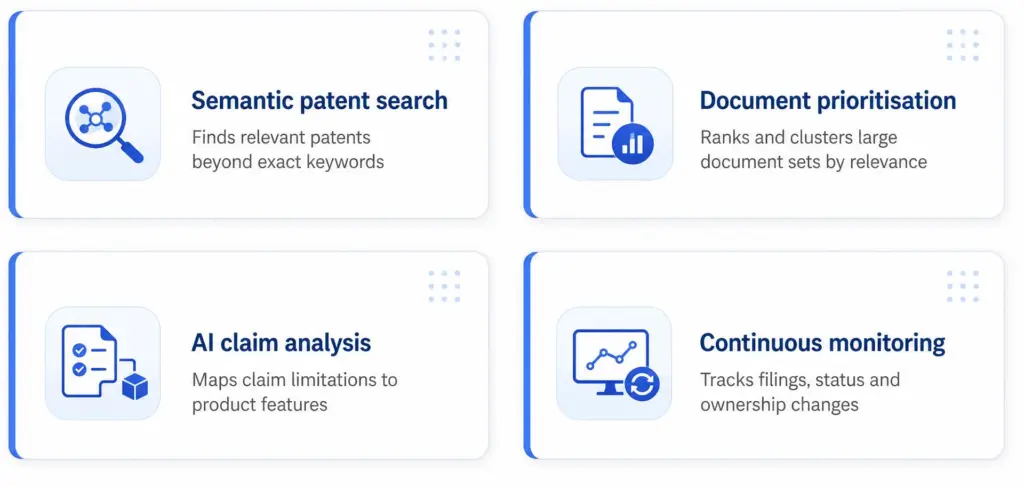
1. Finding relevant patents through semantic patent search
Patent language varies even when describing the same technology. A document on targeted protein degradation might speak of induced proximity, recruitment of an E3 ubiquitin ligase, or bifunctional compounds rather than PROTAC. An AI-powered patent search using semantic matching connects these terms and retrieves documents a keyword search would miss. The analyst then reviews the expanded concepts, removes those that drift off topic, and confirms the search logic is complete and defensible.
2. Prioritising large document sets
An FTO search might surface hundreds of relevant patent documents, but reviewing them in a random order isn’t efficient. An AI-assisted FTO search can rank documents by similarity, differences in claim language, patent family, classification, citation and assignee, cluster similar documents together, and suggest which ones deserve priority for human review. This is where the time savings are largest, because analysts begin with the documents most likely to matter. The ranking sets the order of review but does not decide materiality. Analysts test the ranking, spot check lower ranked documents, and make the call on what is truly relevant.
3. Supporting AI patent claim analysis
AI can extract a patent’s claims, break each into limitations, and compare them against a product description to flag matches, gaps and unclear points. That organises the information but says nothing about what the claims legally mean, which depends on how the patent was written, prosecution arguments and national law. AI produces the first draft of the comparison, and the analyst validates every mapping against the specification and prosecution history.
4. Monitoring patent developments
The date of an FTO opinion can be overtaken quickly once applications are granted, claims are amended, continuations are filed or patents expire. Because AI can track new publications, status changes, ownership changes and maintenance fee events, FTO becomes a continuous process rather than a one-off task carried out before launch. Each alert still passes through an analyst, who checks the source record and decides whether the change alters the risk picture.
Also Read: Common Pitfalls to Avoid When Conducting Freedom to Operate Search
Where Human Expertise in FTO Analysis Still Matters?
The sections above show where AI saves time. The ones below show where its output is only a starting point, because the conclusion depends on a person.
1. Whether a claim covers the product
Technical similarity does not necessarily mean infringement. The product or process must contain every limitation of an enforceable claim. AI can line up claim limitations against product features and point to likely matches, which gives the analyst a faster route into the comparison. Even a very similar case might differ in one important limitation, while a seemingly minor difference could turn out to be the deciding factor. Validating this requires both technical and legal knowledge, which is why human expertise in FTO analysis remains essential even as AI speeds up the document review.
2. How claim language should be interpreted
The meaning of a patent claim is rarely obvious from its wording alone. Patent claim interpretation depends on the definitions given in the patent itself, the arguments and amendments made during prosecution, and the jurisdiction in which the claim is being read, since the same term can carry different meaning in different countries. If a claim states that a component “recruits” another molecule, that raises questions of how, how much, by what structure, and to what result. AI can surface the passages where the word is used and gather the related prosecution documents, but it can’t answer those further questions. The analyst reads the material and applies legal judgment, not word matching.
3. Whether a patent can be enforced
The practical importance of a relevant patent can be limited by its validity, priority, written description, enablement, term, maintenance status, and the outcome of any post-grant proceedings. AI can retrieve and summarise this information quickly, which saves the analyst hours of collecting records. Patent legal status verification and the judgment on whether the underlying issues are legally sound, and how they affect commercial risk, still require a patent professional who checks each point against the official record.
4. What the company should do next
The right course of action depends on the company’s business objectives. Options include redesigning the product, arranging a licence, challenging the patent, restricting activity to certain jurisdictions, monitoring a pending application, or obtaining a formal legal opinion. AI can gather and organise the evidence behind each option, and the analyst validates that evidence before it reaches the client. Deciding which option fits the company’s commercial position, risk exposure, timing and resources is a call that depends on a proper patent infringement risk assessment, not just the data behind it.
The Human in the Loop Model
| FTO Activity | How AI Supports the Analyst | What the Analyst Validates |
|---|---|---|
| Scope definition | Turns product descriptions into search concepts | Product, process, jurisdictions and commercial acts |
| Patent discovery | Semantic search, classification expansion and citation analysis | Search logic is complete and defensible |
| Screening and prioritisation | Ranks patents and identifies claim themes | Whether a document is truly material |
| Claim mapping | Extracts limitations and drafts comparisons | Claim construction and every limitation |
| Risk assessment | Flags overlap and organises evidence | Infringement, prosecution history, validity and local law |
| Monitoring | Tracks filings and legal-status events | When a change needs redesign, licensing or a new opinion |
A Practical Approach to Freedom to Operate Analysis Using an AI Tool
An AI-assisted FTO search follows five stages. At each one, AI does the heavy lifting, and an analyst validates the result.
1. Set out the scope. Prepare a scoping note covering the product’s main features, how it will be used, the countries where it will be sold, and the relevant commercial details. AI can help turn the product description into search concepts. Analyst validates: the scope reflects the actual product and market.
2. Expand the search. Use AI to generate synonyms, IPC classifications and alternative ways the technology might be described, then have a person review the list before the search runs. Analyst validates: the search logic has no gaps and can be defended.
3. Retrieve and rank the documents. The AI identifies documents that meet the criteria and ranks them, along with traceable information such as publication numbers, priority dates, relevant claim text and legal status. Analyst validates: the ranking is tested, and the results are checked against the source records.
4. Review the documents identified. AI drafts the claim comparisons, and a person examines the most relevant documents, looking at claim scope, patent family, prosecution history and claim construction. Analyst validates: every limitation is analysed, not only the ones AI flagged.
5. Draw a business conclusion. AI organises the evidence, and a conclusion is reached that supports one of several outcomes, such as taking no action, redesigning around the patent, obtaining a licence, challenging the patent, or continuing to monitor it. Analyst validates: the recommendation fits the company’s risk exposure and commercial goals.
Conclusion
AI in FTO search speeds up document discovery and prioritisation, and keeps watch on new developments, but it still can’t judge commercial viability on its own. That decision has to be made by a person after weighing the claims, technical implementation, prosecution history, legal status and commercial risk. The strongest results come from treating AI in FTO search as a copilot: it extends speed and scope, while people retain control over the evidence and the final commercial decision.
At Ingenious eBrain, our analysts use AI to widen the search, screen large document sets quickly and organise the evidence, so more of their time goes to analysis rather than sorting. Every result is then validated by a multidisciplinary team of PhDs and subject matter experts across ICT, engineering and life sciences, who check the search logic, read the priority documents in full and confirm claim scope and legal status. Each patent clearance search draws on coverage across 100+ countries and 15+ databases, with results delivered in a claim-organised report built for action. Get in touch with our team to discuss your next FTO patent search.
Frequently Asked Questions (FAQ)
1. Can AI conduct a freedom to operate search on its own?
It can handle the discovery and ranking stages, retrieving and organising the relevant patent set, but it should not work unchecked. An analyst validates the results and confirms claim scope and legal status before any conclusion is drawn.
2. How is AI used in FTO patent searches?
Mainly for semantic search, claim extraction, document clustering, and ongoing monitoring of status changes, the parts of the process that are high-volume and pattern-based rather than judgment-based. Analysts use the output to work faster, then validate it before it informs any conclusion.
3. Can AI identify blocking patents for a new product?
It can surface patents whose claims overlap with a product’s features and rank them by relevance. Whether any of them actually blocks the product depends on claim construction, which an analyst works through and validates against the full patent record.
4. Can AI compare patent claims with product features?
Yes, this is one of the stronger uses: breaking claims into limitations and mapping them against a product description. Where it stops short is judging whether a partial match amounts to infringement, so an analyst reviews and validates every mapping.
5. How do experts verify AI patent search results?
By checking the search logic for gaps, reading the highest-priority documents in full, and testing the AI’s claim mapping against prosecution history and jurisdiction-specific case law.
6. Why does AI patent search output need human validation?
AI can misread a claim, miss context, or rank a document too high or too low. A person who checks the output against source records catches those errors before they reach a business decision, which is what makes the speed of AI safe to use.
You can speak to our experienced IP specialists by completing the form provided below or by emailing us at contact@iebrain.com.