

A bill of materials (BOM) may look simple at first glance, but it can hide dependencies that disrupt production: a chip sourced from only one supplier, a supplier based in a politically unstable region, a part nearing end of life with no ready replacement. BOM risk analysis exists to catch these problems early, letting businesses evaluate the risks and build a safety stock strategy that prevents costly delays and losses.
This article looks at what BOM risk analysis is, why it’s gotten harder to manage, and how to identify and prioritise these risks before they cause a disruption.
What Is BOM Risk Analysis?
BOM risk analysis, also called a BOM risk assessment, means examining a bill of materials to spot the risks connected to each component, supplier, or related element. It is not a one-time check for obvious problems, but a continuous process covering single-sourcing, component lifecycle, supplier financial stability, and the geographical reach of the supply chain.
Companies that make it a regular practice catch problems before they happen; those that do not usually deal with risks only after they have caused damage.
Why BOM Risk Has Become Harder to Manage
A few forces have changed BOM risk over the past several years:
- The shortages of semiconductors revealed how dependent a large number of products are on a small number of manufacturing facilities and supply sources.
- Because of geopolitical and export-related problems, some areas and types of components have become greatly more vulnerable, almost suddenly.
- The lifecycles of components are getting shorter, especially in the field of rapidly developing electronics, which is leading to a higher rate of end-of-life and obsolescence events.
- Supply chains have grown more global and multi-layered, so a risk buried several tiers down can still affect the final product.
- The aspects relating to sustainability and compliance, which are examined in a BOM compliance analysis (for example, conflict minerals, RoHS, REACH), introduce a risk factor that has nothing to do with price or availability.
These trends appear to be accelerating, which makes systematic BOM risk analysis more valuable now than a decade ago.
The Three Layers of BOM Risk
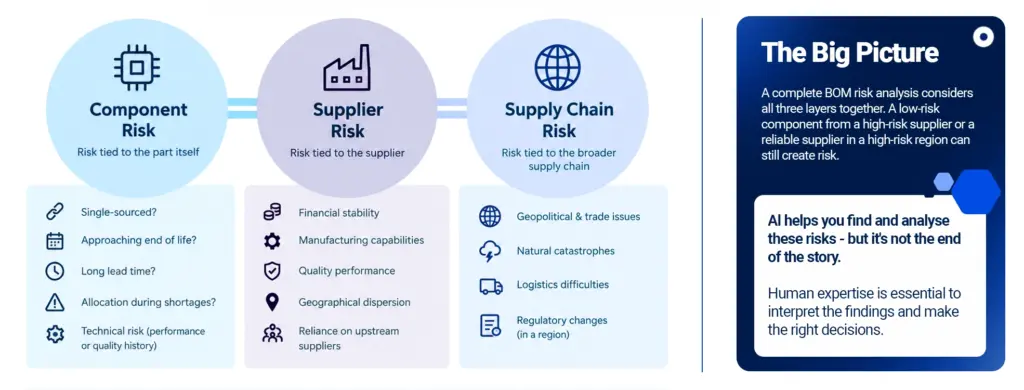
Most BOM risk falls into three closely related layers, and findings are easier to act on when they are grouped under one “supply chain risk” view rather than treated separately.
1. Component Risk
The risk in this case relates to the component itself, which is the main aspect of component risk management: is it obtained from a single source? Is it nearing the end of its life? Does it have a long lead time? Is it subject to being allocated when there is a shortage? Technical risk is also part of component risk, since the part’s specifications or its quality record indicate that it may not perform reliably on a large scale.
2. Supplier Risk
This category, which is generally known as a supplier risk assessment, includes the suppliers’ financial stability, their manufacturing capabilities, quality performance, the geographical spread of their operations, and their dependence on their own upstream suppliers; even if the component itself has a good record, a supplier that is weak-whether because it is financially unstable or because its production process relies too heavily on a single factory, is still a potential risk.
3. Supply Chain Risk
This category is focused on broader supply chain risks, the focus of any supply chain risk assessment, including geopolitical and trade issues, areas vulnerable to natural catastrophes, logistics difficulties, and regulatory changes in a particular region that could impact the ability to acquire components from any source within that region.
A complete BOM risk analysis weighs all three layers together: a low-risk component from a high-risk supplier, or a reliable supplier in a high-risk region, both carry real risk.
How to Identify These Risks Before They Disrupt Production
1. Tag the BOM: Set attributes for each item: sourcing status, lead time, lifecycle stage, supplier location.
2. Identify single points of failure: Components with no qualified second source are the ones most likely to stop production if they fail.
3. Evaluate supplier health: Financial and operational checks should not stop at onboarding; supplier risk exposure needs ongoing review.
4. Track component lifecycle status: Watch for end-of-life or allocation notices, since lifecycle changes can affect production continuity.
5. Watch the geopolitical and regulatory environment: Tariff and trade-restriction changes are hard to predict, but they can hit the supply chain hard when they land.
6. Score and prioritise: Not every component or supplier carries equal weight; rank risk factors so the ones that matter most get attention first.
7. Plan for risk, do not just list it: Mitigation planning might mean qualifying a second source, redesigning a part or subassembly, or lining up alternative supply plans.
What Good BOM Risk Analysis Actually Prevents
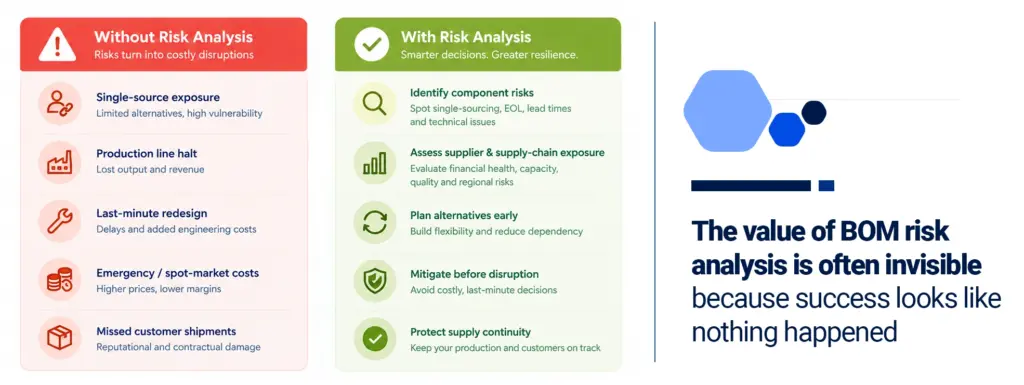
When done correctly, the process both prevents and mitigates the following expensive events:
- Production line halts caused by a single-sourced part suddenly going out of stock
- Last-minute redesigns forced by an unexpected end-of-life notice from a supplier
- Unplanned cost increases from being pushed into a spot market purchase at a premium
- Compliance issues stemming from restricted materials, denied suppliers, or missed regulatory changes
- Reputational and contractual damage from missed customer shipments and broken delivery commitments
- Strained supplier relationships when a last-minute order forces a partner to jump the queue for other customers
The value of the analysis typically outweighs the cost by a considerable amount. Unfortunately, the benefits of a BOM risk analysis are often invisible until there is a disruption. That renders the process an easy target for budget cuts in the best of times.
Conclusion
BOM risk analysis would not eliminate every risk; some exposure is unavoidable in any supply chain. What it provides is a clear picture of where the exposure points are, how severe they are, and a process for reducing their impact. The companies best positioned to handle shortages are the ones that treat risk assessment as an ongoing practice rather than an afterthought.
Finding the risks in a BOM is only the first step. The real advantage comes from understanding the true cost structure behind each component and identifying where design, sourcing, or process decisions can create value. The IeB BOM and Cost Structure Analysis service looks past published datasheets and list prices, running engineering-supported teardowns, physical and theoretical, to validate design structure, benchmark components against real industry data, and produce a cost-validated BOM that R&D, procurement, and sourcing teams can actually use.
Talk to our seasoned experts by filling out the form below or emailing us at contact@iebrain.com.


