

A drug may obtain EU approval and meet all the regulatory requirements yet still lose a year of market exclusivity depending on when and where it is launched. According to the new regulatory update, if a company submits an application for approval anywhere outside the EU and does not then have a corresponding application in the EU within 90 days, it will not be able to secure that year’s exclusivity. Hence, the decision to launch a medicine in Europe can no longer be separated from questions related to market protection, pricing, supply and market access. This is one of the major changes included in the EU Pharmaceutical Reform Package, which is the most important reform of EU medicines law since 2004.
Through the introduction of stronger obligations around the availability of authorized medicines, if a Member State requests that a product be made available in its market, the manufacturer may need to pursue pricing and reimbursement, participate in procurement, or provide an acceptable roll-out plan. Failure to meet the applicable requirements can put market protection or orphan exclusivity in that country at risk.
At the same time, the revised rules change how companies can earn additional periods of protection, strengthen preparation rights for generic and biosimilar manufacturers, and introduce new considerations around supply resilience and procurement.
In short, for pharmaceutical companies, the implications extend well beyond regulatory compliance.
Since the new rules have been introduced, they have had a major impact on the economic prospects of companies that have depended on phased rollouts in the EU or have adopted ‘file-and-forget’ launch strategies.
The article sets out the different changes which will be introduced by the EU Pharmaceutical Reform Package, explains its significance along the entire value chain, and outlines the steps that companies should take, based on the final agreed texts and the practical measures now available to the Member States.
What Does the EU Pharmaceutical Reform Package Include?
The new Directive and Regulation in the EU Pharmaceutical Reform Package replace the existing 2004 framework and introduce a series of changes intended to improve patient access, reduce medicine shortages and encourage innovation in areas of greatest need.
Among the most significant changes are:
- Revised and more conditional periods of regulatory protection;
- Stronger obligations around the availability and continuous supply of medicines;
- Expanded rights for generic and biosimilar manufacturers to prepare for market entry before protection expires;
- Revised incentives for orphan medicines;
- Measures supporting supply-chain resilience and procurement diversification; and
- New mechanisms under the Critical Medicines Act (CMA) to strengthen manufacturing and procurement.
The new landscape is defined by three themes:
-
Incentives must be earned
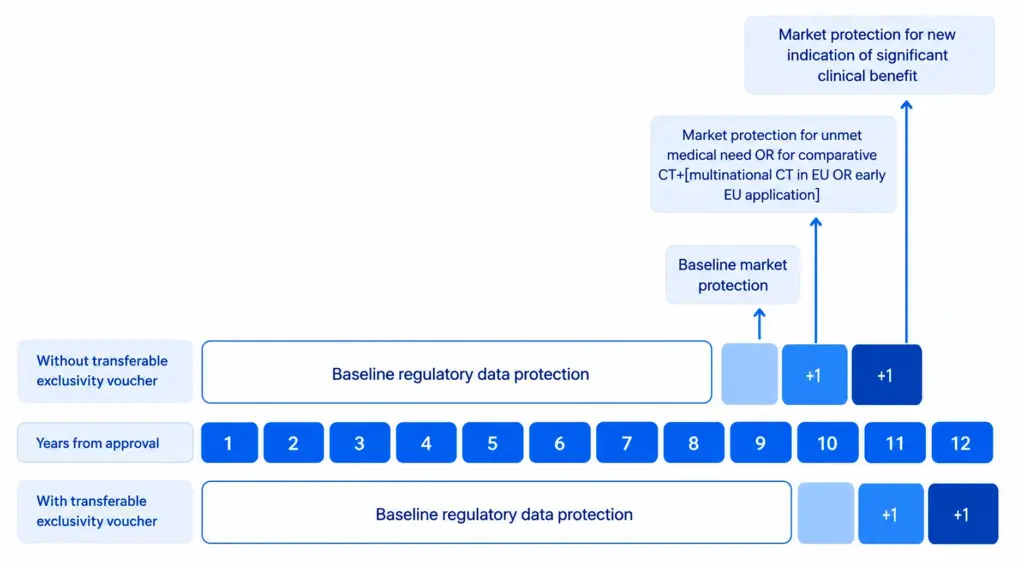
The baseline market protection period is being reduced to half, from two years to one year (so that it changes from “8+2+1” to “8+1(+1)+1” years). Even though firms can make up for that lost year by applying for modulated extensions on the grounds of unmet medical need; because of the quality of the comparator; by filing in the EU first (or very shortly afterwards); and by providing evidence in multiple states. The upper limit stays unchanged, being usually 11 years, or 12 years if an antimicrobial exclusivity voucher is in question, which shows clearly the actual intention: now protection has to be earned rather than taken for granted.
-
Availability is a compliance metric
Because of the provision in the revised Directive known as Article 56a, Member States have considerable power since this allows them to require a product subject to market protection (or orphan exclusivity) to be actually available and continuously supplied in their own market. As a result, companies may be compelled to apply for pricing and reimbursement, meet the procurement requirements, and draw up a roll-out plan. If the three-year period necessary for placing the product on the market is missed, the protection or the orphan exclusivity will cease to apply in that state.
-
Generic and biosimilar pathways are clearer and faster
The Bolar exemption now explicitly includes activities concerning marketing authorization, HTA, pricing and reimbursement, and procurement tenders, on the condition that no actual sale or marketing occurs during the protection period. In practice, this allows competitors to carry out a coordinated EU launch well before the original protection period begins.
For innovators, the takeaway is that global launch sequencing, the choice of comparator, and supply planning can no longer be detached from the regulatory function, since generics and biosimilars have a much clearer route to a day-one launch in the EU.
Market access planning, therefore, needs to account for the full competitive entry pathway, rather than treating the end of patent or regulatory protection as the only relevant milestone.
The Core Regulatory Shifts: What You Need to Know?
-
Regulatory protections: from “8+2+1” to “8+1(+1)+1”
The duration of the baseline is reduced from two years to one year. However, in multiple scenarios, the year that has been reduced can be reinstated in the baseline:
- The product addresses an unmet medical need (a life-threatening or severely debilitating disease for which there is either no treatment authorized in the EU or in which there is a clinically significant improvement in terms of efficacy or safety, with comparable efficacy).
- When applying for new active substances, the applicant uses a comparator that is appropriate and based on evidence, in keeping with the scientific advice from the EMA, and submits the application in the EU or within 90 days of filing in another region.
- Where it is not possible to carry out comparative trials, pivotal efficacy trials carried out in more than one Member State can be used to support eligibility for extension, together with a filing that is first in the EU or filed near simultaneously.
- A new therapeutic indication (including for children) which provides a meaningful clinical benefit: it is worth one additional year, but only once.
Why this matters for market access?
The evidence demonstrating clinical differentiation can have value beyond reimbursement discussions. It can potentially influence whether a company qualifies for additional protection, while also shaping how the product is positioned against competing therapies. For manufacturers, this means that market access considerations should enter target product profiles and development planning earlier, rather than being addressed shortly before launch.
-
The Drug Launch Obligation: When Availability Becomes Strategic
The revised rules give Member States greater ability to require a medicine covered by market protection or orphan exclusivity to be made available in their market. This can involve pricing and reimbursement applications, procurement participation, or an agreed roll-out plan.
For manufacturers, this creates a new tension between broad access and controlled market sequencing.
Historically, companies have often prioritised European markets based on factors such as market size, expected price, willingness to pay, reimbursement environment, international reference pricing, supply readiness, and commercial attractiveness.
The launch obligation introduces another variable: the possibility that a Member State may require availability even if the company had not initially prioritized that market.
How Long Is Orphan Drug Exclusivity Under the Revised EU Regulation?
The new Regulation reformulates and replaces the current method for providing orphan incentives by introducing one exclusivity period per active substance and adopting a tiered system which takes into account the actual level of differentiation of the product.
-
Traditional orphan products: 9 years
The new baseline for orphan medicinal products which do not satisfy the breakthrough criteria and are not based entirely on bibliographic data is nine years. Unlike the previous baseline of ten years (together with possible paediatric extensions), this change shortens the standard period of protection and places more emphasis on obtaining extensions by means of new indications.
-
Breakthrough orphan medicinal products: 11 years
A drug qualifies for “breakthrough” status when there is no EU-approved treatment available for the condition and its use has a meaningful effect on reducing morbidity or mortality among that group of patients. It is precisely with first-in-class, highly impactful therapies for rare diseases that protection is maintained or indeed gained: the reform is clearly designed to reward true clinical differentiation.
-
Products authorized on bibliographic data: 4 years
When the approval is based on existing literature rather than new clinical trials, exclusivity is only granted for four years. This sends a clear message that genuine clinical development is rewarded, while merely repurposing published evidence is not.
-
Extension mechanics and the single‑clock rule
Under the old regime, separate orphan designations for the same substance could lead to the activation of independent “10+2” windows. This is no longer the case. The new system provides a single exclusivity period starting from the first orphan marketing authorization for that substance in the EU. You may obtain up to two one-year extensions, but only on condition that you secure approval for a genuinely different orphan indication at least two years before the expiry date. This approach is intended as a way of discouraging the practice of ‘indication stacking’ in order to promote development programmes that target a broader range of distinct rare diseases.
What does this mean for market access?
For orphan portfolios, companies will need to consider not only how many indications they can develop, but when each indication should enter the market and how it contributes to the overall value of the product.
Indication sequencing should therefore be assessed alongside:
- Patient population
- Unmet medical need
- Potential breakthrough qualification
- Development timelines
- Remaining exclusivity
- Reimbursement opportunity
- The timing of future indications
The single-clock approach makes lifecycle planning particularly important.
How Do These Reforms Impact Pharma & Biotech Across the Value Chain?
a) Regulatory exclusivity and innovation incentives are now performance‑based
The level of protection that you achieve is directly affected by the quality of the evidence, the design of the trial, and the order in which the applications are filed. It is necessary to include in the target product profiles from the Phase II stage onwards a comparator strategy, the EU-first timing, and the rationale based on unmet medical needs, rather than adding these elements at a later stage. You must look at your portfolio models in the event that the extension does not take place, as this could have a major effect on NPV and on the launch sequence.
b) Higher expectations on availability and shortage prevention
Member States have the option of asking for a continuous supply within one year of being authorised, and in such a case, if that supply has not taken place within three years then market protection (or orphan extension rights) will cease in that state. Furthermore, MAHs have more rigorous obligations concerning the early detection of shortages and in keeping shortage prevention plans for prescribed medicines.
There is also a pricing trade-off worth mentioning: by launching early at a low reference price you will be able to comply with an Article 56a request and thus secure your exclusivity, but at the same time you might find that the price levels across the EU are lowered as a result of international reference pricing. This trade-off has to be addressed explicitly and not merely ignored
c) Supply chain resilience moves to the centre of regulatory focus
Alongside the Pharma Package, the CMA layers on an industrial-policy dimension: strategic EU manufacturing projects, procurement diversification, and a mechanism for joint Commission-led procurement once five or more Member States ask for it. Companies relying on single-source suppliers or concentrated geographies should expect more scrutiny, and possibly procurement preference for EU-based capacity.
d) Regulatory modernization and digitalization will expand
Electronic product information, multi-country and multi-language packaging, more centralized data for tracking shortages and compliance: all of it keeps growing. Organizations with mature digital QMS and real-time supply visibility are better positioned to keep up.
e) Start regulatory and operational readiness assessments now
Full application lands in late 2028, and there are still plenty of implementing acts to come. That gives you time to reposition pipelines, contracts, and launch playbooks, but not unlimited time. Starting the readiness work now is what keeps you from a costly mid-development pivot later.
How Does the EU Pharmaceutical Reform Change European Market Access Strategy?
The reform changes market access from a primarily country-by-country launch decision into a more interconnected strategic exercise.
Five areas require particular attention.
-
Launch sequencing becomes a strategic decision
Companies will need to assess European markets using more than market size and revenue potential.
Launch sequencing should consider expected price and willingness to pay, international reference-pricing exposure, market protection, potential Member State availability requests, supply requirements, procurement exposure, and the cost and feasibility of maintaining availability.
This may make a single European launch sequence inappropriate across an entire portfolio.
Different products may require different approaches depending on their price sensitivity, competitive environment, supply requirements and exclusivity profile.
-
Pricing strategy becomes closely connected to access strategy
The reform could reduce the flexibility companies have historically had to delay lower-value launches while establishing prices in higher-value markets. Manufacturers will need to model the potential consequences of each European entry price before making launch decisions.
The relevant question becomes: What does the first European price mean for the rest of the European launch sequence and the product’s global pricing architecture?
This makes price corridor modelling, reference-pricing analysis and launch-sequence scenario planning increasingly important.
-
Exclusivity becomes linked to commercial decisions
Additional protection is potentially available when companies meet specified criteria relating to unmet medical need, comparator selection, filing sequence and clinical development.
Consequently, market access strategy needs to account for the value of potential extensions when assessing the optimal development and launch pathway.
A one-year difference in protection can have significant implications for cumulative revenue, competitive entry and lifecycle value, particularly for high-value therapies.
-
Supply becomes part of sustainable market access
A product cannot deliver meaningful access if it cannot remain available.
The reform therefore increases the importance of manufacturing capacity, inventory, sourcing and shortage-prevention measures.
Companies may need to assess dual sourcing, manufacturing diversification, EU-based production options, inventory policies, distribution capacity, and shortage-prevention mechanisms.
The Critical Medicines Act adds another dimension by supporting supply diversification and collaborative procurement. Depending on implementation, these measures could influence both where companies manufacture and how they approach European market entry.
-
Competitive entry may become more coordinated
The expanded Bolar exemption gives generic and biosimilar manufacturers greater scope to prepare for market entry before protection expires.
This means innovators should assess not only the duration of formal protection but also how quickly competitors can prepare their commercial, regulatory and procurement pathways.
Lifecycle planning should therefore incorporate competitive-entry scenarios well before loss of protection.
What Steps Are Companies Aiming to Take?
- Rebuild target product profiles around the new incentives: Companies need to map each asset against unmet-need criteria, comparator requirements, and EU-first filing windows, then align clinical protocols accordingly.
- Design for multi-state evidence: Where it’s feasible, run pivotal efficacy trials across more than one Member State to support both extension eligibility and HTA readiness.
- Lock in EU-first or near-simultaneous filing strategies: Coordinate global regulatory timelines to meet the “EU first or within 90 days” threshold wherever it’s advantageous.
- Operationalize launch and supply obligations: Build country-by-country launch playbooks covering pricing and reimbursement applications and procurement steps, with shortage-prevention triggers built in from the start. Track the three-year response window for each Member State request, so protection is not lost by default.
- Stress-test orphan strategies: For rare-disease portfolios, reassess indication sequencing under the single-clock model, and prioritize breakthrough qualification, where criteria are met.
- Diversify supply and align with CMA priorities: Evaluate dual-sourcing, EU-based manufacturing options, and inventory policies that satisfy both business continuity and new procurement expectations.
- Invest in regulatory intelligence and scenario planning: Monitor implementing acts and EMA guidance and run “extension granted/ not granted” scenarios to inform investment and launch decisions.
How Can Ingenious e-Brain Help You Navigate the EU Pharmaceutical Reform?
These reforms bring real opportunity alongside real risk, and working through them takes expert regulatory interpretation, strategic scenario planning, and assessment that’s specific to your product, not generic. That’s where we come in:
- Market Access and HTA Support. We help align clinical and economic evidence with the new unmet-need and comparator expectations, to strengthen your pricing and reimbursement outcomes.
- Tailored Impact Assessments. We map how the revised framework hits your current and future portfolio, including exclusivity sensitivity and launch-obligation exposure.
- Strategic Regulatory Pathway Planning. We design filing sequences, trial footprints, and evidence packages built around the new exclusivity and incentive structures.
- Scientific Advice Preparation. We support comparator justification, multi-state trial design, and clinical evidence strategy to maximize your extension eligibility.
- Orphan Designation Strategy. We assess breakthrough criteria, indication sequencing, and extension pathways under the revised definitions.
Conclusive Note
The EU Pharmaceutical Reform is changing the economics of European market access.
The key shift is not any single regulatory provision. It is the way multiple provisions interact: market protection is becoming more conditional, availability can become an obligation, pricing decisions can have cross-market consequences, competitive entry can be prepared earlier, and supply resilience is becoming increasingly important to sustained access.
For pharmaceutical companies, European launch strategy therefore needs to move beyond the traditional question of where the commercial opportunity is greatest.
Talk to our healthcare industry experts and consultants to thoroughly understand EU Pharmaceutical reform, the EU drug launch obligation, and what these changes mean for launch strategy, market access, and commercial planning.
Fill out the form below or email us at contact@iebrain.com