

A product can look almost identical to a registered design and still slip past a basic search. That is the risk companies face when they treat design patent search as a quick keyword exercise. A design protects how an item looks, and appearance is hard to put into words. One team calls a handle a grip, another calls it a bar or a pull, and a search built on a single term misses the rest. Classification helps close that gap, but classification alone is not enough.
A product can resemble to a registered design very closely and yet still manage to escape a simple search. This is the risk that companies face when they treat design patent search as a quick keyword exercise. Since a design protects how an item looks and as appearance is difficult to describe in words, one group refers to a handle as a grip, another as a bar or a pull, and a search based on just one term will therefore overlook the other options. Classification helps to narrow this gap, but classification by itself is not sufficient.
This article explains what a reliable design patent search requires, and why effective searching goes beyond keywords and classification.
Why Design Patent Search Needs a Structured Approach
To carry out a search for design patents, one has to look for prior registrations that are similar to the ornamental appearance of a product. This type of search can assist with a number of decisions, such as determining whether a new design can be protected, whether launching the product could amount to infringement, and whether an existing registration can be challenged. Since each objective requires a different level of analysis, the depth of the search should be tailored accordingly.
The problem lies in the nature of the subject. Because designs are represented through drawings rather than technical claims, and their titles are often short and general, such as ‘Bottle’ or ‘Electronic device,’ text searches can capture only a small portion of the available prior art. Searchers must therefore rely on their visual judgment, have knowledge of the classification system, and be familiar with the method used by different offices to record designs.
Two Classification Systems That Strengthen Design Patent Searches: Locarno and US Design Class
The Locarno Classification by WIPO is used by the majority of design offices all over the world. It consists of 32 classes and over 200 subclasses so that a single classification can be used in many different jurisdictions. However, different products can fall within the same subclass, while similar designs may be placed in adjacent classes, making searches across neighboring classes important.
The US Design Class system uses D codes, such as D14 for communication equipment. Its subclasses follow product form and function more closely, which suits exhaustive US searches. US design patents carry kind code S and last fifteen years from grant, so clearance must reach back over a decade.
The table indicates the areas in which each one is most appropriate:
| Aspect | Locarno Class | US Class |
|---|---|---|
| Governing body | WIPO | USPTO |
| Structure | 32 classes, 200+ subclasses | D classes with detailed subclasses |
| Coverage | Most design offices worldwide | US design patents |
| Granularity | Broader product groups | Finer product form and function |
| Best use | Multiple-jurisdiction screening | Exhaustive US clearance |
| Main risk | Different designs can share one subclass | Limited value outside the US |
Locarno gives breadth, US Class gives depth, and both depend on human review of the actual drawings. A search that relies on classes alone will miss designs filed under unexpected codes. That gap is why Ingenious e-Brain wraps both systems inside a longer process.
Ingenious e-Brain Five-Step Design Patent Search Methodology
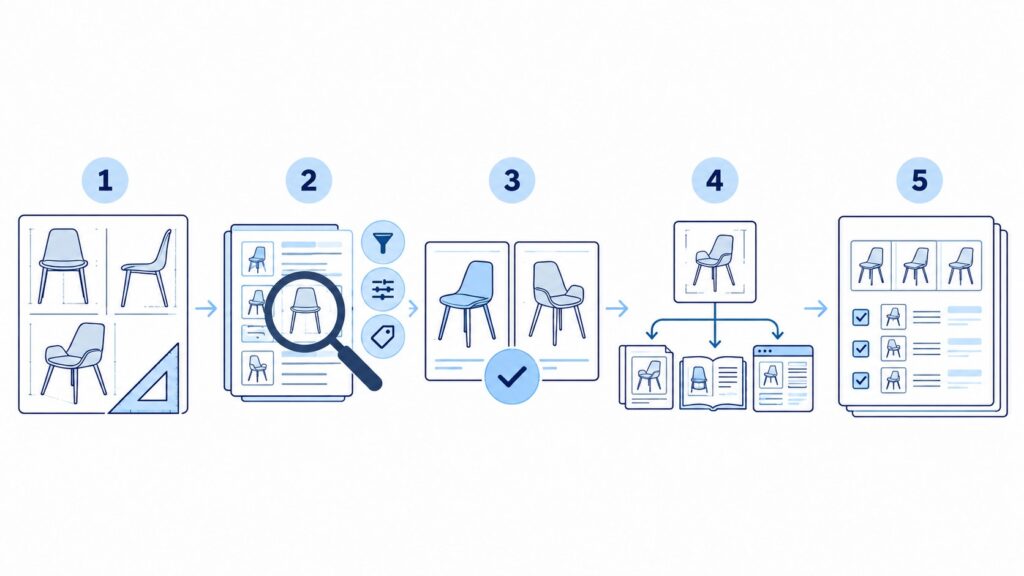 Step 1: Understand the Scope
All projects begin with the drawings, not with a query. The analysts examine the design that has been made public, looking at its views, proportions, and ornamental cues. They also establish the purpose of the search, whether it is to carry out a new design assessment, challenge the validity, or establish freedom to operate. The purpose determines what counts as relevant, so the boundaries for comparison are fixed before any search is carried out.
Step 2: Build Search Strategies and Run Initial Searches
With the visual scope clear, analysts list the key design features and plan three kinds of searches: keyword searches, keyword plus class searches, and design class searches using Locarno, US classes, and jurisdiction specific schemes. These searches are run across platforms such as Questel, PatSnap, and WIPO’s Global Design Database. On Thomson Innovation, the team searches with kind code S, class codes, and keyword combinations. Content based image retrieval runs on several search engines to match appearance without relying on titles.
Step 3: Review Visually and Shortlist
Every retrieved reference, patent and non-patent, is screened by eye. Analysts compare perspective views, images, and ornamental elements against the subject design. A small change in proportion or surface detail can shift the whole impression, so no similarity score replaces this review. Only designs with meaningful similarity move forward.
Step 4: Refine and Search Beyond Patent Records
The first pass shapes the second. Analysts revisit keywords, update classes, and search relevant assignees and inventors. Then they widen the net to sources a classification search never reaches:
- Utility patent drawings
- Product listings, online marketplaces, and review sites
- Prototype catalogues and historical product variants
- Manufacturer or region specific design archives
Scopus, Google, and ScienceDirect add journals and web publications. A product shown online before a filing date can change a novelty or invalidity argument, yet it appears under no design class.
Step 5: Report and Map Relevant Designs
Findings are mapped in different views in order to assess how close each reference is to the subject design whether it is identical, highly similar, or only related. Along with each reference there are supporting visuals and bibliographic information, such as the assignee, inventor, filing details, and grant status. The report also records the reason why a design was included or excluded, so that the reader can understand the logic without having to go through the same process again.
Why Businesses Choose Ingenious e-Brain for Design Patent Search
A method is only effective when the right people and adequate coverage support it. The Ingenious e-Brain team consists of more than 300 PhDs and subject matter experts in the fields of ICT, engineering, and life sciences.The team uses over 14 or 15 databases, depending on the filing date, covering more than 100 countries. It also offers native-language capabilities across more than 25 languages, including Chinese, Japanese, and Korean.
Analysts combine AI tools with human judgment. In the United States and in India, the search teams work within well established export control compliance procedures, and strict access protocols guard the clients’ data. Prices are customized for each project, and clients pay only when they are completely satisfied.
Final Thoughts
A design patent search requires a high degree of discipline. While the Locarno Classification provides global coverage and the US Design Class offers greater depth for the American market, neither substitutes for a careful manual review of the visuals. The best results come from combining classification, image retrieval, and research outside of patent databases, followed by a hand check of each result.
Since design work is a visual activity, the process involved must be structured, transparent, and repeatable. Whatever the aim, whether protection, clearance, or challenge, the same level of discipline is applied. If you are planning a product launch, preparing a filing, or evaluating a competitor’s design, speak to our design patent search team by completing the form below or emailing contact@iebrain.com.