

A Freedom to Operate (FTO) search, also known as a patent clearance search, assesses whether a product, process, or technology may infringe enforceable third-party patent rights in the countries where a company intends to operate. It typically involves identifying relevant patents and published applications, reviewing their legal status, and analysing whether their claims may cover the proposed commercial activities. The FTO search is therefore important at specific times for companies to ascertain their clearance to operate, which makes knowing when to conduct a freedom to operate search just as important as the search itself, as it is a strategic activity designed to help companies avoid patent infringement lawsuits and associated costs. Knowing when to perform an FTO search can help organizations save time, money, and resources in the long run.
The most challenging part of an FTO search is not understanding what it is – it’s knowing when to conduct one. In this article, we discuss the 7 most critical business scenarios that require an FTO search, so you can act early, avoid costly mistakes, and make better decisions.
7 Critical Business Triggers for FTO Searches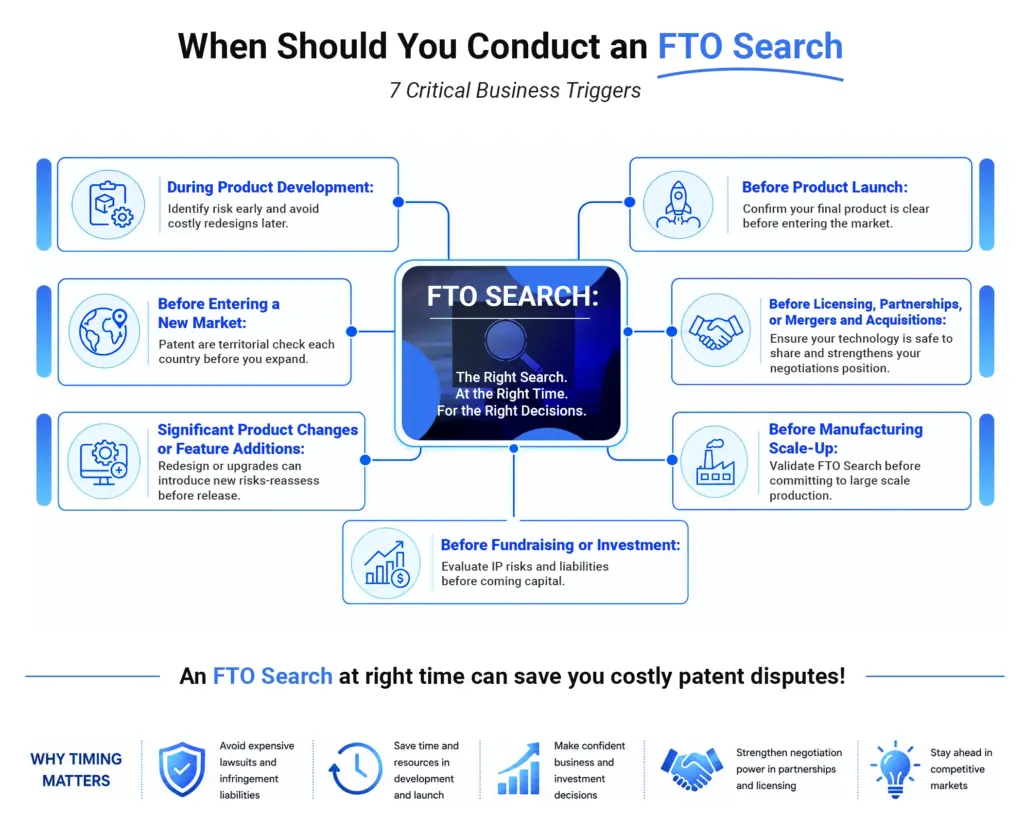
Let’s walk through each of these triggers in detail:
1. During Product Development
When: During ideation or prototyping, before significant R&D investment.
The first reasonable time to do an FTO search while developing a product – when your main idea is set, a rough understanding of the design and the technological solution is available, but the ultimate design is not yet locked.
Many founders wonder when the right time is to do an FTO search. The truth is that it should be done earlier than most people think. Doing a search while one is still designing the product gives them an advantage because it allows them to:
- Modify around a patent before it is too late.
- Identify any opportunities for licensing.
- Avoid the R&D costs of a feature that may need to be removed later.
If a prototype uses some novel or particularly risky technical solution, then an FTO search should be done before the prototype is finalized since doing one at this stage would be significantly more cost-effective than a redesign after tooling and testing are complete.
Best Practice: Conduct a high-level landscape analysis once your desired design features have been defined with sufficient detail to allow searching, but before the design has been finalized.
2. Before Product Launch
When: Months before commercialization of the product and after the design has been finalized.
This is the trigger that most businesses are already familiar with. An FTO search before product launch is by far the most relevant check before putting the product on the market because the launch is the moment when the infringement risk truly becomes a possibility to be enforced against.
If you are going to do only one FTO search throughout your product’s development, this is the one. It should happen after final design (or right around the time of final design). A comprehensive pre-launch FTO search confirms your final product design doesn’t infringe enforceable third-party patents in each target market. Because development takes considerable time, new patents may have issued since your initial FTO, making this final clearance essential.
For a sense of what this looks like in practice, see how an FTO search helped clear obstacles for a real invention in the camera-based augmented reality space.
Best Practice: Re-run the search as close as possible to your launch time to account for any new patents filed since your initial FTO.
3. Before Entering a New Market
When: Before committing to sell, manufacture, or distribute in a new country; ideally as part of your market-entry planning, not after the decision is already locked in.
Patent rights are territorial; a patent granted in one country has no legal force in another. This means an FTO search before entering a new market is a distinct trigger from your original launch search, not a formality you can skip because you already cleared your home market. The World Intellectual Property Organization (WIPO) notes that because patent rights are territorial, the relevant countries and intended commercial activities need to be clearly defined whenever a freedom to operate assessment is carried out.
For example, a product that is deemed “cleared for the Indian market” may conflict with an existing patent in Germany or the United States because a competitor might have filed for protection in these regional markets that are not yet visible in India. Since a PCT application can enter the national phase in any of the targeted countries, searching only the granted patents may not be sufficient for market-entry searches; pending applications should also be taken into account.
Best Practice: Treat each new target market as a separate search, and consider pending PCT applications, as they may enter the national phase in your target country of interest.
4. Before Licensing, Partnerships, orMergers andAcquisitions
When: Before signing a licensing agreement, entering a partnership, or closing an acquisition; ideally as part of due diligence, not after terms are set.
FTO due diligence becomes essential whenever your product or technology is set to become legally and financially integrated with another party. There are several scenarios such as:
- Licensing: The FTO search before licensing technology makes sure that what’s being licensed in (or out) doesn’t contain any infringements that could disrupt the agreement later.
- Partnerships: The patent risk assessment before engaging in a commercial partnership safeguards both sides from unexpected liabilities.
- Mergers and acquisitions (M&A): FTO analysis during mergers and acquisitions is usually part of a broader IP due diligence and freedom to operate review. The acquiring entity wants to make sure that the products of the target company do not pose a patent infringement risk after the acquisition. This due diligence step is critical to value the target company accurately or cancel the deal in time.
Bypassing this trigger is never an option since the danger is only transferred to the next level of the business relation. For example, if an acquisition deal is closed, the previously unidentified risk in the target company’s core technology area might become an intellectual property issue for the acquiring company, which incorporated the target’s product at a price that did not account for this risk.
Best Practice: Build FTO review into the due diligence checklist itself, not as an optional add-on, so it’s addressed before terms are finalized rather than after.
5. Significant Product Changes or Feature Additions
When: After major design modifications, new features, or technology pivots.
Product evolution often leads to new infringement risks. Introducing new features, changing the manufacturing process, or changing the formula can lead to the involvement of patents that were previously not relevant. A change in these factors requires conducting a fresh freedom-to-operate search that focuses on the new aspects of the product.
New patents are constantly issued; thus, it is possible that even a minor change to a product design might result in its infringement on recently granted patents.
Indications when you should conduct an FTO search are:
- A product’s significant redesign, in its function, materials, method of operation, etc.
- Introduction of a significant new feature.
- Entering a new market or utilizing a new manufacturing process.
There are no hard rules about how long an FTO search is valid for – but as a rough guideline, anything older than 12 – 18 months, or that precedes a major product change should be considered for a refresh.
Best Practice: If your product is growing, evolving, or entering new technical spaces, revisit your FTO analysis.
6. Before Manufacturing Scale-Up
When: Prior to full scale or contract manufacturing, after your pilot has been successfully tested and you are preparing to ramp up to volume production.
A search done for a small pilot run does not protect you when you scale up to commercial production. There is a big difference between searching for an FTO before manufacturing begins versus searching after you’ve already begun.
Searching before you manufacture is much more important because the number of products you are making will drastically change the risk you are willing to take. For example, it is much more likely for a patent owner to sue a company manufacturing thousands of products, rather than a few pilots.
This trigger is especially relevant if:
- You are moving production overseas or to a new facility.
- Your manufacturing process itself uses patented methods or equipment.
- You are increasing volume significantly after an initial soft launch.
Best Practice: Make sure to carry out a targeted search before signing a manufacturing agreement or placing a volume order, particularly one that involves a change in facility, process, or supplier. Moreover, treat a significant increase in production scale as an opportunity to update a search originally done for a smaller run.
7. Before Fundraising or Investment
When: Prior to fundraising, preferably several months before institutional investors begin formal due diligence.
FTO analysis before fundraising is becoming a common practice, especially among startups that plan to raise money from institutional investors. So, when should a startup perform an FTO search? Normally, it is reasonable to do an FTO search before a funding round where potential investors will carefully assess the intellectual property (IP) risk as part of due diligence.
Does it mean that investors will require an FTO analysis? Not necessarily explicitly, but more and more sophisticated investors, such as venture capital funds that specialize in hardware, biotech, medtech, or other R&D-intensive fields, understand that before investing significantly in a young company, they should at least have a rough understanding of the threats and opportunities in the patent landscape. Thus, an FTO search for a startup before fundraising serves two purposes: it protects the company’s interests, and it demonstrates to potential investors that the startup knows what it is doing in terms of IP strategy.
Best Practice: Conduct or update your search prior to your due diligence process commences and prepare a short summary of key risks for potential investors to speed up the process and demonstrate that your IP strategy is in control.
What is the Best Time to Conduct an FTO Search?
Looking at all seven triggers together, a pattern emerges: the best time to conduct an FTO search is before a major commitment of money, legal exposure, or reputation; not after. In other words, the optimal time to conduct an FTO search is when there is still room for maneuver, such as design changes, licensing opportunities, or renegotiations, rather than once a commitment has been made.
For most companies, the optimal timing probably falls somewhere between two key points: an FTO search at some point during the development process (to identify and address any issues that can be fixed cheaply) and another just before launch (to make sure that the finalized version of the product/design/service is indeed free to use).
Waiting until after tooling has been made or shortly before launch leaves companies with fewer options, all of which are likely to be more expensive (redesign, new licensing deals, product recall).
Final Thoughts
Timing an FTO search around these seven FTO triggers, rather than thinking of it as a one-time event, provides the most flexibility in managing patent risk throughout the potential lifecycle of a product or technology. Whether you need to time it to your R&D, launch, funding round, or other business initiative, the recurring thread behind all seven of these FTO triggers is the same: the sooner you do an FTO search, the more options you have for redesign, license, negotiate, and the fewer you are left with if you wait. Ultimately, knowing when to conduct a freedom to operate search is what separates businesses that manage patent risk proactively from those that discover it the hard way.
If you are working through one of these FTO triggers and need guidance on navigating the patent risk ahead, Ingenious e-Brain’s Freedom to Operate search service helps you get the most comprehensive coverage of patent databases in 100+ countries with human expert analysis to help you formulate a clear path forward and build a strong FTO position.
Frequently Asked Questions
1. When is an FTO search required?
An FTO search is a commercial necessity, but not a legal requirement. It is standard practice before launching a product, scaling manufacturing, entering a new market, seeking investment, licensing technology, or entering into any large-scale commercial commitment where infringement risk could outweigh the reward.
2. When do you need an FTO search?
You need an FTO search before making a significant, difficult to reverse business decision about a product or technology. The most common decisions that require an FTO search are before launching, scaling up manufacturing, entering a new market, raising funds, licensing technology, or buying another company.
3. Does an FTO search ever expire, and if so, how long is it good for?
While an FTO search does not technically expire, the relevance and accuracy of a search can decrease when new patents are issued and when your product design changes. As a general guideline, any search that is more than 12-18 months old or that preceded a major design change should be repeated.
4. How often should an FTO search be conducted?
There is no universal schedule. The best approach is to treat each search trigger mentioned above as a separate criterion. If more than a year has passed since you performed a search, you should renew the search, since a lot can happen in a year, especially in the fast-moving realm of technology.
5. How long does an FTO search take?
It depends on the product’s complexity, the number of jurisdictions, and the number of patents to be reviewed, but on average, it takes 4-6 weeks to complete, with some cases taking less time to meet short-term launch needs.
Talk to our seasoned IP experts by filling out the form below or emailing us at contact@iebrain.com.