
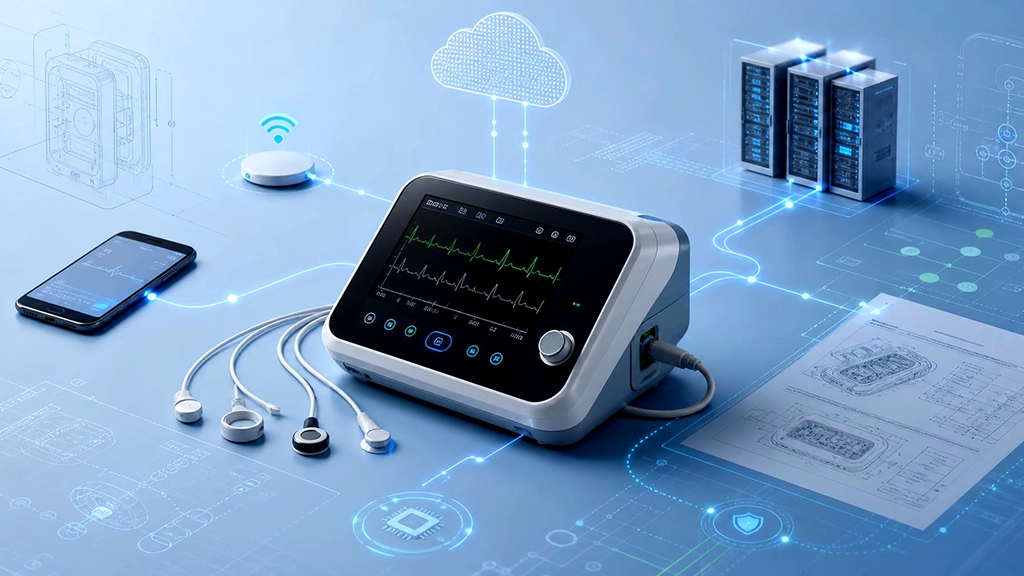
Medical devices are becoming more connected. Infusion pumps link to hospital networks, wearable ECGs send patient data in real time, glucose sensors pair with smartphones, and remote monitoring devices rely on cellular networks to stay in touch with care teams. As standards become embedded in medical devices, they also bring new IP and licensing considerations. This raises an important question for MedTech: could Standard-Essential Patents (SEPs) become the industry’s next major licensing battleground?
In this article, you will learn where exposure to SEPs may arise in the MedTech industry, who could be exposed, and what companies can do to mitigate licensing risk before it becomes a dispute.
Where Does SEP Exposure Sit in MedTech?
The primary source of SEP exposure in MedTech is connectivity. Medical devices are becoming more connected and increasingly rely on technologies developed through standards organizations and industry forums. Three areas in particular stand out.
-
Wireless Connectivity: Wi-Fi, Bluetooth, and 4G/5G
Wireless communications standards are the most visible layer. Wi-Fi is used within hospitals to connect infusion pumps and patient monitors. Bluetooth Low Energy is utilized for glucose monitors, pulse oximeters, and wearable ECGs. 4G/5G networks transmit data from remote patient monitoring devices, cardiac patches, and medical alert systems.
Examples of connected products that illustrate where such standards are used include Philips IntelliVue monitors, Baxter Spectrum infusion pumps, Dexcom G6, Masimo MightySat, iRhythm Zio, and TytoCare.
-
Video Codecs: The Hidden Link to Telemedicine and Imaging
The second area of concern is video coding. HEVC, AVC and VVC all contribute to more efficient video transmission, which is crucial for telemedicine, endoscopes and medical imaging. The dynamics are similar to the SEP disputes in the streaming sector. An Oppo VVC-related litigation was initiated against ASUSTeK in Shanghai IP Court in December 2025, which is reportedly the “first known pure VVC SEP assertion”. Although not directly related to MedTech, it shows that new standards can also give rise to licensing disputes.
-
Healthcare Data Standards: A Less Visible Risk
The third and possibly less visible pressure point is healthcare data standards. Healthcare-specific standards such as HL7/FHIR, DICOM, and IEEE 11073 introduce another potential exposure vector. A Connected Health Initiative analysis 2025 identified only three HL7 IPR disclosures, with the most recent one dating back to 2006 and highlighted limited public information on DICOM IPR. DICOM does have a formal patent policy, so the issue is better described as a visibility and verification gap. However, if any of the relevant IPR changes ownership or is acquired by a patent assertion entity, it may become difficult to assess the potential risk going forward.
Why the Risk Is Moving Up the Healthcare Supply Chain
SEP pressure does not typically reach the device manufacturer first, as connectivity is often integrated into the product at the level of semiconductors and communications modules so licensing pressure often comes from upstream. Tunstall Healthcare, the UK-based connected-care provider, which cares for over 100,000 people in their homes, reported to Parliament that it had to negotiate separately for licences for the 4G and Wi-Fi connectivity, which raises the question of who ultimately bears that cost, the module supplier, the device manufacturer, or both.
Exposure spans across module manufacturers, such as u-blox, Telit, Quectel and Thales, and device companies, including Philips, GE HealthCare, Siemens Healthineers, Medtronic, Abbott, Dexcom, Masimo, Baxter, BD, iRhythm, ResMed, Dräger and Tunstall itself.
Who Could Be Involved?
Potential SEP licensors or assertors include Nokia, Ericsson, Qualcomm, InterDigital, Huawei, Sisvel, Panasonic and Sun Patent Trust, along with various codec licensing programs, such as Access Advance and Via Licensing Alliance, as well as NPEs acting in the background. In addition, Philips presents a notable complication: it is both a major MedTech company and a cellular SEP holder, placing it on both sides of the negotiating table depending on the transaction.
THE ECOSYSTEM IS ALREADY FORMING
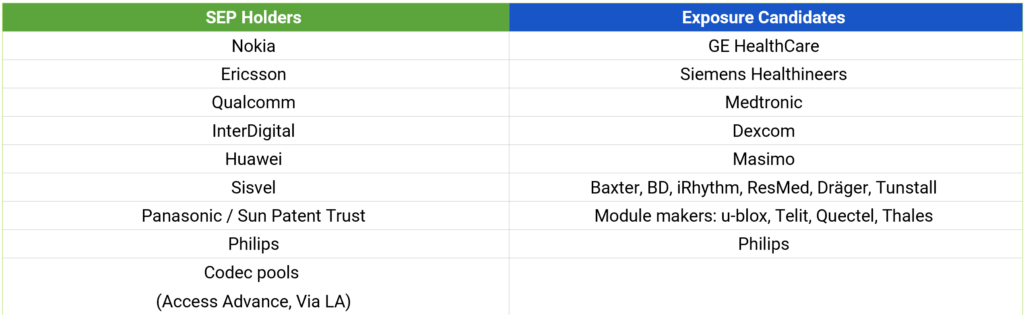
The remaining companies named above are organisations whose products or supply chains implement these standards, not confirmed defendants in any dispute. Lawsuits against the companies mentioned above have not been filed to date.
Recent SEP Cases That Matter to MedTech
Three recent cases are useful for understanding the legal environment, even though they are not themselves MedTech SEP cases.
- InterDigital vs Disney: Produced the first UPC anti-antisuit injunction in Mannheim, May 2025. After Disney attempted to use a US court to stop InterDigital from pursuing its European enforcement. This case shows how quickly a dispute over a standard essential patent can extend to multiple jurisdictions.
- Fraunhofer vs Lenovo: The first ever US SEP assertion case by Fraunhofer, and it was filed in October 2025. The lesson for MedTech to take away from the case is that the source of SEP risk is not limited to the traditional telecom licensors. Research entities are also asserting patents as well.
- Oppo vs ASUSTeK: Filed in the Shanghai IP court in December 2025, is the first assertion targeting VVC SEPs exclusively. As new standards emerge, disputes are likely to erupt around them before the industries relying on those standards fully understand the licensing implications.
MedTech Patent Activity Is Growing
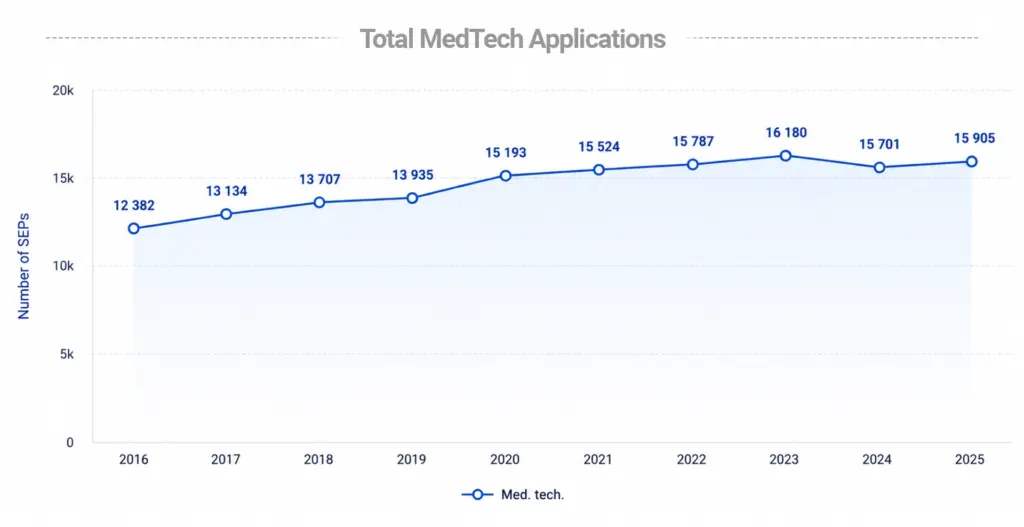
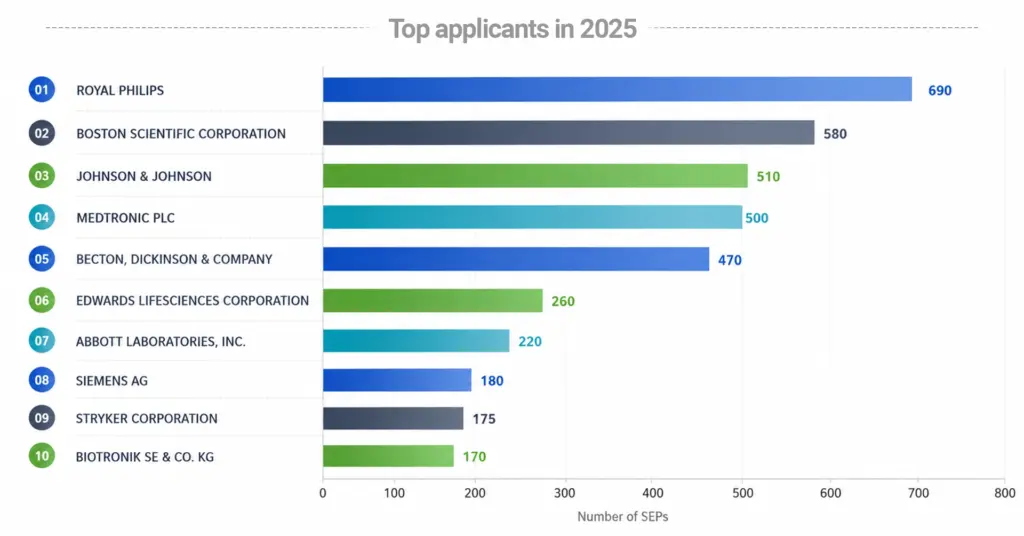
The potential SEP issue is developing alongside strong MedTech patent activity. In 2024, medical technology accounted for 15,701 EPO patent applications– representing 7.9% of all applications. Of these, 40.5% were filed in EPO countries, 38.2% in the US, and 21.3% in other regions. MedTech was the 4th largest technical field, with Royal Philips, Johnson & Johnson and Medtronic among the top applicants. More importantly, the trend shows that the MedTech patent filings have grown more than three times over the past twenty years, compared to nearly stagnant pharmaceutical and biotech filings.
The EPO’s 2025 data show that the applications grew by 1.3% year-on-year, reaching 15,905 total medical-technology applications. This means medical technology companies now hold more than ever a dual role as both patent owners and implementers of third-party standards. As a result, the strategic focus is expanding beyond protecting proprietary inventions to understanding which standards products implement and which third-party patents may be relevant to those standards.
What Licensing Options Are Available?
The table below summarizes the most relevant approaches for MedTech companies today.
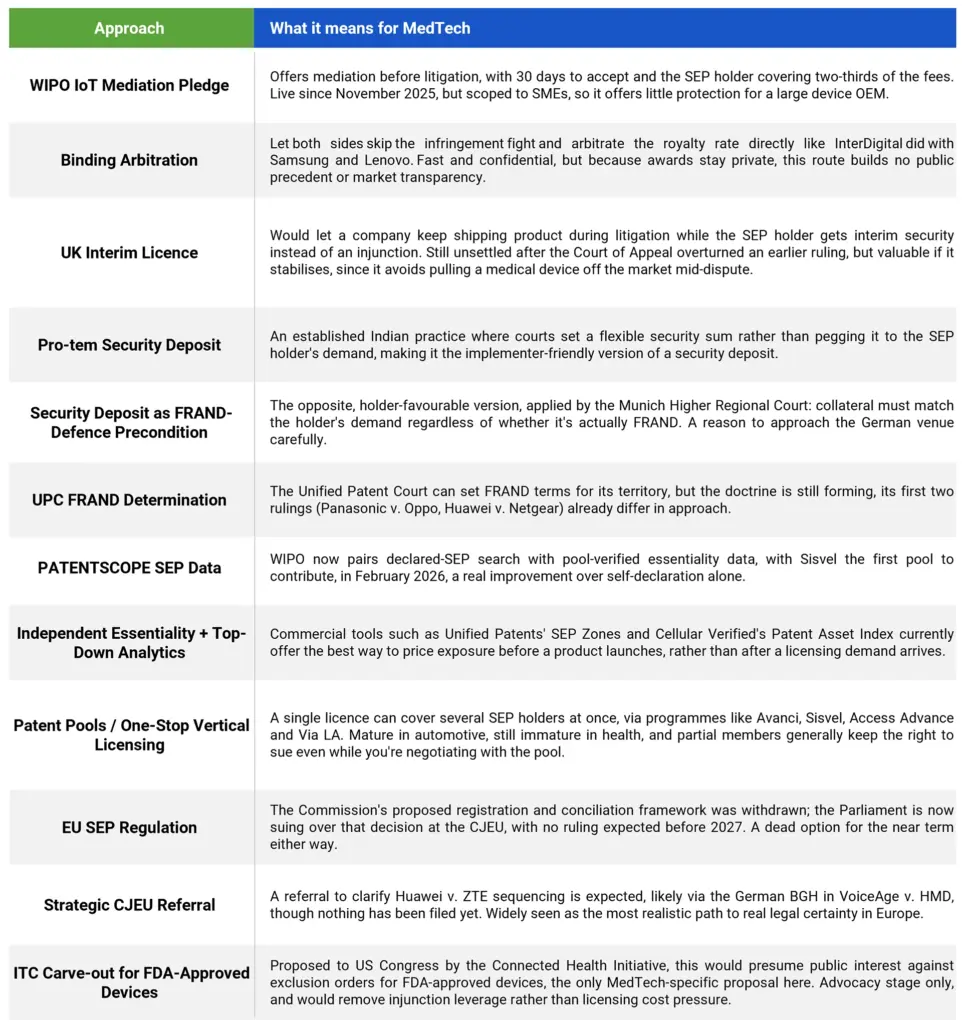
The SEP Toolkit Is Getting Better
One of the biggest developments in 2026 for SEP was the improvement of the information in standard essential patents (SEPs). In particular, WIPO’s PATENTSCOPE now provides information on declared SEPs for selected standards and essentiality for information verification provided by patent pools such as Sisvel and Via Licensing Alliance. Such data is valuable because a declaration alone does not prove that a patent is actually essential; claim-to-standard analysis and other evidence may still be required.
WIPO published its 2026 FRAND Economics: Valuation Methods in Licensing Standard Essential Patents report that describes analysis of comparable licences, bottom-up valuation and top-down royalty calculations. For MedTech companies, this means that preparation can increasingly move beyond identifying patents to estimating the potential royalty stack and negotiating position before a product reaches the market
What Should MedTech Companies Do Now?
The practical response is early SEP exposure mapping. Companies adopting technical standards should first determine whether essential patented technology requires a license and address that licensing requirement before adopting the standard. WIPO guidance recommends verifying licensing requirements before adopting a technical standard. They should also analyse which of the patents declared are actually necessary, examine the relevant patent families, and evaluate the possible royalty liabilities. This way, they will be able to avoid future patent litigation over licensing disputes.
Final Thoughts
MedTech has not yet faced SEP disputes at the scale seen in the smartphone or automotive industries, but the conditions for greater exposure are present and growing. Connected devices are increasing, standards are becoming more deeply embedded in healthcare products, MedTech patent activity is rising, and the global SEP licensing framework is becoming more sophisticated.
For MedTech companies, the focus should be on understanding standards, patents, and licensing exposure before it becomes a commercial issue. The question is no longer about device connectivity, but whether the company understands the IPR implications that connectivity brings with it.
This is where Ingenious e-Brain can help by providing patent landscaping, patent ownership tracking and licensing-risk assessment, helping companies identify potential SEP exposure early and make smarter decisions about product development, partnerships, and licensing negotiations.
Talk to our seasoned IP experts by filling out the form below or emailing us at contact@iebrain.com.