

When a pharmaceutical company launches a therapy or commercializes a drug, it ensures that the product entering the market meets the safety and efficacy standards in its home market. But approval gets a drug to market; it does not guarantee access. As the therapy crosses borders, value and pricing expectations tend to get far less attention until much later, and that is usually where the trouble starts. If the treatment stalls at the reimbursement desk, then it’s not the failure of science. Instead, it’s a failure of the evidence strategy behind it: a strategy built for one market’s regulatory submission rather than for the range of payers, health technology assessment (HTA) bodies, and price regulators a global launch actually has to satisfy.
As more companies pursue near-simultaneous launches across multiple geographies, the gap between “approved” and “reimbursed” keeps widening in the markets where those companies are counting on for growth. Closing that gap does not begin at submission. It begins in early clinical development, with an evidence strategy that is built to be global from the first protocol rather than retrofitted market-by-market after the pivotal data are locked.
However, stakes have risen sharply in Europe. Since 12 January 2025, the EU HTA Regulation (Regulation (EU) 2021/2282) has required a Joint Clinical Assessment (JCA) for new oncology active substances and advanced therapy medicinal products (ATMPs), with orphan medicines following in 2028 and all centrally authorized products by 2030.
In this article, we cover:
- Why clinical trial evidence alone rarely secures reimbursement outside the home market.
- What actually makes an evidence strategy “global,” beyond simply generating more data.
- Which fundamental levers are actually closing the gaps in the global evidence strategy.
- A step-by-step approach to build an Integrated Evidence Plan (IEP) across different geographies and functions.
- Why an evidence strategy needs re-evaluation triggers, not a fixed shelf life.
From Regulatory Approval to Reimbursement: The Bar Shifts When the Decision Changes
| Regulatory Decision | Reimbursement Decision |
|---|---|
| Is it safe? | Is it worth the price? |
| Does it work? | How does it compare with current care here? |
| Clinical efficacy | Comparative effectiveness |
| Controlled trial population | Local and real-world population |
| Regulatory endpoints | Patient-relevant outcomes |
| Benefit-risk | Cost-effectiveness and budget impact |
| Approval | Access |
Why Clinical Trial Evidence Is Not Enough to Secure Reimbursement Worldwide?
Randomized controlled trial (RCT) data can support regulatory approval. But on its own, it rarely secures reimbursement, because payers and HTA bodies are answering a different question from regulators. Regulators ask whether a therapy is safe and effective compared with placebo or an accepted control. However, payers ask a broader question: Is the therapy worth its price for our population, compared with our standard of care, and within our value framework? That framework may assess cost per QALY, comparative added benefit, budget impact, or other measures of value.
The gap sits in three places that trial designers routinely underestimate.
The first is the comparator. Regulatory trials are frequently placebo-controlled or run against a global reference arm. A payer wants the therapy tested against the treatment a clinician in their country would otherwise reach for, and that comparator differs by market. Germany’s Federal Joint Committee (G-BA) defines an “appropriate comparator therapy” (zweckmäßige Vergleichstherapie) that a manufacturer cannot simply choose for itself. When the pivotal trial did not include it, the comparative story has to be reconstructed after the fact.
The second is the endpoint. Regulators often accept surrogate endpoints, such as progression-free survival or response rate. Payers and HTA bodies increasingly expect evidence that shows how a treatment improves patient outcomes in real-world care. This includes overall survival, validated patient-relevant outcomes, and health-related quality of life, often measured using instruments such as the EQ-5D-5L. These quality-of-life measures help generate the utility values used in Quality-Adjusted Life Year (QALY) calculations. A reimbursement dossier that relies heavily on surrogate endpoints but lacks mature survival data and robust quality-of-life evidence can face restrictions or a negative recommendation.
The third is the patient population. Trial eligibility criteria produce a cleaner, younger, and healthier population than the one a payer is actually funding. The burden of disease, the comorbidity profile, and real-world adherence all shift the value equation once the therapy leaves the trial.
That’s why a strong reimbursement case almost always extends beyond the trial into real-world data from claims and electronic health records, patient registries, comparative effectiveness studies, and patient-reported outcomes. None of these belong at the end of the process as clean-up work. They belong in the plan alongside the pivotal trial. Put plainly, the evidence package that gets a product approved is the starting point for the evidence package that gets it reimbursed, not the finished article.
What Makes an Evidence Strategy “Global,” Not Just Broad?
Once a team sees the gap, the instinct is to generate more evidence. That is rarely the right fix. The harder and more valuable question is whether the evidence being generated represents the populations and comparators the company actually intends to launch into.
Most real-world data in circulation clusters around a handful of geographies, largely the United States and parts of Western Europe, leaving many growth markets thinly represented. The recurring obstacles are well documented: inconsistent data standards across registries, missing or non-standard endpoints, limited explainability where machine learning is used to impute gaps, and a persistent lack of diversity that can bias an analysis before it starts. The consequence for reimbursement is direct. A dossier built around a US claims dataset does not carry the same weight with a European HTA body assessing added therapeutic value against its own comparator landscape. Treating it as if it will means arguing the case with the wrong data in front of the wrong audience.
The JCA has made this concrete in a way nothing before it did. An initial step in the process is PICO scoping, where the coordinating group collects the Population, Intervention, Comparator, and Outcome questions that individual member states care about and consolidates them into a single set. Because standards of care and relevant comparators differ across the 27 member states, that consolidated set is rarely tidy. Industry analyses have warned of PICO counts running past thirty in complex indications, and an illustrative immuno-oncology scoping in hepatocellular carcinoma produced thirteen. The tovorafenib assessment landed at eight, and the developer was able to submit comparative data for only two of them. Once the final PICOs are issued, a manufacturer has a window of roughly three months, on the order of a hundred days, to assemble and submit the dossier. The probability is significantly low for a single pivotal trial covering that ground.
So, a genuinely global evidence strategy is a sequencing and design decision as much as a data-volume decision. Which markets, which comparators, which local endpoints, and which local stakeholders need to shape and validate the plan before it is finalized, and which of those inputs can only realistically be gathered years ahead of submission rather than in the hundred-day scramble.
The Technical Toolkit That Actually Closes the Gaps
Recognizing the gap is one thing. Closing it draws on a specific set of methods and knowing which lever to pull for which gap is where an experienced team saves months.
-
Indirect treatment comparisons
When the pivotal trial did not include a market’s preferred comparator, and a head-to-head trial is neither feasible nor timely, the relative effect has to be estimated indirectly. Where a common comparator exists across trials, an anchored network meta-analysis (NMA) is the cleaner route. Where it does not, population-adjusted methods such as a matching-adjusted indirect comparison (MAIC) or simulated treatment comparison (STC) come into play, using individual patient data from the sponsor’s own trial to reweight against published aggregate data from the comparator. The first JCA relied on exactly this: an unanchored MAIC of tovorafenib against dabrafenib plus trametinib for one subpopulation. These methods are powerful and also fragile. They rest on assumptions about shared prognostic factors and effect modifiers that assessors probe hard, and the JCA methods guidance, inherited from EUnetHTA 21, sets a demanding bar for how those assumptions are justified. Building this capability into the plan early, rather than commissioning it under a hundred-day deadline, is one of the highest-leverage moves available.
-
External and synthetic control arms
For single-arm studies, especially common in rare ailments and in oncology when breakthrough designations have taken place, a comparative narrative is formed using external references that may vary from trials in history, registries, to real-life cases. Regulatory and HTA authorities scrutinize the comparability of such controls, and thus the field of origin and processing become equally crucial as research.
Real-world evidence, built to standard
RWE has shifted from the margins to the center of the European assessment. The number of HTA reports drawing on RWE went from around 4% in 2011 to approximately a third of the total in 2021. To be usable, that evidence needs to be represented in common data models, like OMOP, and other initiatives like EMA’s DARWIN EU federated network are setting the benchmsrks for “credibility.” The work is detailed and methodical: harmonizing endpoints, establishing reliable data sources, and prespecifying analyses that can translate exploratory research into robust, decision-ready evidence.
-
Health economic modelling
Beyond the clinical comparison, most markets want a cost-effectiveness model, typically producing an incremental cost-effectiveness ratio expressed as cost per QALY, and a budget impact model that answers the payer’s other question: what does this do to my annual spend? In oncology the choice between a partitioned survival model and a state-transition (Markov) structure carries real consequences, as does the survival extrapolation method used to project beyond the trial’s follow-up. Assessors have grown sophisticated about extrapolation, and an aggressive parametric curve is a common point of challenge. Utility values, discount rates, and time horizon all vary by jurisdiction and all move the ICER.
-
Access and pricing mechanics
Where the value case is strong but the uncertainty is real, particularly for high-cost one-time therapies, managed entry agreements bridge the gap. These range from simple financial arrangements such as price-volume caps and confidential discounts to outcomes-based agreements that tie payment to results. Layered on top is external reference pricing, the practice in many markets of benchmarking a launch price against a basket of other countries, which turns launch sequence into a pricing decision. The order in which a company enters markets can quietly set a price ceiling it later regrets.
Country-specific Requirements Worth Designing For
No single dossier satisfies every market, but the major systems are knowable in advance, and designing for the strictest audience usually carries the others.
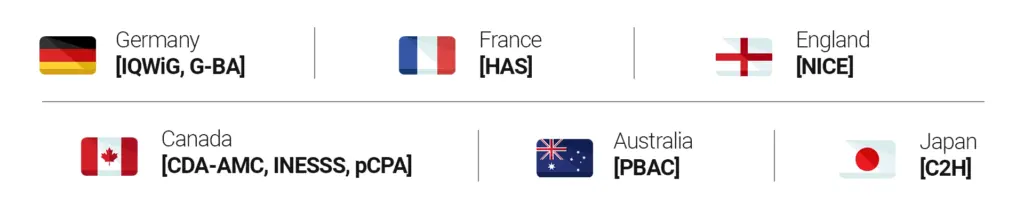
- Germany (IQWiG, G-BA). The AMNOG process runs an early benefit assessment against a G-BA-defined appropriate comparator, producing an added-benefit rating (Zusatznutzen) that anchors the subsequent price negotiation. It is comparative, evidence-heavy, and unforgiving of a mismatched comparator.
- France (HAS). The Transparency Committee grades clinical benefit (SMR) and, critically for pricing, the improvement in benefit versus existing care (ASMR). Products claiming a meaningful ASMR face economic evaluation by the CEESP.
- England (NICE). A reference-case cost-utility analysis against a cost-per-QALY threshold, now modulated by a severity modifier that replaced the older end-of-life criteria, with the Cancer Drugs Fund and Innovative Medicines Fund available for managed access under uncertainty.
- Canada (CDA-AMC, INESSS, pCPA). The former CADTH now operates as Canada’s Drug Agency (CDA-AMC), with Quebec’s INESSS running its own review; a positive recommendation feeds price negotiation through the pan-Canadian Pharmaceutical Alliance.
- Australia (PBAC) and Japan (cost-effectiveness assessment via C2H). Both add their own comparator conventions, economic expectations, and evidentiary preferences that a global plan should anticipate rather than discover.
The point is not to memorize every rule. It is to know, at trial-design stage, which of these audiences your evidence will eventually have to convince, and to build backwards from the hardest of them.
How a Pharma Team Should Actually Build the Integrated Evidence Plan?
An integrated evidence generation plan (IEGP) is not just a document. It is a cross-functional roadmap that aligns evidence needs across functions, geographies, and decision points. A common failure occurs when medical affairs, HEOR, market access, regulatory, and commercial teams each develop evidence plans from their own vantage point, only to combine them later. The result may look integrated on paper, but gaps between functions and markets remain unaddressed. A true IEGP brings these perspectives together from the outset, creating a coordinated approach to generating the evidence needed for each decision.
A workable sequence looks like this.
- Map the gaps market by market, and PICO by PICO. Bring medical affairs, HEOR, market access, and regulatory together to define what each target market’s payers will expect to see, expressed in the comparators, populations, and endpoints they actually use, not what the home-market submission requires. Local affiliates belong in the room; they are usually first to know what a payer will ask for in practice. For JCA-scope products, this is also the moment to model the likely PICO landscape rather than wait for it to arrive.
- Prioritize by reimbursement risk, not scientific interest. Not every gap is worth closing before launch. Rank them by the commercial weight of the market and by whether the gap would block access outright or merely slow it. Scientific curiosity is a poor allocator of a finite evidence budget.
- Sequence the roadmap to each market’s timeline. A plan organized around a single home-market submission date will underserve every other market, because HTA cycles do not align and the JCA hundred-day window punishes anything left unprepared. Sequencing also has to respect external reference pricing, so that an early low-price market does not undercut a later high-value one.
- Validate externally and in-market, early. Advisory boards and payer interviews in the target geography surface gaps a headquarters-only review misses. Where the pivotal trial is still in design, the EU’s Joint Scientific Consultation, ideally run in parallel with EMA scientific advice, lets a company test its evidence-generation plan with regulators and HTA bodies before the design is fixed. That single interaction can prevent the most expensive category of error: a beautifully executed trial that answers the wrong comparator question.
This is the exercise where an outside advisor earns its place, not by supplying data but by running the cross-functional, cross-geography prioritization that most internal teams lack the bandwidth or mandate to run on their own.
What Breaks a Global Evidence Strategy After Launch?
An evidence strategy is not a document to file once the roadmap is signed off. Standard of care shifts, fast in areas like oncology and inflammatory disease. A competitor releases data that resets payer expectations. A safety signal emerges that the original plan never accounted for. Any one of these can make a strategy that looked strong at launch look thin eighteen months on.
Global launches add a trigger a single-market plan never has to consider: entering a new market at all. Every new market brings a new payer with its own evidence expectations, and a plan not built with that market in mind will need genuine re-scoping rather than a light refresh. The JCA adds another: assessments can be revisited, and national bodies continue to reassess as fresh evidence lands, so the dossier is a living asset with a maintenance cost.
The takeaway is not that evidence strategies should be revisited on a fixed calendar. It is that they need a named owner watching for the events that genuinely should trigger a revisit.
What This Looks Like in Practice?
Consider a mid-size biopharma that built a strong evidence plan for its lead market and secured reimbursement there on schedule. Eighteen months later, it began expanding into two further markets with different HTA requirements and a payer base the original plan had never considered. Instead of a clean launch, the team found itself running gap analyses and stakeholder validation from scratch in each new market, in parallel with a commercial rollout it had already committed to.
The delay was not a data problem. It was a planning problem, the direct cost of building an evidence strategy for one market and expecting it to travel.
Where Pharma Leaders Should Start?
The pattern across the literature is consistent. Companies that treat evidence generation as an integrated, cross-functional, cross-geography exercise from the outset outperform those that build for one market and adapt later. Retrofitting a strategy market by market is slower, more expensive, and more prone to gaps than building it globally from day one. Now, the timelines have compressed to the point where the retrofit approach is not just costlier but often simply too late.
How IeB Can Help Build a Global Evidence Strategy?
We work with pharma and market access teams as a strategic partner, bringing the structure, prioritization, and validation that most internal teams do not have the capacity to run alongside everything else on their plate.
Our strategic healthcare consulting solutions include:
- Cross-functional gap analysis. We bring medical affairs, HEOR, market access, and regulatory together to map what each target market’s payers will expect, including likely JCA PICO scenarios, surfacing the gaps a single-function view would miss.
- Reimbursement-risk prioritization. We help teams rank evidence gaps by commercial weight and reimbursement risk, so resources go to the gaps that would actually block or stall access, not the ones that are merely interesting.
- Multi-market roadmap sequencing. We build the roadmap around each target market’s HTA timeline and reference-pricing dynamics rather than a single home-market date, so no market is left underserved by a plan built for somewhere else.
- Indirect comparison and RWE strategy. From MAIC, STC, and network meta-analysis through external control arms and real-world data workflows, we help construct the comparative evidence that JCA and national HTA bodies now expect.
- Health economics and pricing. We support the cost-effectiveness and budget-impact modelling payers want to see alongside trial data, and help shape pricing and managed entry approaches that hold up across markets.
Discuss Your Global Evidence Strategy with Our Team of Consultants…
If you are planning a multi-market launch, we can help you identify the evidence gaps that matter, prioritize them by reimbursement risk, and build a coordinated roadmap that holds up from the first submission through to the markets you have not entered yet.
Because reimbursement success is shaped long before a dossier reaches the payer, evidence planning needs to begin with the markets & decisions that lie ahead.
Fill out the form below or email us at contact@iebrain.com to talk to our healthcare and pharma industry experts.