
As battery technologies have become cost-effective, more and more battery energy storage system (BESS) projects are proving financially viable on merchant revenues alone. The investment decision, however, depends on the applicability of incentives, tax credits, and revenue guarantees. This is the contradiction we look at here.
For investors, the real question has shifted from whether the subsidy is available to what that subsidy offers in return. This covers local standards, supply chain compliance, long-term arrangements, and requirements for grid-service obligations. Failing to account for this change could leave a BESS project with stranded assets in markets that are narrowing their support mechanisms.
Key Takeaways
- Global BESS additions hit a record 112 GW in 2025, and policy design now influences where the next gigawatts land.
- The US keeps its storage investment tax credit, but foreign entity of concern (FEOC) rules now decide who can actually claim it.
- China has moved from mandating co-located storage to paying standalone storage for available capacity.
- India and Italy use viability gap funding and long-term contracts to bridge the gap between cost and bankable revenue.
- The UK and Italy are tying support to long-duration storage, while Australia is tapering a residential rebate.
- Incentive risk now includes policy tightening and compliance, not only policy removal.
What Does the BESS Market Look Like Today?
Global storage additions, excluding pumped hydro, reached 112 GW in 2025, up about 48% from the previous year. (reported by BloombergNEF). China and the US accounted for 70% of that total storage capacity. Demand comes from renewable curtailment, evening-peak stress, capacity shortfalls and, increasingly, data center loads. Growth is held back by interconnection queues, trade barriers, cell supply concentration and policy uncertainty. The US shows the gap clearly: S&P Global Energy cited 58 GWh of expected 2026 storage demand against just 37.25 GWh of domestic lithium iron phosphate (LFP) cell capacity available for storage.
The pace of development in energy storage markets differs significantly across regions. China is shifting its focus from expanding storage capacity to improving its utilization, with cumulative new-type storage reaching 168.3 GW/448.7 GWh by mid-2026, despite an 18% year-on-year decline in first-half additions. In contrast, markets such as India and parts of Europe remain more dependent on subsidy-driven growth, where government incentives continue to play a key role in expanding storage deployment.
Which Technologies Are Being Incentivized?
Established: lithium-ion, led by LFP. LFP accounts for about 90% of annual additions and remains the default for utility-scale projects of one to four hours. Most incentive frameworks are written around it.
Emerging: sodium-ion, flow batteries and other long-duration options. Sodium-ion supply deals, such as CATL’s 60 GWh agreement with HyperStrong, point to early commercial traction. Flow batteries and other long-duration technologies matter because policy increasingly rewards duration: the UK scheme sets an eight-hour minimum, Italy’s MACSE leans toward eight hours, and India’s second tranche requires at least two hours.
Utility-scale systems dominate, but residential storage drives Germany’s volumes and Australia’s rebate-led boom. Technology maturity is high for LFP and still developing for long-duration alternatives, so incentive design is partly a bet on which technologies scale.
How Do Incentives and Tax Credits Differ by Region?
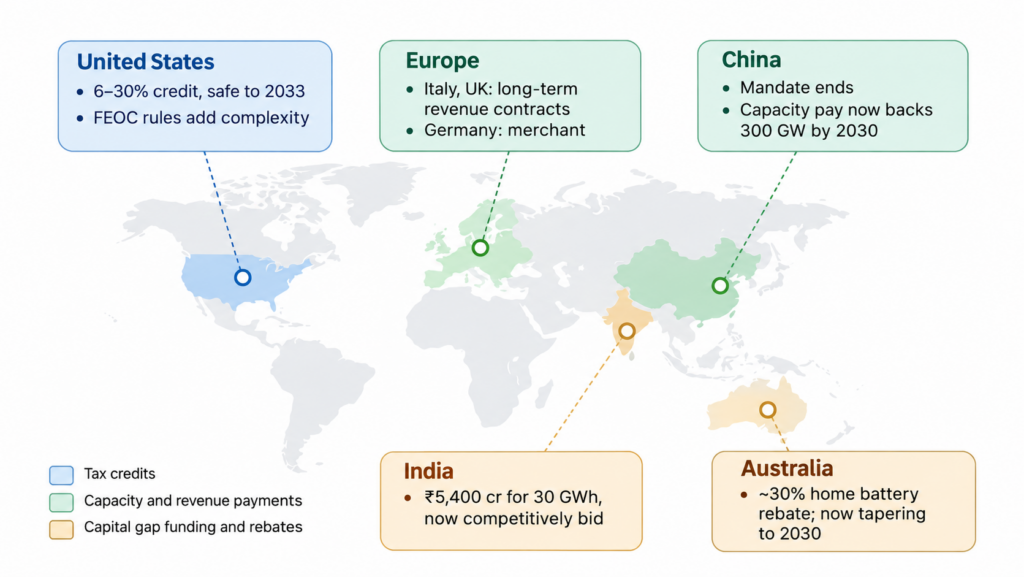
Support models fall into three broad groups: tax credits in the US, direct capacity or revenue payments in China, Italy and the UK, and capital gap funding in India and Australia. The regional picture below shows how each works in practice.
Current Situation in the United States
The Section 48E investment tax credit for standalone storage projects, offering 6% base credit that may go up to 30% if prevailing wage and apprenticeship requirements are met. Unlike wind and solar, storage projects have not been subject to the accelerated end-of-2027 timeline. So, the projects beginning construction before the end of 2033 will continue to receive the full credit, and it’ll phase down beginning in 2034 and will be eliminated from tax credits after 2035. The Section 45X manufacturing credit remains intact.
But conditions in FEOC could prove challenging. Storage projects starting construction after December 31, 2025, can lose credit eligibility if they rely on significant assistance from a disqualified foreign entity and certain taxpayers are ineligible to claim the credit. The Treasury’s February 12, 2026, Notice 2026-15 offered operating guidance, though compliance remains complex. Domestic content can provide a bonus, and credits can still be transferred, enabling monetization.
Current Situation in China
A dramatic shift is witnessed in the nature of support for renewable energy in China. The mandate requiring renewable projects to install storage capacity alongside has ended in 2025. In January 2026, a national notice introduced capacity pricing for standalone grid-side storage, paying for available capacity rather than energy delivered.
Several regional authorities are working on this model, and Shaanxi is for example, offering a capacity price of 165 yuan (around €20) per kilowatt/year from 1 August. China is aiming for 300 GW of new energy storage by 2030. As fixed support is being phased out and replaced by revenues from market mechanisms, there may be more tougher project screening and approvals due to oversupply concerns.
Current Situation in India
India’s energy sector relies heavily on viability gap funding. Tranche I (₹3,760 crore) was extended from 4 GWh to 13.2 GWh to reflect falling tariffs. The ongoing Tranche II is extending ₹5,400 crore from the Power System Development Fund for 30 GWh across 15 states and NTPC, with support per MWh declining significantly from previous tranches. It also front-loads the disbursal, requires a minimum duration of two hours, and introduces competitive bidding, offering a template to be adopted by other emerging countries.
Current Situation in Europe
There’s no single approach to storage in Europe. Italy’s MACSE project, for instance, offers 15-year contracts that blend a fixed year-on-year premium with market revenues, aiming to support up to 50 GWh of energy storage across three auction rounds. Meanwhile, the UK’s cap-and-floor scheme for long-duration storage has attracted Ofgem to select a total of 16 projects, totaling 7,645 MW, in August 2026. Germany’s market remains largely merchant-based and deeply residential, with 2.9GW out of its 3.8GW installations by 2025 were home batteries. Other such schemes could also influence the returns for non-supported projects, implying that the various policies have an additional impact on storage economics.
Current Situation in Australia
The Cheaper Home Batteries Program, launched 1 July 2025, delivered roughly 30% upfront discounts. Demand was higher than expected from the start, and the government raised its budget to about AUS$7.2 billion. From 1 May 2026, the program has gradually scaled back with significantly lower incentives for larger systems, and more reductions are scheduled for each January and July through 2030. The lesson is that residential rebates need active budget management to stay sustainable.
Read More: Lithium-ion Battery Logistics: The Critical Backbone of the Energy Transition Worldwide
How Does Policy Shape Adoption, Investment, and Competition?
Policy now shapes adoption through three levers: who qualifies (FEOC, domestic content), what gets paid (capacity, premiums, CAPEX gap), and how long support lasts (tapers, caps, tranches). Regulatory barriers include compliance verification burdens in the US, provincial variation in China, and budget-driven rebate changes in Australia.
These levers are already visible in how the industry is moving.
Manufacturing and supply chains. US policy is focused on promoting both cell and component onshoring, along with converting electric vehicles (EVs) into energy storage. LG Energy Solution has established a US$1.4 billion LFP plant in Holland, Michigan, with 16.5 GWh per year cell capacity for the grid-scale storage market. Its Ultium Cells joint venture is retooling its Spring Hill, Tennessee, plant for LFP cell production after a US$70 million investment. Samsung SDI has announced another 60 GWh+ in orders for U.S. storage batteries in 2026, with planned LFP production in Indiana, and has secured long-term cathode supply from South Korean materials companies for its applications to the Federal Electric Operating Company (FEOC). Meanwhile, Chinese suppliers are expanding their footprint outside their home market, with 298 GWh of overseas orders in the first half of 2026, up 83% year over year, according to the China Energy Storage Alliance (CNESA). The firms are also moving beyond equipment exports into overseas manufacturing, service markets, and technology partnerships.
New technology. Sodium-ion deals and larger long-duration formats show suppliers positioning themselves for duration-based incentives. Duration plays a critical role in incentivization, as the fifteen projects that won Italy’s first MACSE round averaged 6.6 hours.
Geographic expansion. Developers are following contract-backed markets. European owner-operators are already entering Poland’s capacity market and Italy’s Market for Capacity and System Services (MACSE), while India is drawing both foreign and local bidders to several state-backed tenders. Northland Power, for example, successfully financed 1.2 GWh of projects contracted through Poland’s capacity market, while the first MACSE auction was oversubscribed four times, with volumes clearing at an average price of €12,959 per MWh of capacity per year, well below the €37,000 reserve premium. Nearly 70% of the capacity awarded went to Enel and Eni, suggesting that well-known companies with strong grid and permitting assets had an edge.
M&A and capital. Minority stakes in contracted European projects show investors paying for revenue certainty over merchant exposure. TotalEnergies sold half of an 11-asset portfolio in Germany, representing 789 MW/1,628 MWh, to a third-party fund in a deal worth €500 million. Allianz Global Investors acquired a 51% stake in GESI, a developer focused on 2.6 GW of development-ready storage capacity in Germany. Around 50 large-scale battery energy storage system (BESS) deals in Europe have been reported till now in 2026.
Strategic positioning. The strongest players treat incentives as a design input: they choose duration, sourcing, and revenue stacking to fit each market’s rules rather than retrofit them later.
FAQs
Do US storage projects still get a federal tax credit?
Yes. Storage was spared the accelerated termination that hit wind and solar under the 2025 budget law, but credits are now conditional on FEOC compliance.
Which regions pay storage developers directly for capacity?
China (capacity pricing for standalone storage), Italy (15-year MACSE contracts) and, in a different form, the UK (cap and floor for long-duration storage).
Is India’s viability gap funding still available?
Yes. A second tranche of ₹5,400 crore for 30 GWh is being allocated across 15 states and NTPC.
Are residential battery rebates sustainable?
Australia’s experience suggests they need active budget management. Its rebate was tiered and tapered because uptake outran forecasts.
What Comes Next for BESS Policy?
Market direction. Record additions continue, but BNEF expects growth to broaden beyond China and the US, with India and Australia among the new centers.
Momentum shifts. Long-duration and capacity-backed models should gain, while flat per-kWh capex subsidies fade. Oversized residential incentives are likely to be redesigned elsewhere, following Australia.
Leading regions. China and the US remain the largest, with India, Italy, the UK, Australia and the Middle East gaining share.
Competitive shifts. Supply chain compliance will separate bankable projects from risky ones, and non-Chinese cell supply gains strategic value in the US.
Risks and opportunities. The main risks are FEOC compliance failure, oversupply-driven policy tightening, and tapering rebates. Opportunities sit in contract-backed markets, hybrid revenue stacks, and technologies built for duration.
How Can Ingenious e-Brain Support Investors, Developers, and Suppliers Navigating Battery Energy Storage Incentives?
As incentives play a critical role in the profitability of battery energy storage systems (BESS), stakeholders must structure their projects and supply chains to qualify for available benefits. The challenge is to secure these incentives before they are reduced and to remain competitive in securing IEAPE contracts. Our strategy consulting services help businesses navigate these complexities and make informed decisions.
- Policy and Regulatory Landscape: We closely track incentive programs, eligibility criteria, and monitor timelines across key regions, including the US, China, India, Europe, and Australia. Our experts keep track of guidance from the FERC and capacity pricing schemes, offering an aggregated view of the requirements of each market and potential policy risks to our clients.
- Technology Scouting: We map cell, system, and long-duration technology providers, from LFP suppliers to sodium-ion and flow battery players, to assess which route fits best for duration-based incentives and sourcing regulations. This enables clients to shortlist suppliers or technologies for comparison, rather than starting from scratch.
- Technology Due Diligence: We assess how ready a supplier or technology is for commercialization, and how exposed it is to FEOC and domestic content requirements, before a client commits capital or signs a long-term supply agreement.
- GTM Strategy: We help developers and suppliers decide which markets and revenue models to prioritize first, whether capacity contracts, merchant revenue, or hybrid revenue stacks, and how to position offerings against each market’s incentive rules.
- Market Opportunity Exploration: We size and rank BESS markets based on demand drivers (revenue potential from renewable energy curtailment, peak stress periods, capacity gaps) combined with the strength of incentive support, interconnection issues, and revenue visibility. This focuses on targeting markets with the most favorable returns as opposed to the highest capacity additions.
Conclusion
Market size, technology choice, regulation, and competition now interlock. The most important implication is that incentive value depends on eligibility, not headline rates. A 30% credit means little if sourcing rules disqualify the project, and a capacity payment means little if the market tightens approvals.
We advise clients to map incentives region by region against their supply chain, duration strategy and exit horizon before committing capital. If you are assessing where to deploy storage or how to structure sourcing, connect with Ingenious e-Brain by emailing contact@iebrain.com or by filling out the form below to build an incentive-aware BESS strategy.