Heat is what determines battery life, charging rates and safety. As energy storage and the electrification of transport continue to grow, thermal management has moved from being a supportive function to a fundamental engineering requirement. Getting it right requires one to define the problem, design the system, select the materials, select the separators and then scale to production.
In this article, we explore the six key stages of battery thermal management, from defining cooling requirements and selecting materials to validating performance, scaling production and evaluating the supporting infrastructure.
Why Thermal Management Matters?
Lithium-ion cells have a limited operating temperature range in which they perform effectively, ideally between 20 and 40°C, with their performance degrading rapidly outside of this window. Low temperatures will slow the movement of ions and reduce the power capability while high temperatures will accelerate the aging process and in extreme cases one failing cell heats its neighbours in a chain reaction.
Fast charging, increased energy density, and compactness result in greater heat generation, which needs to be managed through a thermal management system. This must be considered at an early stage rather than after the battery pack has been designed.
Three Key Approaches to Battery Thermal Management
Battery thermal management can be considered through three interconnected approaches: prevention, suppression, and rectification.
Prevention:
The primary goal is to keep the battery within its required operating temperature range, minimise excessive heat generation and reduce the risk of thermal failure. The danger of thermal failure can be reduced by using cooling system design, temperature monitoring, suitable materials and separator technology.
Suppression:
When a cell failure occurs, priority is to control the spread of heat and prevent thermal runaway from spreading to surrounding cells. Thermal insulation, controlled dedicated vents and suitable cooling arrangements can all be used to manage the thermal influence of a failed battery cell.
Rectification:
This involves identifying weaknesses through testing, redesigning and corrective action. Cell, pack and thermal propagation testing will assist in identifying the weak points prior to implementation, whereas manufacturing quality checks, repairs and recycling will assist in rectifying them during implementation.
These three methods operate simultaneously throughout the battery development cycle, from conception through production and implementation.
From Thermal Requirements to Production: Six Key Stages
The process consists of six interconnected steps that help enhance the performance, safety, and scalability of the final battery system.
Step 1: Define the Real Heat Problem | Approach: Prevention
Without the right data, there can be no effective solution. Before selecting which technologies to employ, a team evaluating battery cooling must understand the thermal characteristics of the pack being cooled. The team must understand the heat generated during fast charging and heavy use (such as driving or grid services), as well as the highest ambient temperature the battery is expected to encounter.
A few questions can help narrow the field:
- What is the maximum heat load (and for how long)?
- What operating temperature range is required?
- How much variation between cell temperatures is acceptable?
- What are the allowable constraints on weight, size and cost?
Teams may design a system in a lab at 25°C only to find that it does not perform as expected once shipped to a desert or an arctic port.
Step 2: Design the Thermal System | Approach: Prevention and Suppression
The first step that designers have to take is choosing a method of heat rejection from the pack. Four basic methods can be identified.
- Air cooling: The simplest and lightest method, but it has the lowest heat dissipation capability. This method is appropriate for low-power systems.
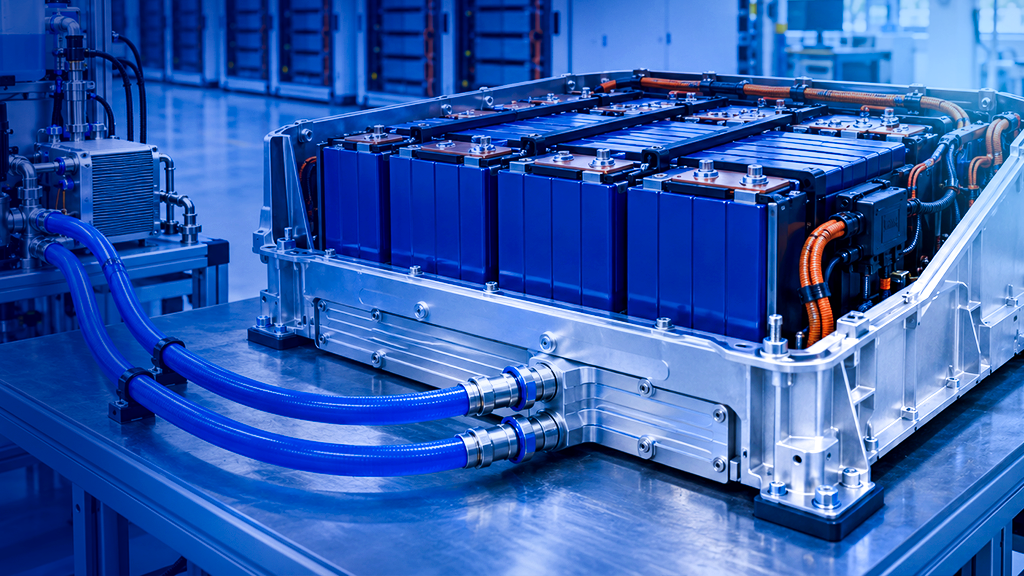
- Liquid cooling: It involves the circulation of a liquid through channels or plates located near the cells. It has the best capability of handling thermal energy and has become an industry standard for many EVs and large-scale storage projects.
- Immersion cooling: The battery cells are immersed in a dielectric liquid, providing good temperature uniformity and protection for the battery. However, this approach is rather heavy and expensive.
- Phase change: Materials that absorb a lot of heat during melting are very effective in damping transients.
After choosing the technique, the positioning and arrangement of cells, coolant paths, and temperature sensors are determined using the simulation process. Temperature uniformity within the arrangement becomes important to avoid the rapid ageing of cells due to excessive temperatures.
In addition to this, provision for the heat transfer path should be included in the design. This can be done by using physical barriers between the cells and special heat vents for each cell.
Step 3: Choose the Right Materials | Approach: Prevention and Suppression
Materials make the difference between a drawing and a working system. The cell cannot transfer its heat to a cold plate unless there is a good interface medium between the two, such as a thermal interface material in the form of a paste, pad or gap filler.
The options are:
- Cold plates, typically aluminium for a good balance between cost, weight, and thermal conductivity.
- Interface materials to fill the small gaps between the cell and plate.
- Fire barriers such as aerogel or mica sheeting between adjacent cells.
- Coolants, either water and glycol mixtures or electrically safe fluids.
Each choice has a cost. A filler that conducts heat may crack after three years, and a light barrier may rupture under crash loads. The only valid comparison is based on lifetime performance, not initial desktop testing.
Step 4: Do Not Ignore the Separator | Approach: Prevention
Inside the cell the separator is a very thin plastic film in each cell which prevents the two electrodes from making contact with each other but which allows the ions to pass freely between them. Expansion due to excessive heat can cause the separator to shrink, bringing the two electrodes together. Internal shorting is one way that the runaway effect gets started.
That’s why one should consider separator technology in the thermal conversation. Some newer designs use ceramics coated on the film surfaces that maintain their shape at higher temperatures. Other films are designed to close up their pores as the temperature increases, stopping the flow of ions before the reaction can get going. And manufacturers are working on making very thin separators that are strong enough to let the cells contain more energy.
A separator with improved thermal stability and mechanical strength can enhance cell safety, but it must be considered alongside pack-level cooling and other safety measures.
Step 5: Test Until it Breaks, Then Test Again | Approaches: Rectification and Suppression
Prior to production, the design must undergo tests designed to push it to the limit. Cell tests evaluate heat output characteristics, as well as ageing effects. Pack tests involve rapid charging under extreme conditions. Abuse tests may include overcharging, nail penetration and external heating, depending on the applicable test protocol. Finally, propagation tests determine whether the failure of one cell can be contained within the pack.
The results are then fed back into the design process, with most companies going through this cycle several times before beginning production. It may appear to be a very slow process but redesigning a battery at that stage is vastly cheaper than recalling a finished product.
Step 6: Move from Prototype to Production | Approaches: Rectification and Suppression
A pack that has been tested on a bench may not work so well on the factory floor. Thermal paste has to be applied consistently. Cold plates have to be manufactured to very close tolerances. A tiny bubble in a gap filler or a small leak can result in a hotspot which can take months to appear.
Implementation will of course require its own project plan. The team will need to assess whether the suppliers can deliver the materials in the required volumes and with the required quality, identify the potential failure modes across the production line and work out how to deal with any failures (repair and recycle). A slightly lower cost per pack is obviously attractive when millions of packs are being manufactured but the cost of a faulty pack under warranty is typically a lot higher.
How Ingenious e-Brain Can Help at Each Stage
IeB identifies the technological landscape, tracks materials and separators, and performs competitive and supplier landscape analyses. We have more than 14 years of experience, have completed over 6,000 projects, and our expert community includes more than 300 experts in the field.
We can help you at each step in the following ways:
-
Engineering & Design:
IeB provides the BoM and Cost Structure Analysis service, which breaks down the pack, cell, or module into its components, both theoretically and physically, and reviews the claims regarding cold plates, interface materials, and barriers.
-
Technology Choices:
Technology scouting and forecasting help identify cooling technologies, materials, and separators that require earlier consideration.
-
Sourcing:
Component-level pricing and supply chain due diligence services will assist in supplier selection and negotiations.
-
Legal Risks:
Patent landscape and freedom to operate analysis identify whether a certain design is crowded or risky from a legal point of view.
-
Utilities and Investors:
Cost analysis and regional policies and regulations on safety are necessary for comparing different storage systems.
Conclusion
Battery thermal management systems function most effectively if they are designed as a whole process. Requirements dictate the design. The design dictates material and separator selection. Testing validates the selections, and production determines their repeatability. Failure at any early stage generally means greater costs down the road to address the problem.
If you have a battery pack, energy storage project, or cooling material development in mind, then it is imperative that you have a clear understanding of the technology, cost considerations, patent information, and potential suppliers before you commit to a project. For further assistance, please contact the Ingenious e-Brain (IeB) team at contact@iebrain.com.
Frequently asked questions: –
What is Battery Thermal Management?
Battery thermal management refers to the techniques employed to ensure that the battery remains within its optimal temperatures during charging, discharging, and idle periods. Battery thermal management involves cooling, heating, insulation, sensor and the control software which coordinates the entire process.
What is the best cooling method for batteries?
It all boils down to the heat load, costs, and available space. Air cooling is suitable for small power levels. Liquid cooling is the common form of cooling used in electric vehicles and battery storage facilities since it can deal with high heat loads. Immersion cooling offers very uniform temperatures but increases the cost and weight of the system. Phase change materials can be used to handle heat spikes.
Why are separators essential for battery safety?
A separator is a very thin layer of material that is used to separate the electrodes in each cell. When the separator begins to shrink or melt due to heat, it is possible that the electrodes will come into contact and cause an internal short circuit. Thermal runaway can result from an internal short circuit and many other reasons. Ceramic-coated and shutdown separators provide extra protection to the cell, but this is done in conjunction with the cooling of the pack.
How does thermal runaway happen, and can it be stopped?
Thermal runaway is caused when the battery gets too hot (as a result of a short circuit, overcharging, or damage), and this heat spreads to neighbouring batteries. While it is not possible to completely prevent thermal runaway from occurring, it is certainly possible to reduce the risk of it occurring. Some of the ways include the use of cooling systems, separators, fire walls between batteries, and vents.