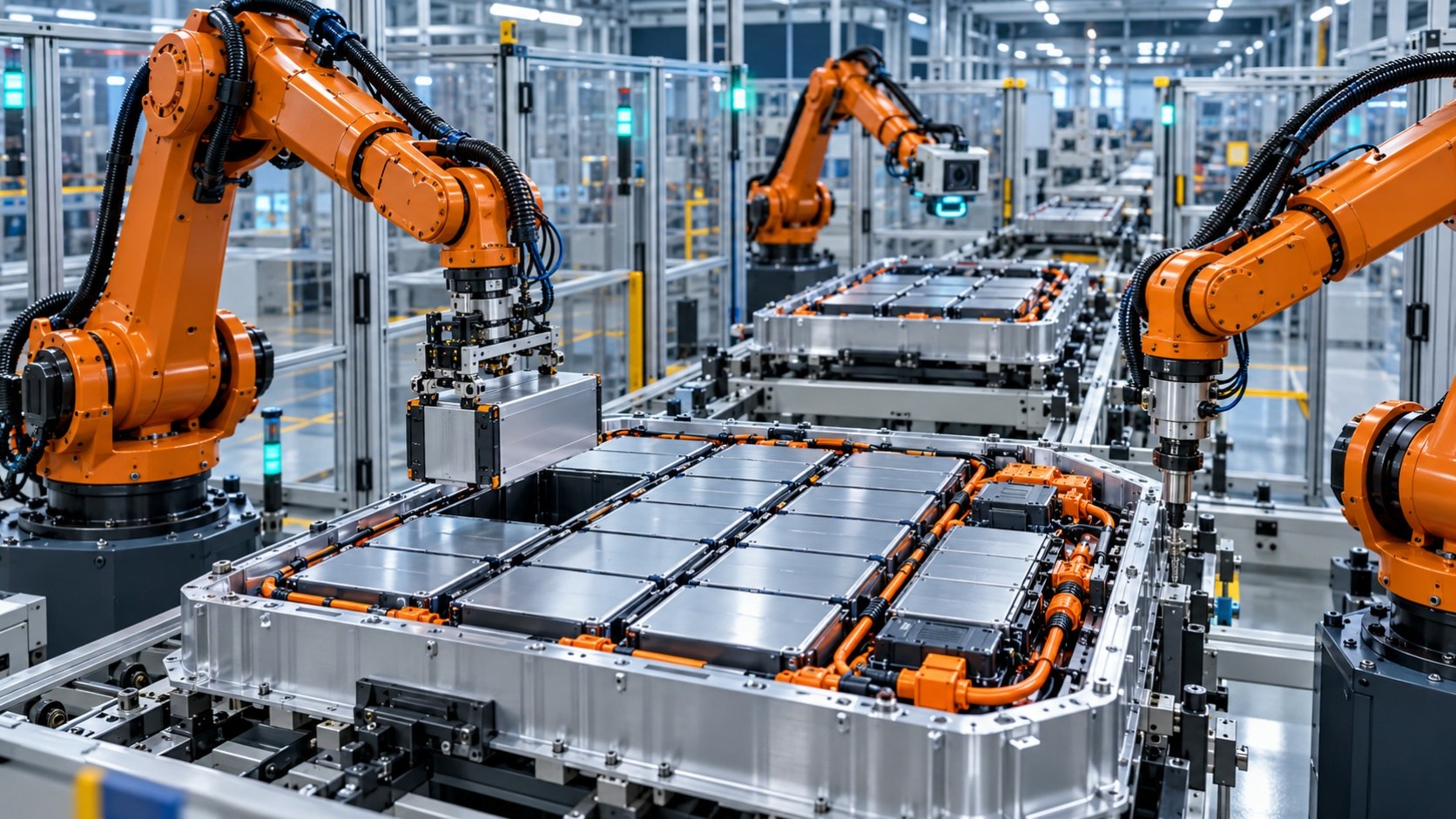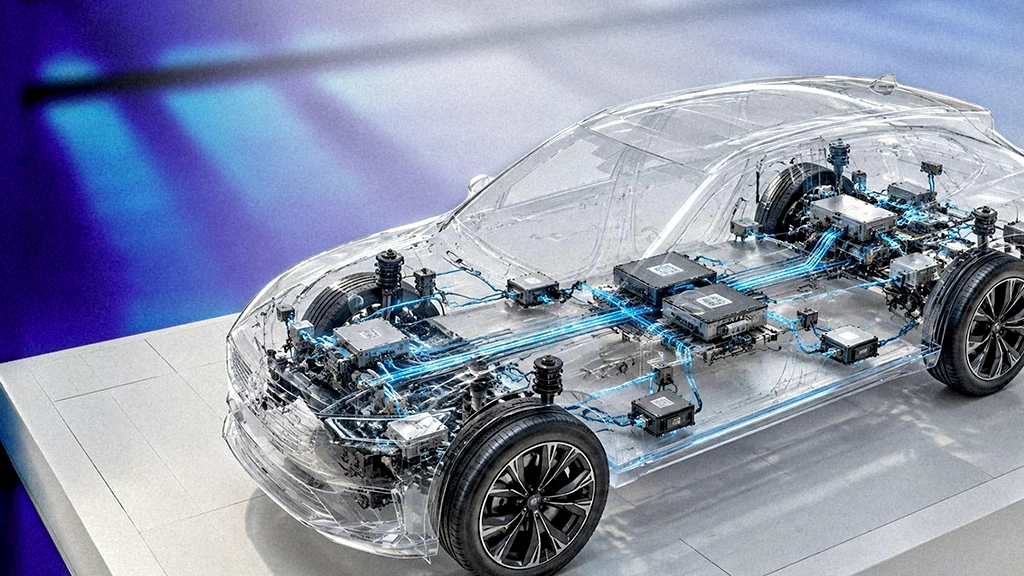
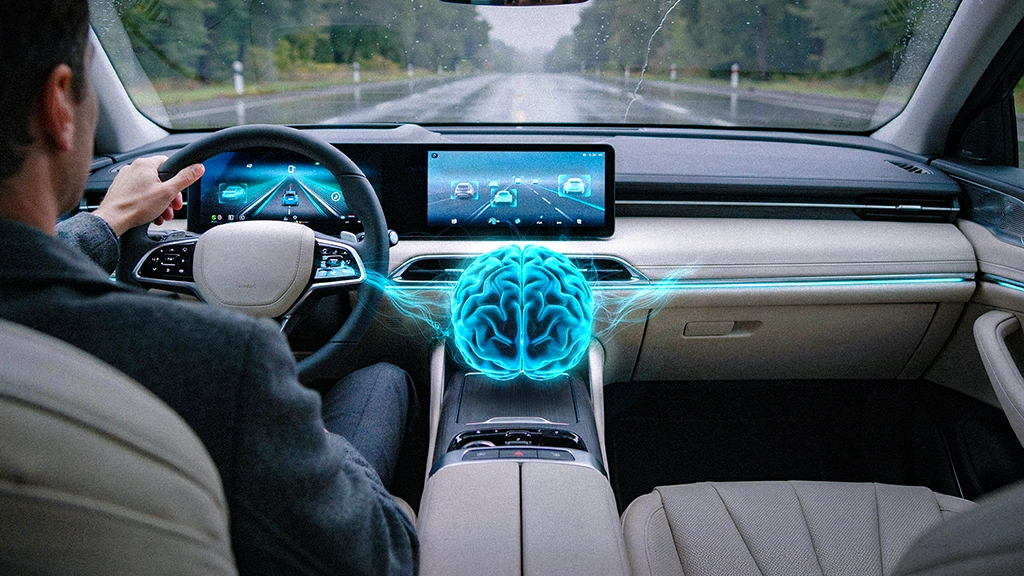
A vehicle used to be defined by its powertrain, its batteries, its mechanical parts. Increasingly, it’s defined by software instead: the code that enables and controls what the vehicle actually does. The next stage of that shift is the AI-defined vehicle, where software-defined vehicles (SDVs) start pulling real value from artificial intelligence rather than just running on it.
AI isn’t staying confined to one or two vehicle domains like driver assistance or voice commands anymore. It’s being woven into the vehicle’s broader stack of computing, perception, cognition, personalization, and service functions. That’s what people mean when they talk about AI-enabled or AI-defined cars: intelligence embedded at multiple levels, working across several vehicle attributes at once rather than sitting in a single feature.
What Is an AI-Defined Vehicle?
Running one machine learning model for one feature doesn’t make a vehicle AI-defined. It’s worth being clear about that, because the term gets thrown around loosely.
What actually qualifies is different: AI shaping performance tuning, safety responses, diagnostics, and the driving experience as conditions change in real time. A car that reads sensor data, driver habits, and road conditions, then adjusts its behavior accordingly, is doing something fundamentally different from a car that just plays back pre-programmed responses. A voice assistant on its own doesn’t earn the label either. What comes closer is braking calibration, energy management, and cockpit behavior, all drawing on models that keep learning and updating themselves.
An AI-defined vehicle typically combines:
- AI-powered perception and sensor fusion
- Intelligent driver assistance
- Predictive diagnostics and maintenance
- Personalized vehicle experiences
- Generative and conversational AI
- Intelligent energy management
- Continuous software and AI-model updates
AI-Defined Vehicles vs. Software-Defined Vehicles
The two concepts overlap, but they aren’t the same thing.
| Software-Defined Vehicles | AI-Defined Vehicles |
|---|---|
| Vehicle functionality is primarily controlled and updated through software | AI becomes a core component of the software layer |
| Software enables configurable features | AI enables adaptive and predictive behavior |
| OTA updates modify vehicle software | OTA updates can also deliver updated AI models |
| Primarily rule-based logic and applications | Increasing use of machine learning and generative AI |
| Focus on software-driven functionality | Focus on intelligent, context-aware functionality |
In short, SDVs give you the software foundation. AI is what makes that foundation adaptive and genuinely intelligent, rather than just configurable.
Technologies Enabling AI-Defined Vehicles
Getting to AI-defined vehicles depends on a handful of enabling technologies that support real-time processing, continuous learning, and AI deployment that can scale across the vehicle’s lifecycle.
-
Centralized and Zonal Architectures
AI workloads need serious compute. That’s pushing automotive architecture toward centralized, high-performance computing and zonal designs that consolidate processing and cut down on the sprawl of independent electronic control units. A centralized vehicle computer can support perception, cockpit functions, diagnostics, and other AI applications all on shared platforms, instead of scattering them across dozens of separate units.
-
Automotive Edge AI
Not everything can run in the cloud. Perception, monitoring, and certain safety-critical driving functions need low-latency processing that happens inside the vehicle itself. Automotive edge AI handles that: models run on-premises, cutting latency and reducing dependence on a constant connection.
-
Cloud-to-Car AI
The cloud still matters, especially for model training, heavier data processing, and fleet-level insights. That creates a hybrid setup where some AI workloads stay local and others lean on the cloud. NVIDIA’s architecture is a good example: in-vehicle AI agents handle real-time interactions, while cloud-based agents take on more complex tasks and pull in external information.
-
OTA AI Model Updates
OTA technology already lets manufacturers update software after a vehicle leaves the lot. As AI becomes more central to the vehicle, OTA processes will increasingly update the AI models, perception systems, and intelligent services too, not just the software wrapped around them. That points toward vehicles that keep improving over time, rather than a software configuration that’s essentially locked in at the point of sale.
Major AI Applications in Software-Defined Vehicles
Some of this is already on the road. Some is still a year or two out.
- AI-powered ADAS and autonomous driving functions use sensor fusion to make sense of traffic that rarely behaves the way a textbook says it should.
- Digital cockpits are becoming more personalized, adapting to the driving styles of the driver, not forcing them into a pre-set menu of settings.
- Generative and agentic AI assistants are moving past scripted responses toward something closer to a real copilot, one that anticipates rather than just reacts.
- NVIDIA’s recent work on cloud-to-car AI agents is worth watching here, since it treats in-vehicle agents as their own technical category rather than a feature bolted onto infotainment.
- Predictive maintenance is helping to spot mechanical issues sooner, before they become expensive or difficult to fix.
- Battery and energy management systems are helping to squeeze more real-world range from EVs, while driver monitoring systems detect when the driver is becoming fatigued or distracted and alert them before it becomes a safety problem.
- Fleets are applying the same underlying intelligence to route optimization and keeping vehicles on the road longer.
What separates AI-defined vehicles from cars with a single smart feature is exactly this: all of these functions working together, not one flashy capability standing alone.
The Future of AI-Defined Vehicles
Through 2030, progress on AI-defined vehicles will likely center on tying together vehicle computing, AI models, cloud systems, and software platforms into something coherent.
Key areas to watch:
- Multimodal and generative AI inside vehicles
- Agentic AI for more capable vehicle assistants
- Wider adoption of automotive edge AI
- Centralized, high-performance vehicle computing
- AI-driven energy and battery management
- Continuous AI-model improvement through OTA infrastructure
- Stronger AI validation and cybersecurity frameworks
- Deeper convergence between automotive software and cloud ecosystems
The real challenge for automotive companies isn’t just adding AI capabilities. It’s designing an architecture where AI, software, computing, data, and vehicle systems can evolve together over the vehicle’s lifecycle, instead of AI being added on as an afterthought.
Strategic Opportunities for Automotive Companies
As artificial intelligence in the software-defined vehicle ecosystem grows, knowledge of the technological landscape becomes increasingly crucial. Automotive companies, suppliers, and technology providers can gain by relying on competitive intelligence on automotive AI, technology scouting, automotive SDV benchmarking, patent landscape analyses, and partner identification.
For organizations still building out their position in this space, understanding emerging architectures, semiconductor platforms, software ecosystems, patents, standards, and supplier capabilities can help identify gaps and seize opportunities before the market consolidates around a smaller set of players.
Conclusion
AI-defined vehicles mark a shift from software-updatable vehicles to vehicles that can actually understand, anticipate, personalize, and make smart decisions on their own.
SDV architecture provides the substrate. AI adds a self-learning intelligence layer on top of it, and that combination is reshaping how the industry approaches development, operations, updates, and monetization across a vehicle’s life.
Companies that understand this landscape early, not just the technology but the IP, partnerships, and competitive dynamics around it, will be the ones best positioned as the industry moves further into software-defined vehicles.
Staying ahead in the AI-defined vehicle space takes more than watching the headlines. IeB helps automotive companies track emerging technologies through Technology Scouting & Monitoring, assess new capabilities and partners with Technology Due Diligence, and plan smarter entry into new markets with Go-to-Market Strategy support. Talk to our experts to see where the real opportunities sit for your business by filling out the form below or emailing us at contact@iebrain.com.