
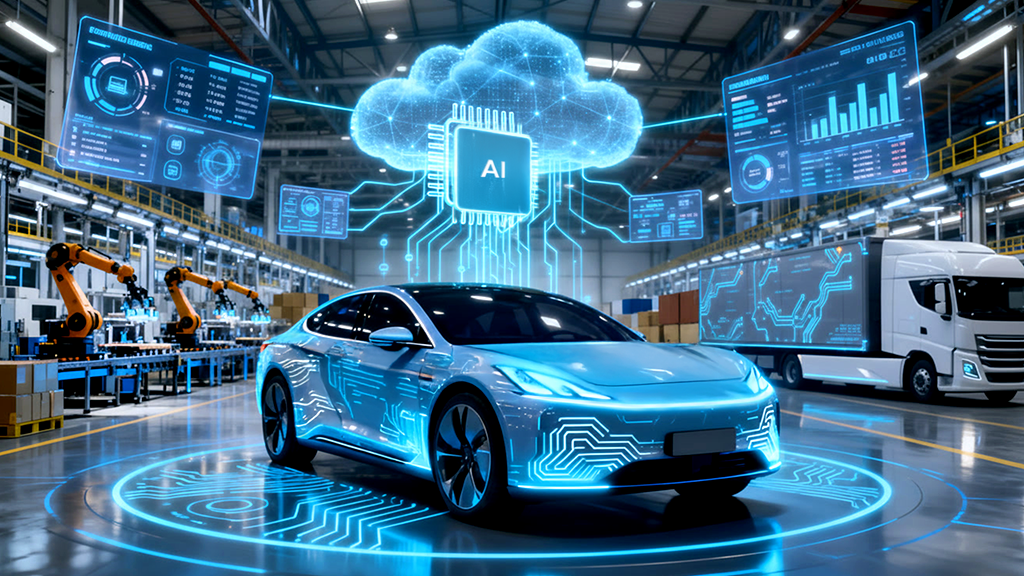
AI has become one of the defining forces of this decade, significantly influencing almost every industry. Even the automotive industry is investing billions in Software Defined Vehicles, smart factories, connected platforms, and digital ecosystems. Yet, beneath all this transformation lies a problem few talk about: decisions are still siloed.
Quality teams analyze defects. Supply chain teams monitor disruptions. Compliance teams track regulations. Sales teams chase leads. Each function uses data and AI models, but none of these systems act autonomously across functions without waiting for human intervention.
The industry doesn’t lack data. It doesn’t lack AI models, systems that can sense, decide, and act across the value chain. And this is where Agentic AI is beginning to reshape automotive not by making cars smarter alone, but by making the entire automotive enterprise self-directing.
From Reactive Automation to Autonomous Decision Systems
For years, AI in automotive has been largely reactive, starting with a machine vision system detecting a surface defect, dashboard flagging a supply delay, CRM logging into a new lead, and the compliance tool highlighting a regulatory update. After that, human intervention is required to make a decision. However, Agentic AI has truly changed this sequence.
Agentic AI on the Plant Floor: Quality, Process, Material, Supply Chain
Manufacturing is where the impact becomes immediately visible. As per the last section highlighted, traditional machine vision systems identify surface or dimensional anomalies, but resolution depends on human interpretation and intervention. But Agentic AI changes this by linking vision analytics with process control. Creating a closed-loop mechanism where process parameters are autonomously adjusted, quality records are updated, and learning is fed back into the system for continuous improvement.
The same applies to process optimization. Agentic systems trained on quality frameworks such as ISO-9000, IATF-16949, Six Sigma, and TQM can analyze metrology data and guide inspectors or automatically suggest corrective procedures aligned with compliance requirements, leading to accelerated decision-making.
The next field of change is material handling and robotics; exception handling has historically required manual coding. Any new scenario meant human intervention. Entering this equation, Agentic AI enables robots and material systems to handle exceptions dynamically by drawing from broader data sources and coordinating actions with other systems in real time.
Moving to the supply chain, which operates under uncertainty from weather events, geopolitical issues, or supplier delays, can now be managed autonomously with Agentic systems. From rerouting logistics, adjusting procurement volumes, to negotiating vendor timelines, these systems are capable of handling all these functions.
Extending into Compliance and Enterprise Operations
This intelligence is not only restricted to manufacturing. As an automotive manufacturers continuously operate in complex and evolving regulations enforced by bodies such as NHTSA and EPA, along with regional compliance requirements across global markets. And tracking these changes, interpreting laws, and managing reporting formats consumes a significant effort.
While Agentic AI can eliminate this problem. By continuous monitoring of regulatory updates, interpreting requirements, and orchestrating end-to-end compliance workflows from data collection to report submission, reducing cost and risk. Also, Agentic AI is contributing to make enterprise operations more efficient, consistent, and less dependent on repetitive human oversight.
Agentic Intelligence Inside the Vehicle: Beyond Rule-based ADAS
This is the most fascinating way AI is influencing the automotive sector, from inside the vehicle. And Agentic AI can further advance it by shifting from deterministic ADAS systems to adaptive intelligence.
Through the implementation of real-time data from cameras, LiDAR, and V2X networks. Systems can predict risks, adapt to driving behavior, and interact with surrounding infrastructure such as smart traffic lights and connected vehicles. Instead of relying on fixed rules, they learn from edge cases and operate under uncertainty.
In a broader connected ecosystem, vehicles as intelligent agents can move beyond the analysis of the surrounding environment to become active participants.
The Most Overlooked Use Case: The Automotive Customer Journey
While OEMs are focusing on autonomy in vehicles and factories, a major inefficiency persists in the customer’s journey. A potential buyer clicks on an ad, visits the website, submits a lead form, and then enters a waiting period. Hours or days pass before a sales representative makes contact. During this gap, interest can drop, and competitors can gain an edge. Sales teams spend much of their time asking basic qualifying questions and answering repetitive queries instead of engaging high-intent buyers.
Agentic AI addresses this gap directly. After the lead is generated, an AI agent starts the conversation with the customer through their preferred channel, WhatsApp, chat, or voice. Then, qualify intent using dynamic scripts, answer queries from a real-time knowledge base, and nurture the prospect with personalized content over days or weeks. And when the lead is sales-ready, it can schedule a test drive or human interaction.
Creating a seamless and hyper-responsive customer journey from the very first click. While the industry is talking about autonomous driving, Agentic AI is already enabling autonomous sales.
Navigating Barriers: Regulation, Safety, and Data Security
Autonomy is the driving force of Agentic AI, and it’s the same factor that introduces challenges. Safety, reliability, and accountability are the three main aspects of regulatory frameworks in automotive and aerospace. AI systems capable of making independent decisions raise questions around compliance, explainability, and liability. At the same time, decentralized data processing and real-time decision-making create cybersecurity concerns.
AI governance frameworks, simulation-based validation, transparent decision models, and continuous alignment with evolving regulations are required to address these barriers.
Conclusion
Agentic AI is not confined to a single function. It connects plant operations, enterprise workflows, in-vehicle intelligence, and customer engagement into a continuous operating system.
The future of automotive is not dependent only on smart cars or smart factories. Self-directing enterprises where decisions happen continuously without waiting for human triggers are also going to be a contributing factor.
The leaders of the next decade will be those who build not just intelligent products, but intelligent automotive ecosystems that can sense, decide, and act on their own.
If you’re exploring how autonomous decision systems can bridge manufacturing, enterprise operations, vehicles, and customer engagement, creating a unified automotive ecosystem, our automotive consultants and AI experts can help you define the right roadmap grounded in regulation, scalability, and real-world execution.
Connect with us by filling out the form below or by emailing at contact@iebrain.com to discuss how Agentic AI can be applied across your value chain.