

Regulators across therapy areas are increasingly relying on accelerated pathways and expedited routes to bring promising treatments to patients sooner. Oncology sits at the center of this shift. Of all the drugs reaching regulators through accelerated pathways, supported by adaptive designs and single-arm pivotal trials; cancer drugs account for more than an 80% share. As a result, approval is no longer the end point of oncology drug development; it is the starting point of a second race. So, does it mean approval still ensures that patients can access treatment? … Not necessarily. The same speed means HTA bodies and payers assess less mature evidence, and health systems must absorb new drugs, diagnostics, and care models faster than they were designed to. The effect is a growing gap between what is approved and what patients actually receive. This gap is rarely due to a single barrier; it spans three linked layers of market access in the oncology domain, which this article covers:
- Evidence barriers: What HTA bodies and payers need to see, and what trials often deliver
- Payer barriers: How value, budget, and pricing are judged
- Delivery barriers: Whether hospitals, clinicians, and data systems can actually get the therapy to the right patient
This article on oncology market access was written for HTA regulators, pharmaceutical leaders, drug innovators, and oncologists. Although each has a different aspect of the problem to deal with, none can solve it alone.
Where does the market access journey break after approval for cancer therapy?
The path from approval to treatment has several stages: HTA, pricing and reimbursement, inclusion on the formulary or in the guidelines, and finally the delivery of the diagnosis and treatment. If there is a delay or a restriction at any of these stages, this affects what the patient ends up receiving.
The time it takes to gain access differs greatly in the United States, the major European countries, Japan, and in the emerging markets. In certain systems, access is granted shortly after approval but with the presence of usage controls. In other cases, reimbursement assessments and price negotiations must be completed before patients can access the treatment. Korea’s experience with Retevmo (selpercatinib) illustrates how far this can extend. The drug was approved by the MFDS in March 2022, but reimbursement has not yet been put in place more than four years later, with the negotiations between the government and the company apparently having come to a standstill at the stage of evaluating commercial viability. Its competitor, Roche’s Gavreto (pralsetinib), was withdrawn from the market in 2024, so Retevmo is now the only targeted treatment available for RET-altered cancers in Korea. At a monthly cost of approximately 8 million won ($5,376), even though a company support scheme covers 20 per cent, patients still have to pay millions of won each month. Approval on its own made little difference to them.
The EU has introduced another stage to the market access. The EU HTA Regulation has been in force since 12 January 2025 for new oncology drugs and ATMPs, and by 14 April 2026 there were 15 joint clinical assessments underway, one of which has now been cancelled. The transition from framework to actual implementation took place not long after. On 30 April 2026, the HTA Coordination Group approved the first JCA report ever produced, which concerned tovorafenib (Ojemda) for use in children with low-grade glioma, with Ireland’s NCPE acting as assessor and Germany’s IQWiG as co-assessor. The European Commission had already granted the product conditional marketing authorisation 12 days earlier, on 22 April 2026. The Commission also opened a second request window for joint scientific consultations on 1 April, thereby providing developers with an opportunity to ask for advice on trial design before a JCA takes place. Orphan medicinal products will be covered in 2028 and all other centrally approved medicines from 2030.
This implies that oncology developers have to carry out one clinical assessment common to all the member states and produce a single body of evidence that must meet the requirements of numerous national perspectives at the same time. The importance of having a well-thought-out evidence strategy before obtaining approval thus increases.
What evidence barriers do HTA bodies and payers raise?
Evidence is the first barrier and, in many ways, the one that shapes all the others. Regulators and HTA bodies ask different questions. A regulator asks whether the therapy is safe and effective. An HTA body asks whether it is better than what patients receive today, by how much, and how certain that is.
Surrogate endpoints and immature data
Oncology drugs are often approved based on progression-free survival or response rate. HTA bodies, however, want to know what those results mean for overall survival and quality of life. When survival data is still immature at the time of assessment, that uncertainty carries through to the decision, leading to cautious recommendations, narrower reimbursement, or higher discount demands.
Single-arm trials and external controls
For rare cancers and biomarker-defined patient groups, randomizing patients is often difficult or ethically questionable, so single-arm studies are commonly used. The trade-off is that there is no direct comparator. External control groups can help fill that gap, but health technology assessment (HTA) bodies closely examine how these groups are built, how well they match the trial population, and how confounding is handled.
Comparator and PICO mismatch
The standard of care varies from country to country, just as the definitions regarding the population, the intervention, the comparator, and the outcome do when the assessors make their requests. A trial based on one comparator might not provide an answer to the question raised by a second or third country. Although the PICO scoping process under the EU HTA Regulation brings these questions together, it can also increase the number of them, and as a result developers may need to deal with several comparators using data from a single dataset.
Indirect treatment comparisons
If direct comparisons are not available, indirect ones are used to fill the gap. Whether or not they are accepted relies on the similarity of the populations in the trials, the quality of the evidence network, and the clarity of the methods. Comparisons that are weak or based on many assumptions generally cause suspicion.
Quality of life and patient-reported outcomes
Extending life is only one measure of a cancer treatment’s value. Symptom burden, functioning, and tolerability matter just as much to patients, and increasingly to assessors. But patient-reported outcomes are often collected inconsistently, underpowered, or not pre-specified, which limits their usefulness in HTA decisions.
Biomarker-defined and tumor-agnostic populations
Precision oncology results in smaller and more specific groups. While this enhances clinical targeting, it at the same time decreases the number of patients in each dataset. With regard to tumor-agnostic indications, the assessors also inquire whether efficacy is consistent among different tumor types, since small cohorts have difficulty showing this.
Real-world evidence
Real-world evidence can provide information about long-term outcomes, effectiveness in everyday clinical practice, and insights into populations that are under-represented in trials; yet its acceptance still relies on the quality of the data, the methodology used, and its relevance to the decision, and it supports the case rather than taking the place of controlled evidence.
Post-approval commitments
Since confirmatory data is required, a great many conditional approvals and managed entry agreements rely on it. The trials have to be finished, the data have to be gathered, and the reassessments have to take place. If a commitment is one that is hard to keep, then a conditional agreement can later become a restriction.
What kind of payer and pricing barriers slow down market access and reimbursement?
Reimbursement still comes down to whether the system finds the price and the budget impact to be acceptable.
Value thresholds and cost-effectiveness
Since many oncology treatments have prices that are high in relation to the extra benefit they provide, payers and HTA organisations assess the gains in survival or in quality of life against the cost, usually using cost-effectiveness criteria. It is hard to justify modest additional benefits when the prices are high, especially if the data is uncertain.
Budget impact
A treatment can be cost-effective on a per-patient basis and yet still exert pressure on budgets. This is because longer treatment periods, a broader group of eligible patients, and the use of therapy at an earlier stage of treatment all increase the number of patients receiving treatment at any one time. For this reason, payers consider the total amount spent rather than just the value per patient.
Combination regimens
There is a particular issue when combining drugs in the field of oncology: how should value be assigned in a situation where several medicines, usually from different companies, achieve the same result? Even if each individual drug is priced fairly, the total cost of the combination can become very high.
Cell and gene therapies
Cell and gene therapies carry a high upfront cost, and it is not yet clear how long their benefits will last. Payers must fund a single expensive treatment whose value plays out over many years. This has pushed the market toward alternative payment models, though these come with operational demands of their own.
The U.S. is showing how both sides can work together. The CMS Cell and Gene Therapy Access Model brings together 33 states, the District of Columbia, and Puerto Rico, covering about 84 per cent of Medicaid beneficiaries with sickle cell disease. Bluebird bio and Vertex have both agreed to outcomes-based arrangements under it. The model was launched in sickle cell disease, not oncology, but it has proven workable. Cell therapy developers in cancer are likely to be measured against it. Even so, operational gaps can still stand in the way of patient access.
Industry experts point out that manufacturers frequently do not have clearly defined billing codes when their products are approved, which means that healthcare sites are forced to use general codes for the first few months, and in some cases programmes have gone close to a year without having the correct codes. One gene therapy was reportedly pulled back within months of its approval due to an unsound commercial strategy, with payment issues playing a major role. Given that more than 20 cell and gene therapies are expected to be launched over the next two years, planning for coding and payment readiness before approval is just as important as the price itself.
Managed entry agreements
Outcome-based, annuity-based, and financial agreements can help bridge the uncertainty between developers and payers. To work well, they need clear definitions, reliable data collection, and simple administration. If an agreement is too complex to run, it will slow access rather than speed it up.
Cross-country dynamics
International reference pricing connects prices in different markets. As a result, the order in which products are launched is affected, since a lower price in one country can affect the negotiations in the others. Developers thus intentionally decide both where and when to launch, and this may lead to a delay in some markets. The Retevmo case mentioned above illustrates the alternative situation: when a therapy that is the only available one is involved in a pricing standoff, it is the patient who has to bear the cost.
US-specific factors
In the US, coverage is shaped mainly by payer policies, utilization management, and prior authorization, and it varies from plan to plan. This is especially clear for oral anticancer drugs. Specialty oral therapies for leukemias, lymphomas, and multiple myeloma are usually covered under the pharmacy benefit. As a result, patients often face approval requirements and high out-of-pocket costs before treatment begins, even though these drugs can be taken at home.
The Inflation Reduction Act introduces a second layer for drug developers. Imbruvica was the first oncology drug to go through the negotiation process, and Calquence was the next one in the second round, with the agreed prices coming in at about 38% and 40% less than the original list prices, respectively. Xtandi, Pomalyst and Ibrance are also included in this second round, with their negotiated prices set to take effect in 2027. The key issue now is not just what price to set at launch but how lifecycle strategies have to be adjusted when a product is eligible for negotiation. It has also been pointed out that the rules might discourage post-approval studies, something that is important in oncology since new indications frequently arise after the first approval.
Biosimilar and generic entry
The arrival of biosimilars and generics into the field of oncology is having an effect on what payers expect, such as the way they compare new treatments with cheaper alternatives.
What delivery and system-readiness barriers affect patients?
Getting a drug reimbursed is not the end of the journey. It still has to reach the patient, and this is where many access programmes stall. It is also the stage that receives the least attention during development.
Biomarker and genomic testing
Access to targeted therapies starts with appropriate diagnostic testing. If testing is carried out at a low rate, if the results take a long time to return, diagnostic tests are not reimbursable, or there is a misalignment between a drug and its companion diagnostic, then eligible patients may go undiagnosed or untreated. Predictive biomarkers can take five to ten years to reach broad clinical use, held back by evidence requirements, workflow fit, and reimbursement, and turning an assay into an FDA-approved IVD demands standardization, automation, and rigorous analytical validation.
The stakes rise as testing moves earlier in the disease course. Genomic profiling, ctDNA analysis, and MRD testing are currently used to guide therapy selection, treatment sequencing, and the monitoring for resistance in breast, gastrointestinal, and gynecological cancers. In the case of rectal cancer with defective mismatch repair, neoadjuvant treatment with nivolumab and ipilimumab led to a pathological response in 109 of the 111 patients studied in the phase 2 NICHE-2 trial, including 75 complete pathological responses and no cases of recurrence after 26 months. Yet payer coverage for repeat molecular testing remains inconsistent in early-stage disease, and many health systems cannot integrate results into EHRs in a way that informs treatment pathways. A strong drug result does not reach patients if the testing layer is unfunded or disconnected.
Hospital-level barriers
Just because national reimbursement has been approved doesn’t mean that the drug will be available locally. The hospitals’ formulary and pharmacy committees determine which drugs are stocked, and the hospitals’ budgets can prevent the adoption of certain treatments, especially those which are expensive. The time lag between national reimbursement and local adoption is a genuine and frequently neglected barrier to access.
Site of care and infrastructure
Complex modalities like CAR-T therapy need specialized treatment centers, trained staff, and the necessary logistics for handling cell products. Limited center capacity can create waiting lists even when funding is in place.
Radiopharmaceuticals follow the same pattern. They pair targeted treatment with radiation delivered directly to the tumour, and the clinical case for the approach is strong. Access, however, depends on several practical factors: isotope availability, timely logistics, radiopharmacy capacity, specialist teams, site readiness, and regulatory alignment across regions. The science is proven, but delivery is operationally constrained. Infrastructure, not biology, is what limits progress.
Workforce and multidisciplinary capacity
Modern oncology relies on teams made up of oncologists, pathologists, molecular tumor boards, and specialist nurses and pharmacists. Delays or an uneven distribution of these personnel hinders decisions regarding diagnosis and treatment.
Data and digital infrastructure
Cancer registries and interoperable real-world data form the basis for monitoring outcomes and for outcomes-based agreements; when these systems are fragmented or incomplete, it becomes difficult to meet the post-approval evidence commitments and to demonstrate value.
Guideline adoption
Clinical guidelines have an influence on the way prescriptions are issued; because there is a delay between the emergence of new evidence and the updating of the guidelines, and because of the gaps between academic and community hospitals, patients in different types of settings might not be given the same treatment options.
Administration and logistics
Infusion therapies and oral therapies place different demands on hospitals, specialty pharmacies, and supply chains. Cold-chain requirements and dispensing pathways add further operational complexity.
Patient-level barriers
Out-of-pocket costs, distance to treatment centers, and socioeconomic and health equity factors affect who can actually start and stay on treatment. Access on paper is not equal access in practice.
How do these barriers overlap?
These barriers rarely act alone. They reinforce one another in loops.
Weak early evidence often leads to restricted reimbursement. That restriction discourages both biomarker testing and prescribing, so few patients are tested and treated. Without enough real-world data, post-approval evidence commitments go unmet, which weakens the case at reassessment. The result is another round of restricted access, and the cycle repeats.
Data infrastructure is often the point where the loop can be closed. Without registries and linked data, developers cannot fulfil evidence commitments, payers cannot verify outcomes, and clinicians cannot see what works in practice. Since each of the various stakeholders is at a different point in the loop, co-ordinated action is important. A barrier map that connects the evidence, payer, and delivery layers can help teams to identify where their own influence is strongest.
What can each stakeholder do differently?
HTA regulators
Early scientific advice, flexibility with defined reassessment points, and coordination across organisations all help reduce uncertainty for both developers and assessors. Clear guidance on acceptable evidence for rare and biomarker-defined populations lets developers design trials that answer HTA questions from the start.
Pharmaceutical leaders
Planning for integration of evidence and access should start in Phase 2, not when the application is filed. When developing the pricing and launch strategy, consideration must be given at the portfolio level to the possibility of price negotiations, and the continued investment in real-world data infrastructure brings rewards for a number of assets. Access readiness should be treated as a commercial and strategic priority, and not merely as a matter within the market access function.
Drug innovators and developers
The trial design must take HTA endpoints into account, include external controls when randomization is difficult, systematically record patient-reported outcomes, and match the companion diagnostics with the therapy as early as possible. In the case of cell and gene therapies, planning should be done in advance regarding billing and coding readiness.
Oncologists and hospitals
Clinicians provide input by supplying evidence for guidelines, by adopting testing procedures, and by producing real-world data. Hospitals can simplify their formulary procedures so that therapies which have been approved and are reimbursable get to patients more quickly.
Payers
Definite criteria for conditional coverage and feasible outcome-based agreements provide developers and clinicians with a predictable route, and enable payers to obtain better information regarding value over time; sustainable reimbursement for repeated molecular testing and reduced pharmacy-benefit obstacles for oral oncology drugs would eliminate unnecessary friction.
What does a practical market access action framework look like?
We recommend reviewing access readiness in three stages, each of which includes evidence, the payer, and delivery.
| Stage | Evidence | Payer | Delivery |
|---|---|---|---|
| Pre-approval | HTA-aligned endpoints, PICO mapping, PRO capture, external control strategy | Early value and budget impact modeling, pricing scenarios | Companion diagnostic alignment, center and testing readiness assessment |
| Launch | Evidence dossier and JCA readiness, indirect comparisons | Managed entry options, country sequencing, billing and coding readiness | Hospital formulary engagement, clinician education, testing pathways |
| Post-approval | Confirmatory data, real-world evidence, reassessment preparation | Outcomes tracking, agreement operations | Registry linkage, guideline updates, uptake monitoring |
Progress can be tracked by monitoring time to reimbursement, testing rates, hospital formulary listing time, uptake, and real-world outcomes. These indicators reveal where access is slowing down and which lever should be pulled.
Consider a generic scenario. A developer receives conditional approval for a targeted therapy as a result of a single-arm trial and is then given reimbursement on the condition that confirmatory data are collected, although the rate of testing is low and there is no registry available to record the outcomes. Six months in, the developer cannot show uptake or outcomes, and the reassessment date approaches. Planning testing, data collection, and hospital engagement earlier would have addressed each of these gaps.
How does Ingenious e-Brain support market access in the oncology sector?
Closing the gap between approval and market access takes work across the evidence, payer, and delivery layers, ideally started well before filing. At Ingenious e-Brain, we help life sciences organizations plan each layer as one connected program, rather than three separate workstreams.
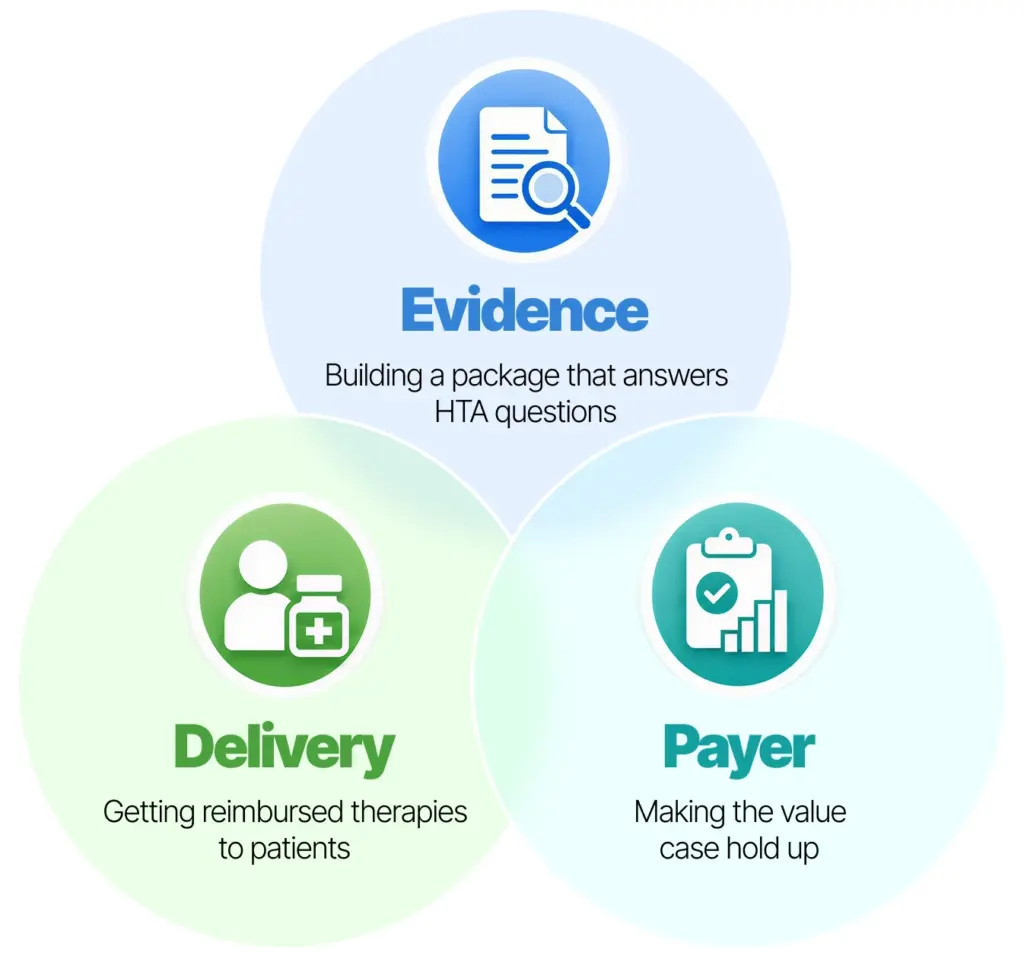
Evidence: Building a package that answers HTA questions
- Evidence strategy and gap assessment ahead of pivotal trials and filings
- PICO scenario mapping and JCA readiness for the EU HTA Regulation
- External control and indirect comparison planning for single-arm and biomarker-defined populations
Payer: Making the value case hold up
- HEOR support, including cost-effectiveness and budget impact modeling
- Pricing and launch sequencing scenarios across markets
- Managed entry agreement design, including outcomes-based options
Delivery: Getting reimbursed therapies to patients
- Real-world evidence generation to meet post-approval commitments
- Registry and data-infrastructure planning for outcomes tracking
- Readiness reviews covering testing pathways, treatment centers, and hospital adoption
Our comprehensive approach:
Begin by using a barrier map for the particular asset and its target markets to show the points at which evidence, payer, and delivery risks are likely to combine. Next, identify the actions that have the greatest impact at each stage, ranging from before approval through to after approval, and monitor them using indicators such as time to reimbursement, testing rates, and uptake.
Our healthcare consultants can assist you in planning for those areas where access is most at risk, whether you are developing a Phase 2 evidence plan, getting ready for a launch, or dealing with a reassessment.
Future Outlook
The following trends will influence access in the years ahead. Since the first JCA has now been endorsed, the EU HTA Regulation will gradually cover orphan medicines and other areas, thereby making joint clinical assessment a common feature of the environment. Advances in AI and better use of real-world data could enhance evidence generation and make it easier to track outcomes. New types of treatment, including cell therapies and radiopharmaceuticals as well as next-generation targeted agents, will continue to test the ability of payers and hospitals to adapt.
The general trend is a move from development focused on approval to development focused on access. Success will be measured less by the date a drug is approved and more by how many eligible patients receive it, and how quickly.
Conclusive Note
Market access in oncology now depends on three layers working together: evidence that answers decision-makers’ questions, payer models that balance value with sustainability, and delivery systems ready to treat patients. For HTA regulators, the opportunity is clearer. For pharma leaders and innovators, it is planning for access from the start. For oncologists and hospitals, it is turning reimbursement into real treatment.
At Ingenious e-Brain, we support life sciences organizations across evidence strategy, HEOR, market access, and real-world evidence.
Talk to our healthcare industry experts & consultants to uncover how evidence, payer, and delivery barriers impact your business operations and what to do about them.
Fill out the form below or email us at contact@iebrain.com.