
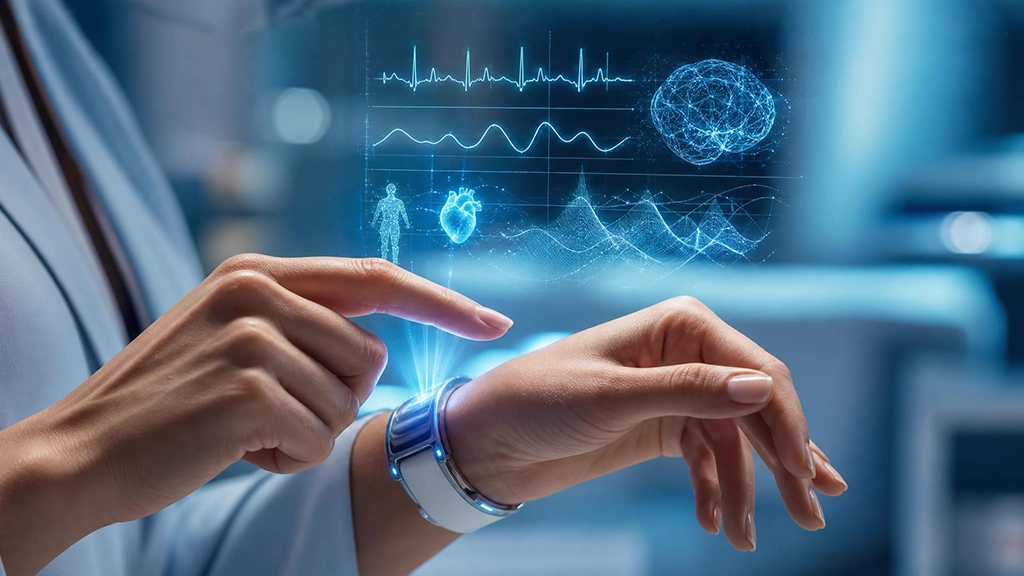
Think about a neurologist examining a patient. The doctor listens to the patient’s concerns, spends 15 minutes examining how she moves, how clear her speech is, how good her memory is, her coordination, and decides on the diagnosis. But what is he doing during the remaining 23 hours and 45 minutes?
That is where digital biomarkers come in.
In simple terms, a digital biomarker refers to electronic indicators of health or behavior that are measurable through digital technologies including wearable devices, smartphone applications, sensors, and other similar devices that can provide a meaningful clinical insight into a person’s health or response to treatment.
In this article, we examine the size of the digital biomarkers market, its potential, the key players shaping the competitive landscape, the intellectual property being developed & protected, the research and clinical trials that are taking place and the market’s future direction.
Digital Biomarkers Market: Growing Almost 20% a Year
The world’s digital biomarkers market is set to record impressive revenue growth in the near future. It is expected to rise from the current USD 6–7 billion (as of 2026) to USD 17–27 billion by 2030–31, which represents around 19% CAGR (compound annual growth rate), although estimates vary depending on how analysts define the market.
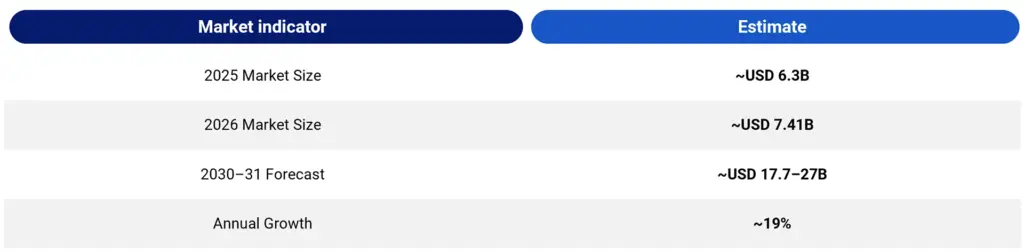
The biggest story is not the growth rate but the development and utilization of the technology where the signals can be transformed from “interesting data” into evidence that doctors and regulators trust.
Across the reports and findings, most of the use cases are focused on physiological signals, such as heart rate, activity, and respiration. Cardiovascular diseases represent a leading application area, while clinical research is one of the fastest-growing applications. North America currently dominates the market, while Asia Pacific region particularly China and India, is expected to witness the fastest growth rates.
Why Digital Biomarkers Are So Important?
-
For Patients and Providers
Symptoms often arise outside scheduled visits and can fluctuate throughout the day or develop gradually over time. Additionally, constant monitoring gives the physician a fuller picture of the patient’s condition beyond what can be captured during a single visit. For example, changes in gait or speech pattern may help flag progression in neurological illness.
Similarly, in cardiology, continuous rhythm monitoring can catch irregular events which a scheduled checkup would never capture during a standard checkup.
-
For Pharma and Biotech
Digital endpoints have the potential to make trials faster, cheaper and more precise by enabling more frequent real-world assessments with less dependence on patients to repeatedly visit a trial site. This provides the opportunity to understand treatment response even better, not only in the context of what might be happening in the clinic, but also in a much broader context of patients’ everyday lives.
-
For Health Systems and Payers
Earlier interventions reduce the costs associated with caring for individuals who have chronic diseases, and decentralized trials can make it easier to recruit a more diverse set of patients by removing the requirement for them to go through the hassle and spend the time getting to major medical centers. Instead of bringing the trial to the patient, the patient conducts the trial in their own home and everyday environment.
What the Competitive Landscape Looks Like?
The digital biomarker ecosystem is evolving beyond wearable-device companies. It now includes companies specializing in digital endpoints, remote monitoring, neurological assessment, cardiac monitoring, cognitive health, imaging, voice analysis, and clinical-trial technology.
Notable Players in the Digital Biomarker Ecosystem
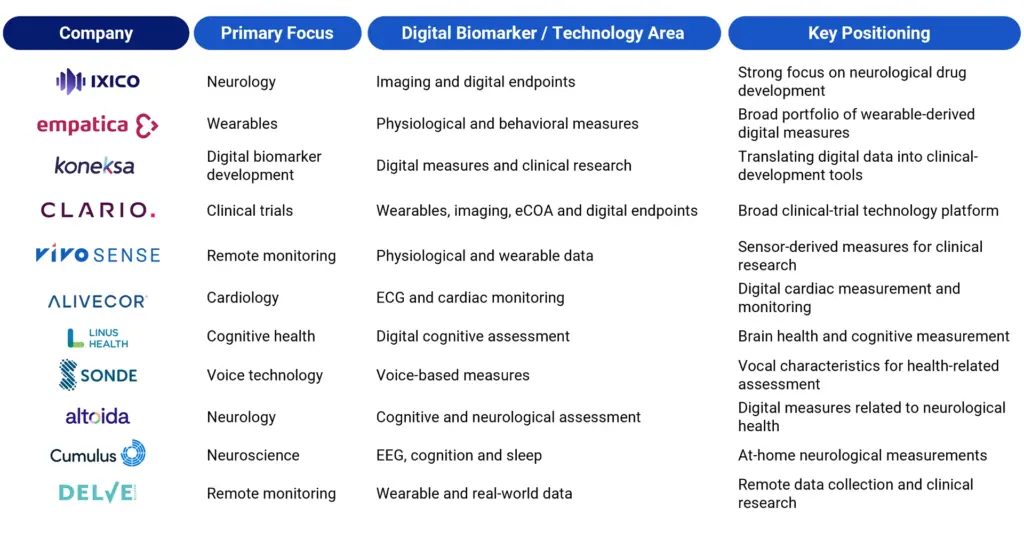 The ecosystem typically relies on cloud providers such as AWS, Google Cloud, and Microsoft for the computing infrastructure needed to collect, process, and analyze digital health data.
At the same time, intellectual-property activity is gaining real importance as per the World Intellectual Property Organization, filings around wearable and connected health-sensor technology have climbed steadily across the U.S., Europe, and international PCT jurisdictions, and the European Patent Office’s own tracking shows medical technology consistently ranking among its top technology fields alongside computer technology and digital communication — underscoring how central IP protection has become to this market.
The competitive question is shifting from “Who collects the most data?” to “Who can turn that data into a reliable measurement that researchers and clinicians can actually use?”
Where Digital Biomarker Innovation Is Happening?
Digital biomarker innovation is expanding across the world. From universities and medical institutions to tech giants and clinical trial organizations, there is a growing interest in digital biomarkers and their potential to redefine the healthcare industry, particularly in areas such as neurology, metabolic health, cardiovascular conditions, and mental health.
The research efforts dedicated to these groundbreaking developments are truly remarkable. For instance, a public analysis of clinical trials published in Communications Medicine in 2026 revealed that 102 clinical studies use digital endpoints. Out of these, 30.4% were focused on endocrine/metabolic conditions while 24.5% were investigating neurological conditions.
A related methodological review in PHUSE Connect’s proceedings — a nonprofit organization of clinical-data professionals — makes a similar point: the field is shifting from simply collecting digital signals to proving, through standardized statistical programming and analysis, that those signals hold up as trial-grade evidence.
Funding is also growing in disease-specific research. A bibliometric analysis of funding sources for Parkinson’s disease research identified 599 funding projects supporting 1396 studies, whereas a similar analysis of Alzheimer’s disease digital biomarker research showed that 81.2% of the 431 studies were funded.
Overall, the trends suggest that the field is beginning to evolve towards AI-based digital biomarker research, as well as digital phenotyping, neuroscience monitoring, physiological sensing, and multimodal digital biomarkers.
Universities and Research Institutions Are Pushing Technology Forward
Much of the credibility is generated within universities, research institutes, and other public-private groups, long before it can be commercialized by any company:
- Mount Sinai’s Hasso Plattner Institute for Digital Health, together with its sister institute in Potsdam, Germany, and Charité Berlin, produces some of the most-cited research into bringing digital biomarkers from the lab to everyday clinical practice.
- TNO’s Digital Biomarker Lab, based in the Netherlands, built a practical framework that covers the entire life cycle of a digital biomarker, from first idea to real-world deployment.
- University of Rochester and Radboud University Medical Center’s joint initiative on personalized Parkinson Project is pioneers in utilizing wearables to monitor patients with neurodegenerative conditions.
- University of Geneva’s Quality of Life Lab and University College London are two of the many universities working on building digital biomarkers for women’s health and patient-reported outcomes.
- Northwestern University, together with academic and foundation partners, is working on developing voice-based biomarkers for Parkinson’s disease.
FDA Digital Biomarkers: From Data to Validated Evidence
Collecting data on health through a wearable device or smartphone does not necessarily make it a digital biomarker. The data captured must be fit for purpose and clinically relevant.
The FDA’s Biomarker Qualification Program offers a pathway for biomarker qualification for a particular use in drug development. According to the FDA, the qualification of biomarker means a biomarker’s ability to provide valid support for its intended interpretation and use of application within that defined context.
The Digital Medicine Society (DiMe) has a complementary, broad, and widely used validation framework and the largest public library of digital endpoints that have already been used in real clinical practice, thereby reinforcing the same message from the research perspective.
This is why validation is now a crucial component in developing digital biomarkers. The key shift is simple: the industry is moving from collecting more health data to proving which data can be trusted as clinical evidence.
Future Opportunities: Where Digital Biomarkers Are Heading
The next frontier of digital biomarkers will be driven by various combinations of sensors, artificial intelligence, clinical insights, and multimodal data.
-
Multimodal Digital Biomarkers
Rather than using one signal, researchers could combine several validated signals, such as movement, sleep, heart rate, voice, and cognitive performance, to build a more complete picture. Several industry reports note the potential value of multimodal approaches, with multiple measurements used to form more comprehensive and robust assessments.
-
AI and Advanced Analytics
The amount of data produced by digital health technologies is too vast to be analyzed manually. Artificial intelligence and machine learning can help sort through these data and identify patterns that can be used to quantify speech, movement, images, and physiological data.
-
More Clinical Trials at Home
Remote data collection can avoid the requirement for patients to visit trial sites numerous times and potentially help researchers capture health data under everyday conditions. The study published in the journal Communications Medicine in 2026 stated that utilizing a decentralized approach to clinical trials may lower enrollment barriers and increase diversity and real-world relevance of trial populations.
-
Digital Phenotyping and Personalized Care
Continuous data might be valuable in studying the patterns of an individual’s behavior, physiology and symptoms over time that could lead to better diagnosis, more effective treatment plans and more detailed follow-ups of treatment.
-
Validation, Privacy, and Bias
Growth will not be dictated by technology alone, as data privacy, cybersecurity, interoperability, patient adherence, device diversity, algorithm bias, and regulatory science will all play a critical role in the development of the industry. Thus, the next big thing may not be defined by the size of the data set, but rather by its quality and clinical utility.
Where Ingenious e-Brain Can Help You?
To identify a commercial opportunity in digital biomarkers space, organizations must go beyond simply analyzing emerging technologies. Companies must understand who is developing them, where the IP is heading and what technologies are gaining clinical practice, and where the future market is going.
Our expertise across these services can help you achieve your business objectives by providing the following insights:
- Patent Landscape Analysis: Help you identify who’s filed what and their positions in the market, as well as threats and opportunities to consider when developing your own patents and commercialization strategy.
- Competitive Intelligence: Benchmarking against players like IXICO, Empatica and emerging startups on product portfolio, IP position, and strategic moves.
- Technology Scouting & Monitoring: Continuous tracking of emerging sensors, AI/ML technology, and multimodal-fusion technologies feed the next wave of digital biomarkers.
- Technology Forecasting: To track down relevant, emerging technologies, such as digital phenotyping, digital twins, AI/ML algorithms, and multimodal-fusion technologies, which can be integrated into digital biomarker development.
- Life Sciences & Chemistry Practice: Domain-specific expertise across pharma, biotech, and medtech clients.
Conclusion
The digital biomarker market is transitioning from an emerging technology space to a highly competitive and evidence-driven market.
Technology is already capable of gathering information on movement, sleep, heart rate, speech, cognition, and other indicators of health outside the doctor’s office. Clinical trials are increasingly testing how these gathered information support drug development and patient care, while research institutions are working to establish validation frameworks needed to make them reliable.
The next step is less about how much data can be gathered and more about how much of that data can be trusted.
For companies, there is one clear way to benefit from these trends: identify which new technologies are being developed, what research backs those advancements, and what clinical trials are being conducted to test their viability.
The companies that spot these trends first will be best placed to seize the next big digital biomarker opportunity.
Talk to our IP experts about how to maximize your competitive position. Get in touch by filling out the form below or by emailing us at contact@iebrain.com.