
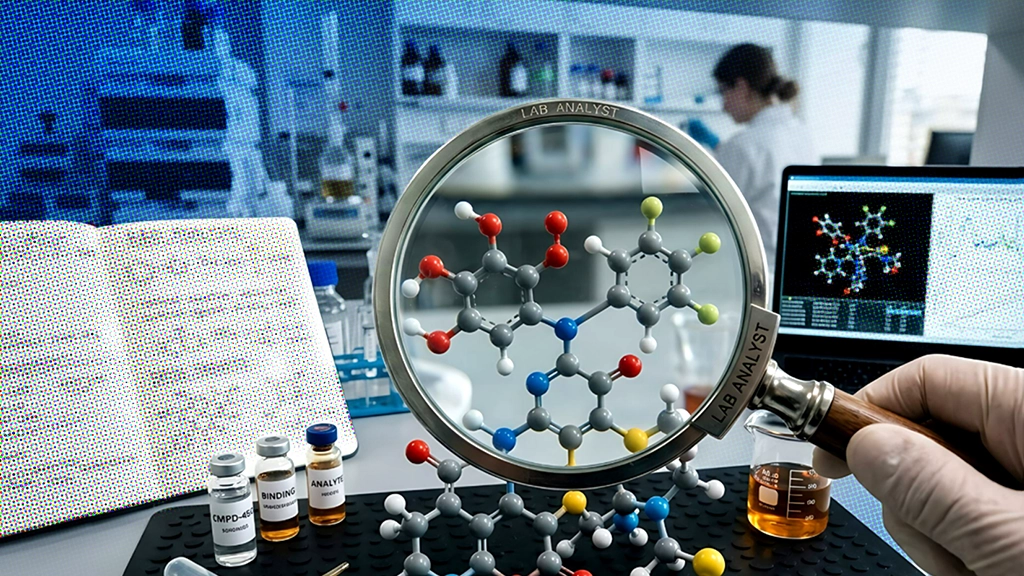
Say your team has spent a few years working on a new compound and the patent search comes up with nothing. That feels like a green light, doesn’t it? Sometimes it is not, because a patent can cover your molecule without ever actually naming it.
Some chemical patents will describe a pattern rather than a list of compounds, and every molecule that fits in that pattern is covered under the claim. This drafting style is called a Markush claim, and finding these claims requires a different kind of search. Below, we explain how it works and when your project needs one.
What Is a Markush Structure?
A Markush structure is a way of claiming many chemical compounds in one go.
Instead of depicting one molecule, the patent depicts a basic structure with several blanks. Each blank is accompanied by a list of variations. For instance, the first blank may have an option of being hydrogen, methyl, or ethyl, and the second might allow any halogen. You can mix and match the various substitutions for each blank spot, and that creates a whole family of compounds.
Some Markush claims cover only a few compounds. Others cover millions, and the inventors may have made only a small number of them. A molecule that nobody has ever produced can still sit inside the claim.
The name comes from Eugene Markush, an inventor who won approval for this style of claim in the United States in the 1920s. Patent offices around the world now accept versions of it.
What Is a Markush Search?
A Markush search is a patent search that looks for these family claims. It answers one question: does any patent claim cover this compound, even if the patent never names it?
A normal search asks, “Is this exact molecule mentioned?” A Markush search asks, “Does this molecule fit inside a family that someone has already claimed?”
That difference is the whole story. A patent can block your compound without ever mentioning it.
Why a Normal Chemical Search Is Not Enough
Most people start with a keyword search or a structure search. Both are useful. Both miss things.
- A keyword search looks for names. Markush claims often use general terms like “a substituted aryl group,” which no keyword will match to your compound.
- A standard structure search looks for specific molecules. It cannot see the large family of compounds hidden behind a general drawing.
- Patents describe the same chemistry in different words. One filing says “alkyl,” another says “C1 to C6 hydrocarbon chain,” and a text search treats them as strangers.
So a clean result from a normal search does not mean the path is clear. It means you have only checked the named compounds.
Why Markush Searches Matter for Chemical Patents
A Markush search is all about protecting your money, your time, and your strategy. That’s where it really matters.
- Freedom to operate: Prior to launch, you need to be absolutely certain that no live patent covers your product. Generic claims are precisely where the hidden risks lie.
- Patentability: If someone has already claimed a family that includes your compound, then your own filing is likely to be rejected or at best will only be granted a very narrow patent.
- Competitor tracking: Markush claims show where the competitor is going. A broad family is often indicative of an entire research programme well before any product actually comes to market.
- Deals and licensing: Buying or licensing a chemical asset without checking the surrounding Markush claims is a complete gamble.
- Better patent drafting: If you know what’s already claimed, you can write your own claims to avoid it.
If you do not do the search, you might find out about a blocking patent only after the money has been spent.
Why Markush Searching Is Hard
If this were easy, everyone would do it. Four things get in the way.
- The claims are huge: A single claim can cover more compounds than anyone could list. You cannot check them by hand.
- The language is loose: Terms like “optionally substituted” can mean very different things depending on the patent and how the description defines them.
- The tools are specialised: Standard patent databases are built for text. Markush searching needs dedicated chemical databases that can read a general structure and test whether your molecule fits.
- The reading takes judgement: A software hit is just the starting point. You need someone with the right chemistry and patent training to read the claim, check the definitions and decide whether it’s a real hit or just a close one.
Because of this, Markush work is a skill as much as a search.
How a Markush Search Works Step by Step
You will probably never run one of these yourself, but knowing the order of the work helps you spot a weak report.
- Define the target: Set the target by specifying the exact compound or group of compounds you would like to examine and also the markets that are important.
- Search several ways: Text, structure, and Markush databases all contain limitations, so run all three.
- Check the claims, not the abstract: The abstract rarely indicates the breadth of the claim, and the description can define terms differently from how a chemist would read them.
- Test the fit: Compare your structure against each general drawing, one blank spot at a time.
- Check legal status: It is necessary to check the legal status. A matching patent matters only if it is still in force in the countries you care about.
- Report in plain terms: Present the risks clearly, ranked according to their importance, not just a bunch of patent numbers.
How Ingenious e-Brain Can Help in Markush Search?
Ingenious e-Brain (IeB) offers Markush searches performed by a team that understands both the chemistry and the claim language. Our team of more than 300 PhDs and subject experts reads the technical and legal sides of each claim together.
We start by breaking down the molecule or Markush structure into its basic building blocks, ensuring that each segment is queried individually. Following the IeB workflow, we then search patents and non-patent literature in more than 15 databases covering over 100 countries.
Our teams can simultaneously search literature in their original language in more than 25 jurisdictions, including China, Japan, and Korea. This matters because many patent filings exist only in their original language, not in English. Our AI accelerates the screening process while an analyst checks the results at this stage.
Once we have a set of relevant patents, we drill down on all relevant patents by following the citation trail forward and backward two levels, identifying all possible inventors and assignees. This often turns up related filings that the first search missed.
You may also decide to go with either of the following options:
- Quick Analysis: a list of relevant references.
- Moderate Analysis: identification of R groups and variables.
- Extensive Analysis: mapping of your actual structure onto the Markush structures we find.
We deliver our search results in Excel or Word formats with different groups of atoms colour-coded so your team can review them faster. Our pricing is flexible, and our turnaround is quick. Our search teams sit in the US and India, and client data stays protected under strict access rules.
If you would like us to look at your compound before you file, launch, or sign a deal, get in touch at contact@iebrain.com.
FAQs
-
Is a Markush search only for pharma?
No. Any field that claims chemical compounds can be affected, such as agrochemicals, polymers, specialty chemicals, and battery materials.
-
When should I run one?
Ideally before you invest heavily in a compound, and again before launch.
-
Can software do it alone?
Software finds candidates quickly. A trained analyst decides which ones are real risks.
-
Does a Markush search replace a normal search?
No. Run it alongside a normal search, because each one catches things the other misses.
-
Is a Markush search the same thing as a chemical structure search?
No, a chemical structure search looks for specific molecules that match or resemble yours. A Markush search goes a step further and checks whether your molecule falls inside a broad family that a patent claims in general terms. Many projects need both, because a patent can name your molecule directly or only cover it through a pattern.
Talk to IeB About Your Compound
If you are developing, licensing, or launching a chemical compound, send our team the structure and the countries you care about. We will explain what a Markush search would cover in your case and how we would approach it.
Contact IeB to request a Markush search for your compound.