
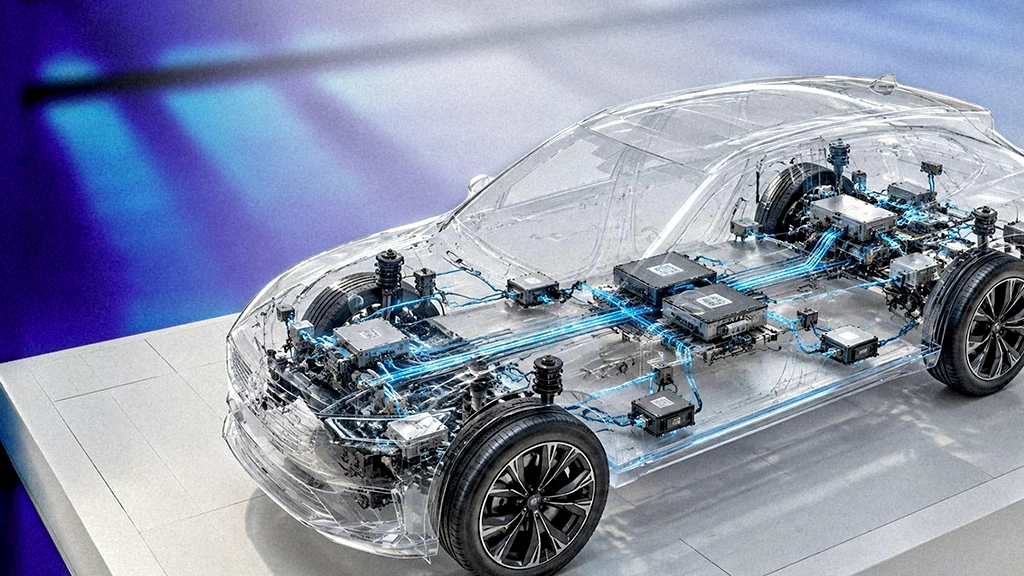
Tomorrow’s vehicle performance will be measured not just by horsepower, but by the speed, reliability, and intelligence of the data flowing through its network. The industry has broadly committed to zonal E/E architecture, and most major OEMs are actively migrating their platforms toward it. That decision is largely settled. What isn’t settled, and what will matter more for competitive position, is what happens underneath it: whose serialization standard ends up carrying the sensor-to-compute link, which Tier 1’s zone controller design actually reaches volume production, and which semiconductor roadmap a given platform gets tied to once that decision is made.
Zonal E/E architecture organizes a vehicle’s electronics by physical location instead of by function. Rather than running separate wiring from dozens of scattered control units back to one central computer, the vehicle is split into zones- front, rear, left, right- each with a controller that collects nearby sensors and actuators and passes that data over a shared backbone, usually automotive Ethernet, to one or two central compute units. The immediate payoff is simpler wiring, lower weight, and a platform that can take a meaningful software update without a service visit.
In this article, we look at why the standards layer beneath zonal architecture has become the real competitive battleground, where the value in this shift is actually migrating, the business questions this raises for OEMs and Tier 1 suppliers, and how that landscape gets tracked with enough precision to act on.
Key Takeaways
- Zonal E/E architecture is no longer a contested decision among OEMs; most major automakers have already committed to it and are actively migrating their platforms.
- The real competitive risk in zonal architecture has shifted from the wiring topology itself to the standards and compute layers underneath it.
- Three SerDes standards, MIPI A PHY, the Automotive SerDes Alliance’s ASA ML, and OpenGMSL, are competing to become the default physical layer for sensor-to-compute links, and none has won outright yet.
- By 2030, the primary differentiator between OEMs will be the sophistication of their compute platforms and semiconductor sourcing strategy, not whether they adopted zonal architecture.
- Supplier and standards positioning in this space changes quarter to quarter, not year to year, making continuous tracking necessary rather than a one-time assessment.
Why Zonal E/E Architecture Has Become a Standards Fight?
For years, the zonal versus centralized debate was framed purely as an engineering trade-off: less wiring, fewer ECUs, simpler integration. Those benefits are real. They are also no longer where the competitive risk sits.
Tesla’s centralized “vehicle brain” approach, once treated as the industry’s default direction, is losing ground to hybrid domain zonal configurations favored by mainstream global brands and China’s top-tier automakers, not because the engineering logic is flawed, but because it demands a level of vertical integration most OEMs cannot build quickly. The market is not converging on one topology. It is fragmenting into competing reference designs, each tied to a different silicon roadmap, whether that means NVIDIA’s DRIVE platform, Qualcomm’s automotive compute line, or NXP’s S32 family.
Three SerDes standards, the serializer and deserializer technology that packages sensor data for high-speed transmission, are competing for that physical layer. MIPI A PHY has pushed its data rate significantly higher in its latest revision. The Automotive SerDes Alliance’s ASA ML builds timing, security, and encapsulation into a single framework. OpenGMSL is pushing an open alternative against proprietary GMSL links. None has won outright, and a supplier that bets wrong faces a multi-year platform miscalculation, not a minor redesign.
Where the Value in Zonal E/E Architecture Is Migrating?
The global automotive software and electronics market is on a clear growth trajectory, driven largely by the shift toward zonal and central computing. Software-defined vehicle capability now sits near the top of the strategic priority list for most OEMs and suppliers, with over-the-air update capability consistently cited as the strongest driver behind cloud integration investment.
Those trends describe a market. They do not describe where a specific company should place its next R&D dollar, and that gap is where broad industry reporting tends to stop being useful. The semiconductor layer beneath zonal architecture, spanning platforms from NXP, Infineon, Qualcomm, and NVIDIA, is increasingly where real architectural differentiation lives, not in the wiring topology itself. By 2030, the primary differentiator among OEMs will likely not be whether they adopted zonal architecture, since nearly all of them will have, but how sophisticated their compute platforms and semiconductor sourcing strategies are. The strategic question stops being “should we move to zonal architecture” and becomes “which silicon roadmap, SerDes standard, and middleware stack will still be viable for a 2030 launch.”
Also Check: 48 V Automotive Architecture: Benefits, Applications, Challenges, and Future Trends
Key Business Questions Zonal E/E Architecture Raises for OEMs and Suppliers
A handful of concrete questions surface once a company moves past general awareness and starts trying to act.
Which standards coalition has the design win momentum, meaning actual adoption rather than announced intent, likely to make it the default choice by 2029 or 2030. Which compute partner’s roadmap, NVIDIA, Qualcomm, NXP, or Infineon, best matches a platform’s requirements three years out, not just what looked strongest at the last industry event.
Where does a Tier 1’s zone controller design carry genuine technical advantage, and where is it a reference design that any competitor could adopt on similar terms. How much runway does a Western automaker actually have before a Chinese OEM’s faster iteration cycle turns a lead into no lead at all.
None of these have a stable answer for long. Supplier positioning moves quarter to quarter, not year to year, and a snapshot taken in isolation tends to tell you where things stood rather than where they are heading.
How IeB Supports Zonal E/E Architecture Strategy and Technology Intelligence?
These questions rarely stay unanswered for lack of information. They stay unanswered because the information sits scattered across standards body activity, supplier announcements, and technical conference disclosures that were never built to be read together.
IeB’s work starts by treating standards body participation as a leading indicator rather than a footnote, since the working groups a supplier actually shows up to tend to predict its next platform commitment before a press release does. It continues with tracking semiconductor and Tier 1 announcements over a long enough stretch to tell a genuine design win apart from an early pilot that quietly never scales. It also means putting one supplier’s zonal architecture approach directly next to a named competitor’s, since technical strength only becomes visible in that comparison, not in a read taken on its own.
Conclusion: The Real Stakes Behind the Zonal E/E Architecture Shift
Zonal architecture itself stopped being the hard question a while ago. The hard question is which standard, which supplier, and which compute roadmap a program is willing to build the next decade on, and that call is best made with visibility into how these signals are moving in real time, not after they have already settled. Ingenious eBrain helps automotive and component companies track shifts like the zonal E/E transition through Technology Scouting & Monitoring and Technology Forecasting, mapping where standards, supplier positioning, and compute investment are heading next, before it becomes obvious to the rest of the market. If your team is weighing a zone controller design, evaluating a SerDes standard, or trying to understand where a competitor’s technical approach actually creates an edge, talk to our experts to see where the real opportunities sit for your business. Fill out the form below or email us at contact@iebrain.com.