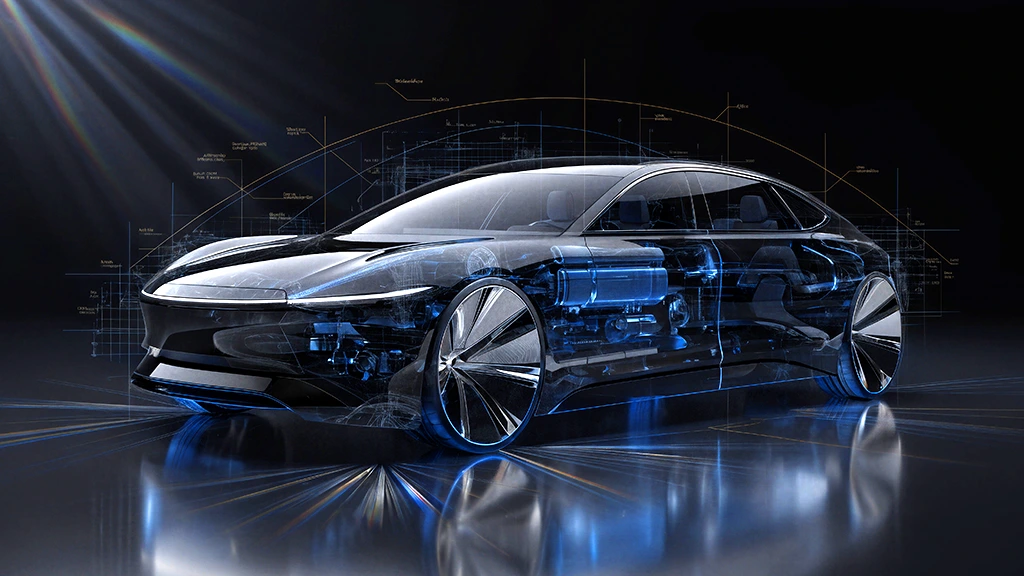
Cars need more electricity than they used to. That’s the short version of a much longer story behind the rise of 48 V automotive architecture. In vehicle electronics, all advanced driver assistance features, electrified components, and bigger infotainment screens draw power. The humble 12 V system that has run vehicle electronics for most of the last century was never built for this kind of load, which is exactly the gap that 48 V automotive architecture was designed to fill.
For a while, automakers simply pushed more current through thicker wires, but that approach has its limits. As a result, the industry has largely settled on a better one by adding a second, higher-voltage electrical system that runs alongside the 12 V network instead of replacing it. That system runs at 48 V, and it is quickly becoming one of the more consequential changes made in vehicle electrical design over the past decade.
In this article, we discuss what 48 V automotive architecture is, how it works, where it’s being applied, and why it’s becoming a standard part of modern vehicle design.
Key Pointers
- Rather than replacing the 12 V network, 48 V systems work alongside it, adding capacity for demanding components while everyday electronics stay on the older 12 V setup.
- Automakers did not land on 48 V by accident. It sits just under the 60 V regulatory line, which means it skips the heavy safety and insulation rules that come with high-voltage EV and hybrid systems.
- Two things are pushing adoption forward. One is simple demand, since ADAS, electric steering, and climate control all need more power than before. The other is regulatory, as manufacturers look for cheaper ways to improve fuel economy without going all in on electrification.
- The payoff shows up in a few places: regenerative braking, electric assist, less energy lost to resistive heating, and enough headroom to run power-hungry parts like electric turbochargers and active suspension.
- It’s not a clean win, though. Running two electrical systems adds cost and complexity, and suppliers still have not standardized their components. For now, 48 V works best as a bridge technology, not a full replacement for electrification.
What Is 48 V Automotive Architecture?
At its core, a 48 V automotive architecture is exactly what it sounds like: a second electrical network, operating at roughly 48 volts, that works alongside a conventional 12 V system in a vehicle. It does not replace the 12 V network, as there is no real reason to change it. Most of a car’s electronics, such as lighting, infotainment, and low-power sensors, run perfectly on 12 V.
The choice of 48 V was not arbitrary. Regulators in most major markets draw a line at 60 V, below which a system is still considered low voltage and does not trigger the heavy insulation, shielding, and safety requirements that apply to the high-voltage systems found in full hybrids and EVs. Sitting just under that line lets automakers add a meaningful amount of power capacity without pulling in an entirely different set of safety engineering requirements. It is a deliberately pragmatic number, one that has made 48 V electrical architecture practical to roll out at scale rather than confined to a handful of flagship models.
Why are Automakers Moving from 12 V to 48 V?
There are two motivations for this change, both of which are not always emphasized in conversation.
-
Demand is the first reason
Climate control, electric power steering, and driver assistance sensors all require current, and a 12 V system begins to show its limitations once several of these devices are combined in a single vehicle. The added power demands thicker cabling and results in greater resistive losses, neither of which automakers are eager to deal with. This is one of the clearest technical arguments for moving toward a 48 V vehicle architecture in the first place.
-
The second reason is regulatory
Emissions standards have become much tighter over recent years, and a 48 V mild hybrid system is one of the more cost-effective ways to recoup a few percentage points of fuel economy. It allows for regenerative braking and provides some electric assistance during acceleration, but without the expense of incorporating a full hybrid or electric powertrain. For many manufacturers, it simply comes down to practical business sense.
How Does a 48 V Automotive System Work?
In practice, most 48 V systems are dual-voltage setups. The 48 V side handles higher power components; the 12 V side keeps running everything else.
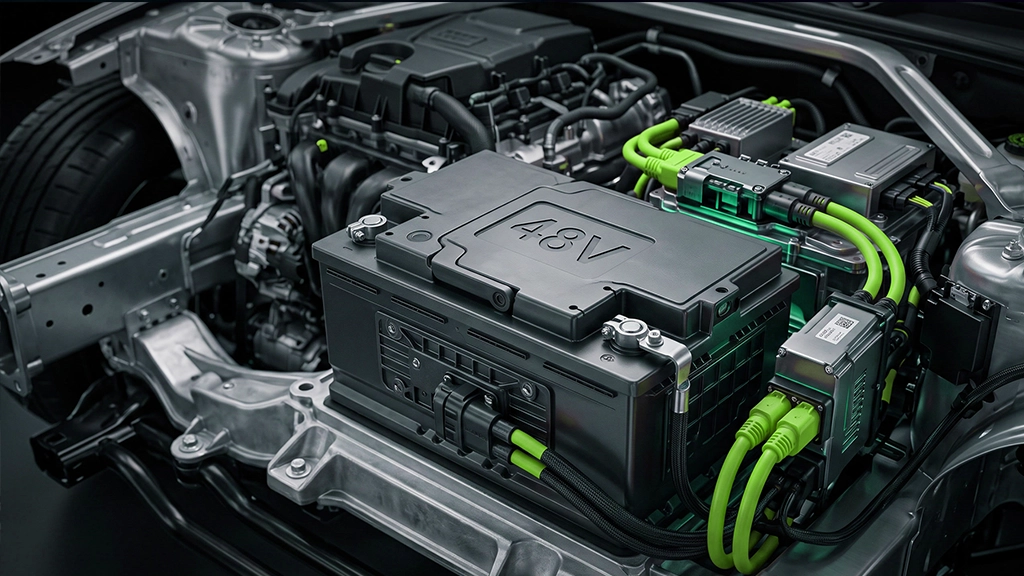
A DC-to-DC converter sits between the two, moving power back and forth as needed. During braking, a belt-integrated starter-generator, which has largely taken over the job a conventional alternator used to do, captures kinetic energy and converts it into electricity that gets stored in the 48 V battery. That stored energy can then assist the engine on acceleration, or run other 48 V components. It is a relatively modest engineering change with a surprisingly large efficiency payoff.
Key Components of a 48 V Architecture
A handful of components work together to make this system function, and none of them are optional.
- 48 V battery: Typically a lithium-ion battery, stores the energy generated from braking.
- DC-to-DC converter: Regulates the power between the 48 V and 12 V circuits.
- Belt integrated starter generator: A dual-function device that starts the engine and generates electricity; it is the key component behind the fuel savings these systems deliver.
- Power electronics: Regulate current across the network.
- Inverters: Convert direct current into the alternating current some motors require.
- Electronic control units: Decide how power gets distributed.
- Power distribution system: Wiring, fuses, and connectors built to handle the higher current loads involved.
Benefits of 48 V Automotive Architecture
The efficiency case that automakers make is the most compelling, since regenerative braking and electric assist genuinely reduce fuel consumption, and operating at a higher voltage reduces current, which means fewer losses due to resistive heating in the conductors.
However, there is a second benefit that also plays a major role, and that is increased power availability. A 48 V power architecture provides more headroom, which makes it possible to include components like electric turbochargers and active suspension, neither of which could be accommodated on a 12 V system. Reductions in emissions and improved physical packaging, such as lighter wiring, are secondary benefits that flow from these two primary advantages of 48 V automotive technology.
Applications of 48 V Systems
The most prominent application is in mild hybrid vehicles, where 48 V power supports electric assist and regenerative braking while avoiding the cost of a full hybrid drivetrain. Start-stop systems also benefit from being able to restart more smoothly and quickly than possible with the 12 V system alone.
From there, the applications spread further than most people outside the industry realize. Electric turbochargers use 48 V power to nearly eliminate turbo lag. Active suspension and electric steering systems need the extra power for real-time adjustments. Thermal management and HVAC systems, particularly electrically driven compressors, draw on it as well. And two categories that get less attention in this conversation, ADAS and infotainment, are quietly becoming some of the biggest power consumers on the 48 V side of the vehicle, simply because sensors and screens keep getting more capable.
12 V vs. 48 V Automotive Architecture
The table below lays out how a 12 V vs 48 V automotive comparison plays out across the areas that matter most to design and performance.
| Aspect | 12 V Architecture | 48 V Architecture |
|---|---|---|
| Power capacity | Limited; cannot carry much current without excessively thick wiring. | Can carry roughly four times the power of a 12 V system at comparable current levels. |
| Current and losses | Higher current needed for the same power, leading to greater resistive losses. | Lower current for the same power, reducing resistive losses. |
| Wiring | Thicker, heavier cabling required as loads increase. | Lighter wiring possible due to lower current draw. |
| Supported components | Traditional electronics: lighting, infotainment and low-power sensors. | Higher-power components: electric turbochargers, active suspension and belt-integrated starter generators. |
| Regenerative braking | Limited capacity to capture and store braking energy. | Can capture and store significantly more energy during braking. |
| Regulatory classification | Well below any high-voltage threshold, with simpler safety requirements. | Stays under the 60 V threshold, avoiding high-voltage safety and insulation requirements. |
| Role in the vehicle | Remains the primary system for most electronics. | Operates alongside the 12 V system in a dual-voltage setup, not as a replacement. |
| Maturity and adoption | Long-established and universal across the industry. | Growing steadily, especially in mild-hybrid and higher-end vehicles. |
Challenges of Implementing 48 V Systems
None of this comes free. Running two electrical systems in one vehicle is inherently more complex than running one, and that complexity shows up in cost, particularly for the battery, converter, and power electronics. Every component in a 48 V automotive electrical system also has to meet its own safety and insulation standards, even though the voltage stays under the high-voltage threshold.
There is also a standardization issue, which is less discussed than it needs to be. With an increasing number of suppliers offering 48 V components, ensuring they work together consistently across different vehicle platforms remains an unresolved, somewhat chaotic part of the industry’s transition. It is not a dealbreaker, but it is slowing things down more than one would think based on the marketing materials.
Where 48 V Fits Between Software and Full Electrification?
Software-defined vehicles require more than just smart code. They require sufficient electrical headroom to allow for centralized computing, over-the-air updates, and the expanding number of sensors and actuators, which a 12 V network often cannot provide. A 48 V system powers the supplemental capacity required by these architectures, quietly enabling the software-centric story that dominates the conversation.
It is worth being clear about what these systems are not, though. They are not a substitute for full hybrid or battery electric powertrains, and they do not deliver anywhere near the same emissions benefit. What they offer is a cheaper, faster way to bring some automotive electrification into vehicle segments where a full EV powertrain is not commercially realistic yet, making 48 V less of a destination for most automakers and more of a stepping stone toward higher voltage platforms down the line.
Future Trends in 48 V Automotive Architecture
Expect closer integration between 48 V systems and active safety features, since ADAS sensors need a power supply that would not waver. Expect the list of components running on 48 V to keep growing too, pulling in chassis and comfort systems that have relied on 12 V for decades.
Battery technology, power electronics, and converter efficiency will keep improving, and as they do, costs should come down. If that happens at the pace suppliers are currently projecting, 48 V automotive technology stops being a differentiator and becomes closer to a baseline expectation across most vehicle segments within the next several years.
Conclusion
48 V automotive architecture is not a flashy technology, and it was never meant to be. It’s a pragmatic middle step, one that gives automakers real efficiency gains and genuine new capabilities without the cost and complexity of full electrification. That combination is exactly why it has spread as quickly as it has, and why it’s likely to keep spreading.
For organizations trying to work out where the real opportunities sit within this space, whether in component innovation, software integration, or supplier consolidation, the landscape is moving fast enough that yesterday’s map is already out of date.
Ingenious e-Brain Solutions helps automotive and component companies track emerging technologies like 48 V architecture through Technology Scouting & Monitoring and Technology Forecasting, identifying where innovation, competition, and IP activity are heading next, before it becomes obvious to the rest of the market. Talk to our experts to see where the real opportunities sit for your business by filling out the form below or emailing us at contact@iebrain.com.