

A decision about whether a drug for a rare disease is funded is not made when the company talks to payers (the insurers or health organisations which pay for treatments). It is determined many years earlier, at the time when the company chooses what evidence to collect, which drugs it will compare against, and what price to set.
In the case of rare diseases, there is very little data, since there are few patients, the tests used to measure the results are often new, and there are few past cases to learn from. Although payers are aware that the data will be limited, they still have to decide whether it is strong enough to justify paying for an expensive drug.
Most teams carry out these tasks individually. One team prepares the evaluation of the drug’s value (known as HTA), a second gathers real-world data, and a third determines the price. Although few teams verify that all three sets of information agree, but payers do check. The best method is to connect all three activities from the beginning, so that any gaps can be corrected before the reviewers identify them.
This article outlines three related steps that assist teams in planning their reimbursement requests when there is limited clinical evidence and presenting a consistent value story to payers in different markets.
How to Build a Rare Disease Market Access Strategy in Three Steps
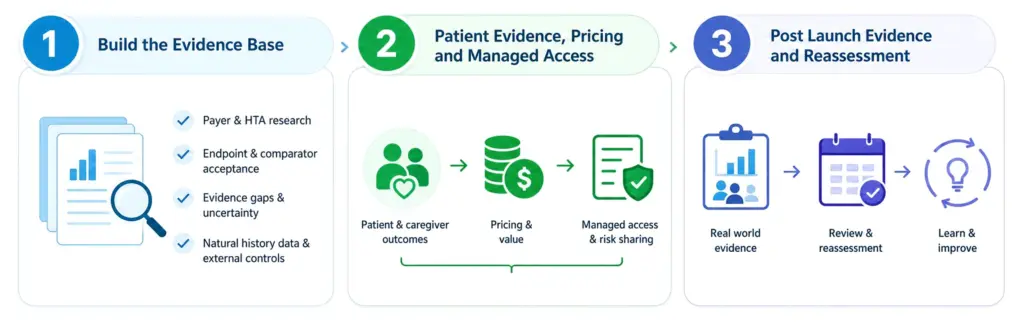
The steps are closely linked. The evidence selected has an impact on how value is assessed, and any uncertainty that remains can affect both the price and the access terms provided to payers. The table below gives a summary of each step.
| Step | What it covers | What it delivers |
|---|---|---|
| Step 1: Build the Evidence Base | Get in contact with payers and HTA organisations as early as possible, identify the areas where the evidence is weak, and plan for natural history data and comparators. Clinical and economic evidence are developed together. | A value story that answers the questions payers will actually ask. |
| Step 2: Patient Evidence, Pricing and Managed Access | Gather what patients and caregivers have to say about their daily lives, compare the price with its impact on budgets, and decide how to share the risk if any doubts remain. | Outcomes that matter to patients, a price you can justify, and access options ready to discuss. |
| Step 3: Post-Launch Evidence and Reassessment | Get registries up and running before launch, gather real-world evidence (RWE), keep an eye on outcomes as patients receive treatment, and know what each review will be looking for. | Answers to the questions the trials did not resolve, and the evidence needed for reassessment and continued reimbursement. |
The questions that come from payers have an impact on the evidence, the evidence in turn affects the price, and the price determines which access options you can plausibly offer. Skipping a step never saves time. It usually ends up costing more time later, especially when teams are under pressure to prepare an HTA submission for a rare disease therapy.
Step 1: Build the Evidence Base
Begin the process with payer and HTA research prior to pivotal study design finalization. Find out which endpoints and comparators the payers are likely to accept, identify where the evidence is weakest, and determine how much uncertainty might influence their decision. Rank these gaps based on their impact and then structure the natural history datasets and external controls in a way that would provide a credible basis for analyzing the treatment effects. Develop clinical and economic evidence in parallel, in order to align the rare disease evidence generation plan with the assumptions of the clinical, HEOR and commercial teams and address the questions that will be asked by payers first.
Step 2: Patient Evidence, Pricing and Managed Access
It is important to give patient and caregiver evidence real importance, since the daily burden and quality of life are just as important as clinical results. When setting up the prices, team should consider the strength of the evidence, along with the budget impact, expected value, and the level of uncertainty regarding the benefit. In the case of rare diseases, decisions about pricing and reimbursement usually depend on affordability as well as the perceived value of the treatment. Where there is still uncertainty, managed access agreements, outcome-based contracts, and staged pricing can enable payers to fund the treatment while further data are gathered, on the condition that the agreed outcomes can be measured.
Step 3: Post-Launch Evidence and Reassessment
Launch is when the real questions start getting answered. In rare diseases, real-world evidence shows when the results from clinical trials hold up in patient everyday lives, and payers lean on it when they revisit funding. If possible, get registries running before launch. Then take each review date and work backwards from it so renewal focuses on outcomes rather than on missing data. Good market access in the rare disease area also involves drawing lessons from each individual market and feeding payer questions into the next submission. Over time, obtaining reimbursement for rare diseases becomes a capability that can be repeated.
How Ingenious e-Brain Can Help in Rare Disease Market Access?
Using this framework takes expertise in evidence, economics, pricing, and payer decisions. Ingenious e-Brain has completed more than 65 projects worldwide and brings all of these skills into every step of the rare disease market access process:
- Coverage of every step: From payer research to reassessment, our team manages the entire plan to avoid the challenge of having to piece together different vendors.
- Payer and HTA insight: We deliver rare disease payer research services and HTA consulting for rare diseases, based on access to a panel of 4,500+ payers.
- Evidence generation expertise: Our rare disease evidence generation consulting spans gap analysis, natural history and comparator planning, and real-world evidence design.
- Health economics and pricing strength: We evaluate price, budget impact, and managed access options simultaneously.
- Global reach for orphan drugs: We provide global market access consulting for orphan drugs across markets with very different HTA and reimbursement pathways.
- Payer first, defensible advice: We start with the question a payer faces, then connect all recommendations back to the question to help teams defend their proposals in the room.
Final Thoughts
Rare disease market access tends to go best for teams that start early and keep their decisions in line with each other. In rare disease, evidence is usually thinner than payers would like. What they respond to is a team that knows exactly where the weak spots are, has a plan for each one, and can show how the data will improve after launch.
That’s the practical value of working in steps. You find the gaps while there’s still time to act on them, you close the ones you can, and you agree with payers on how to handle what’s left. If you only do one thing after reading this, look at your plan and find the weakest step. Fix that first, then work outward.
If you are preparing a rare disease launch, Ingenious e-Brain can help you build a plan that payers trust. Speak to our market access team about rare disease reimbursement consulting, evidence gap analysis, and HTA support, and turn evidence uncertainty into a clear path to patient access. For more information, visit our market access service page.