

Ten years of work. Millions spent. Then a letter from another company’s lawyers, a week before launch.
It happens, and the cause is usually ordinary. Someone else already patented part of what you built. It might be a protein, a gene sequence, or the way you make it. Making the discovery yourself does not mean you are free to sell it.
A Freedom to Operate (FTO) search checks whether you can launch your product without infringing someone else’s patent. In biotech, searching for keywords is not enough. You need to compare the exact sequence of your product with what existing patents claim. It is far better to find any problem before you launch than after.
Why FTO Search for Biotech Products Is Different
Most patent searches rely on keyword searches to highlight any overlapping features. However, biotechnology is very different.
If a competitor has used different terminology, a keyword search will not bring up any blocking patents. Biotech products use living material, protein structures, amino acid chains, and functional mechanisms, which require specialized analysis.
If your product uses a specific sequence, then using a keyword search will leave you completely vulnerable.
Sequence Analysis: Finding Patents That Keywords Miss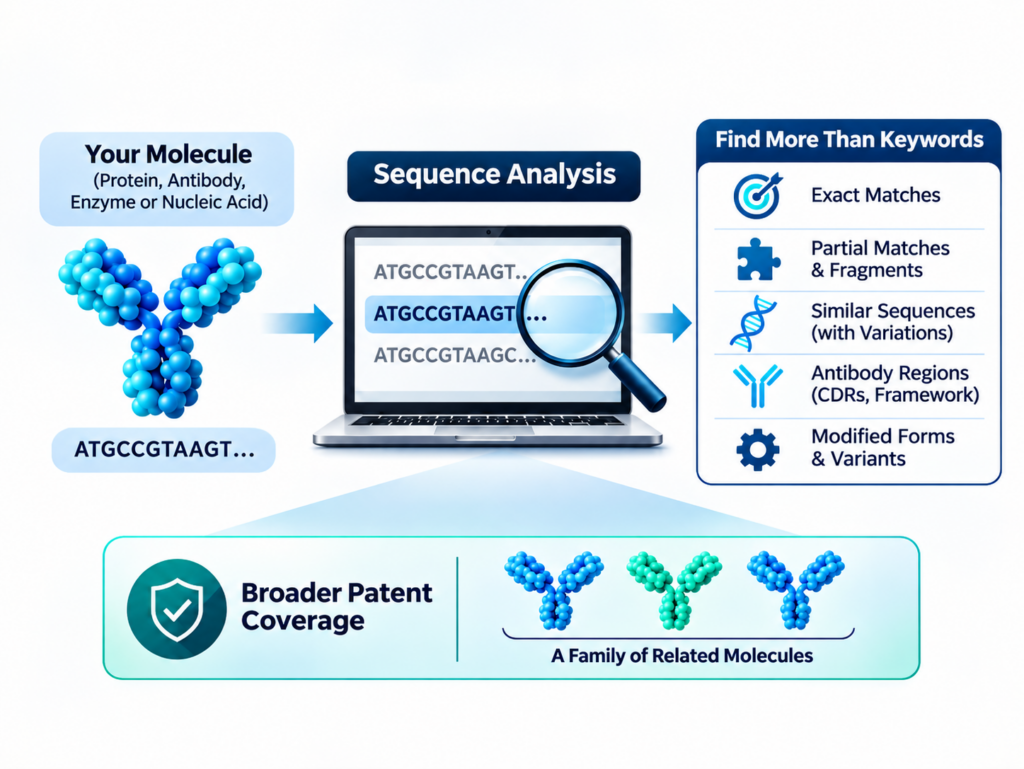
Sequence analysis is the first major part of an FTO Search for Biotech products.
In biotech, one molecule can go by many names, and a patent may cover many close versions of it. Your product could be protein, antibody, enzyme, or nucleic acid. We compare its DNA, RNA, or amino acid sequence with the sequences in patents and patent applications worldwide.
This helps identify patents not found using a keyword search. Often a patent will describe a molecule using the sequence rather than the name you know it by.
A good sequence search looks for:
- Exact matches to your full sequence
- Partial matches and fragments
- Similar sequences with a few changes
- Antibody regions, such as CDRs and framework regions
- Modified forms and variants
This is important because patent holders typically do not claim just a single sequence but rather similar sequences, functionally equivalent sequences, or a family of related molecules, so a product with small differences can still be covered by a claim.
Read More: When Should You Conduct an FTO Search? 7 Business triggers
Claim Analysis: Finding Which Patents Can Actually Stop You
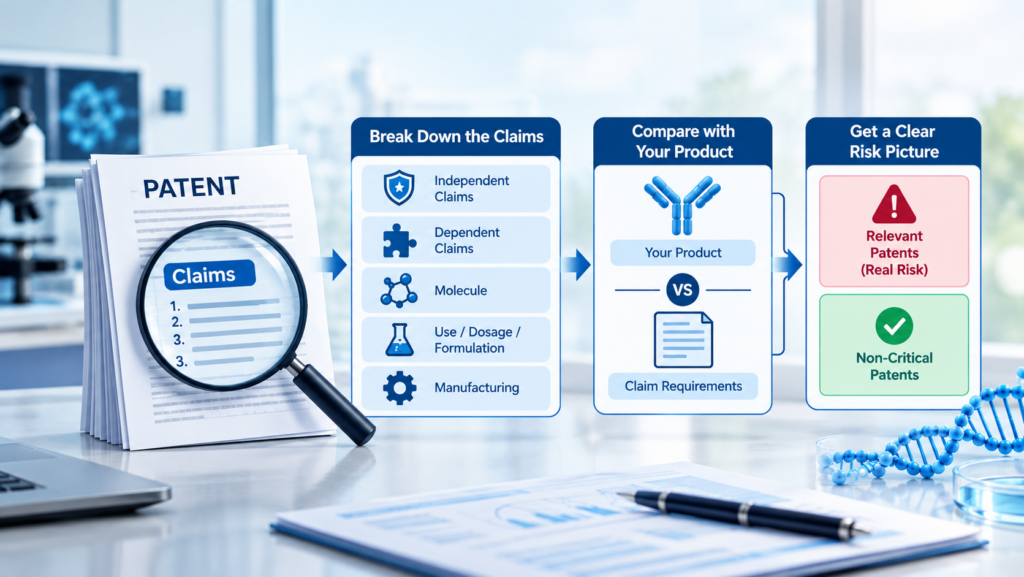
Claim analysis is the second major part of an FTO Search for Biotech.
Once relevant patents have been identified, each important claim is broken into its parts. These parts will then be compared to your product, its use, and your manufacturing process. The key question is simple: does your product meet every requirement of the claim?
A careful patent claim analysis considers:
- Independent claims, which usually define the broadest protection
- Dependent claims, which add narrower but important limitations
- Claims covering the molecule itself
- Claims covering use, dosage, formulation, or manufacturing
- Claims that may apply through equivalents, not just exact wording
This step turns a long list of search results into a clear risk picture. It separates patents that truly matter from patents that merely mention similar science.
How Ingenious e-Brain (IeB) Helps You Reach the Market With Confidence
An FTO Search for Biotech is only useful if you can act on it. IeB is a research and consultancy firm that can help you identify the relevant patents and what to do with them.
- Scoped to your product: We will start by understanding your product, target markets, and commercialization plans.
- AI and human analysis: Our analysts combine AI assisted tools with expert judgment to run a biotechnology patent search across patent and non-patent literature from over 100 countries. We also have native language support in 25+ countries, including China, Japan, and Korea.
- Sequence searching for biotech: We use biological sequence searching to ensure we identify any overlaps that keyword search misses.
- Claim mapping: We will provide you with a grid showing the elements of each relevant claim and a key feature matrix showing how each claim is relevant to your product.
- Risk Assessment Sheet: We will rank the patents by risk, so you can see which ones need action and which can be set aside.
- Report in Word or Excel: Most searches will take around 4 to 6 weeks. Urgent timelines can be discussed.
- Pay only when satisfied: Our work is backed by a satisfaction commitment, and your data stays protected by strict access controls.
Also Read: AI in FTO Search: What it can do and where human expertise still matters
Final Thoughts
Before you sell a biotech product, you need to know if someone else already owns a patent that covers it. An FTO search for biotech answers that with two checks.
The first check compares your product’s exact makeup with the makeup described in other companies’ patents. This finds patents that look different on the surface but match what you are making.
The second check reads what each of those patents actually protects, then compares it with your product. This tells you which ones can really stop you and which ones you can ignore.
Doing both early gives you time to fix a problem, such as changing your design or asking the patent owner for permission. Doing them late leaves you very little room and a much bigger bill.
Frequently Asked Questions:
- How long does a FTO Search for Biotech take?
Most searches take around 4 to 6 weeks, depending on product complexity and the number of countries.
- Do I need an FTO search if I already have my own patent?
Yes. Owning a patent gives you the right to stop others. It does not give you the right to use your product if someone else’s patent covers part of it. - Can a startup afford one?
Scope controls cost. A focused search on your lead product and priority markets can be done at a reasonable budget, and it is far cheaper than a dispute after launch. - Is the search confidential?
We will keep your product details and findings confidential. We are happy to sign an NDA.
Speak to Our Team
If your product is heading to the clinic, funding round, or new market, it’s a great idea to speak to us. Provide us with a short description of your product and target countries, and we can tell you how we would approach it.
Contact Ingenious e-Brain at contact@iebrain.com or fill out the form to discuss your product.