

Every granted patent goes through a careful examination process. But examiners work under real constraints: on average, a patent examiner spends just around 19 hours on an entire application, covering everything from searching for prior art to reviewing claims and communicating with the applicant. With millions of patents and publications worldwide, that’s rarely enough time to catch every piece of relevant prior art. Sometimes the relevant prior art exists but is not found during examination because it uses different technical terminology, appears in an unexpected source, or is hard to find.
That’s when a patent invalidity search can be helpful. It can help find the prior art and evidence that the examiners may have missed the first time around.
What Is a Patent Invalidity Search?
A patent invalidity search (also known as an invalidity search or patent invalidation search) is an investigation of whether a granted patent should not have been granted in the first place.
Patent office’s grants thousands of patents every year. It is just impossible for examiners to find every piece of relevant prior art when reviewing a single application. So, sometimes they miss references that would have changed the result. Patent invalidity searches aim to uncover that missing prior art. This is evidence that could render a patent invalid for lack of novelty or inventive step at the time of filing.
In simple terms: A granted patent is valid only if the invention was really new and non-obvious at the time of filing. If there is any information describing the patented invention that predates the patent in question, such as a similar product, patent, research paper, manual, or even a web page, then this would invalidate the patent as it would no longer be considered novel.
This information is referred to as prior art, and the search for prior art is the basis for any invalidity search.
The Core Concept: Searching for “Prior Art”
The core of any patent invalidity analysis is finding “prior art.” Generally speaking, prior art refers to any publicly available information that can be used to prove that the patent in question is not novel or non-obvious. There are various types of prior art, such as:
- Patent prior art: Earlier domestic and international patents or published patent applications.
- Non-patent literature: Academic research papers, conference proceedings, user manuals, white papers, textbook chapters, and technical articles.
- Public disclosures: Old product catalogs, archived web pages, open-source code repositories, or public trade show presentations.
Patent Validity Search vs Invalidity Search
You might have come across terms “patent validity search” and “invalidity search”, and you might have wondered why two similar-sounding names are used to describe the same process.
The honest answer: technically, it’s often the same investigation, just approached from opposite directions.
- A validity search is usually performed by the patent owner or the entity that is about to license or buy the patent, to ascertain that the patent is valid and can be defensible.
- An invalidity search is usually performed by the entity that is accused of patent infringement, or a competitor trying to clear the way for their own product.
Both validity and invalidity searches examine the same universe of prior art, but the difference is intent. One side is trying to prove the patent stands strong, the other is trying to find the crack that brings it down.
Patent Invalidity Search vs Other Common Patent Searches
It’s easy to confuse different kinds of patent searches in regard to their objectives. This confusion is justified since each search type pursues a different strategic goal.
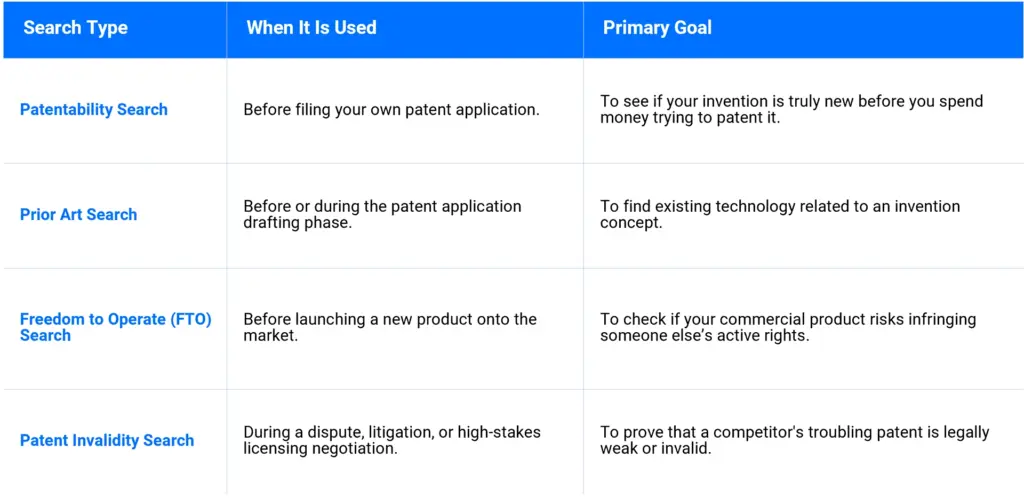
As seen from the table above, while a standard prior art search looks broadly at what exists, a patent invalidity search is far more targeted and aggressive. It goes after the specific claims of one troublesome patent, aiming to take them down claim by claim.
When Do You Need a Patent Invalidity Search?
Simply put, whenever a patent stands between you and something you want to do, for instance, selling a product, defending a patent infringement lawsuit, negotiating a deal, or entering a market, or you have reason to believe that the patent is not valid or doubt its strength, then an invalidity search is worth considering.
Some specific examples of when you might need a patent invalidity search are mentioned below:
-
You have been accused of patent infringement:
One of the most common grounds for defense against a patent infringement claim is that the patent allegedly being infringed should not have been granted in the first place. That’s why an invalidity search is often the centerpiece of many patent infringement lawsuits.
-
You are facing patent litigation:
Whether you are defending a patent lawsuit or thinking about suing someone else, understanding how strong or weak the patent in question is should be central to your legal strategy.
-
You want to challenge a patent before it becomes a problem:
Companies sometimes realize that a competitor’s patent could interfere with their ability to commercialize a product or technology, and they want to challenge the validity of that patent. This can happen even before any litigation has formally begun. A patent challenge doesn’t necessarily take place in court. In many countries, you can initiate a patent opposition proceeding directly with the patent office, using many of the same types of prior art evidence as in an invalidity search.
-
You are negotiating a license:
If you are about to be asked to pay for the right to use a patent, it is important to know whether that patent could withstand a legal challenge.
-
You are evaluating a business deal or acquisition:
Investors and acquirers are often interested in knowing whether the target company’s “core patent” is as good as it looks on paper.
If none of these factors apply to you, chances are you are not in need of one yet, but it is still crucial that you understand the process and learn to identify the need when it emerges.
How Does Patent Invalidity Search Work?
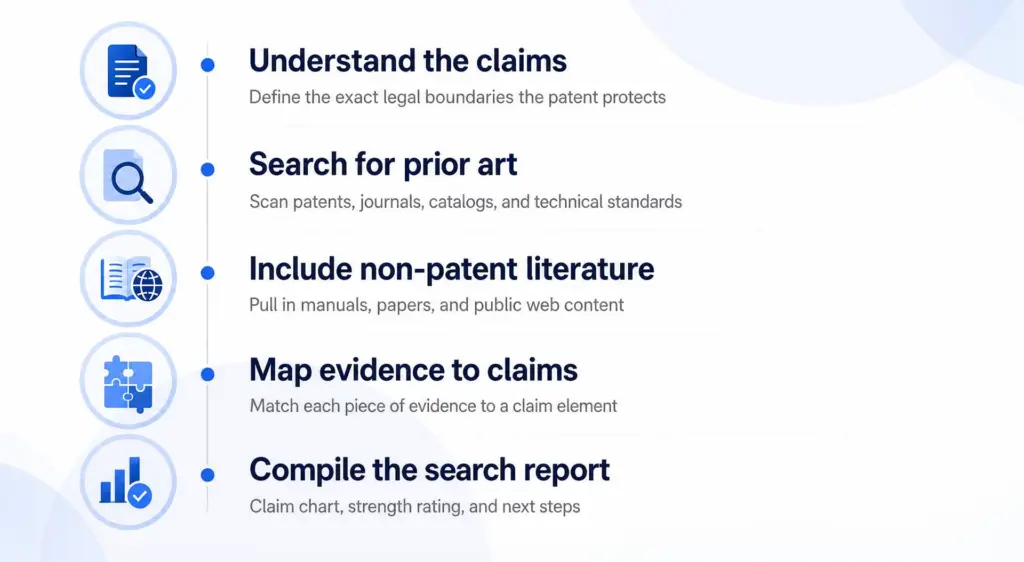
The invalidity search process typically involves the following steps:
-
Understanding the patent’s claims
Every patent has numbered “claims” at the end of the document that define the scope of protection for the given invention. You can say the precise legal boundaries of what’s actually protected. With that in mind, an invalidity search typically works to target and invalidate specific claims, rather than the invention as a whole.
-
Searching for prior art
This is the primary process, and the whole point of answering the question of “how do I find prior art to invalidate a patent?”
Researchers search patent databases, journals, product catalogues, technical standards, and other publicly available resources, looking for prior art (existing technologies or ideas) that were created before the patent was filed and are related to the patent’s claims in any way, including adjacent industries, since inventions are sometimes anticipated by something built for a different field entirely.
-
Including non-patent literature
Prior art doesn’t have to be another patent; it can be non-patent literature, such as academic papers, product manuals, articles presented at conferences, web content, and even YouTube videos – any public source that discloses the invention or something substantially similar to it before the filing date. This is where most of the evidence is usually found, as examiners are more likely to review patent-related documents than non-patent sources.
-
Mapping prior art to the patent claims
Finding an old document is only the first step. The real challenge is showing how the evidence supports each part of the patent claim and proves that the invention is not new or would have been obvious.
For example, if a patent claims a chair having “four legs, a backrest, and a locking recline mechanism,” one old product brochure showing all of these would be sufficient to challenge that claim.
A single piece of strong evidence can be enough, but evidence scattered over numerous documents must demonstrate that it would have been obvious to combine the documents in question. This is where novelty and non-obviousness, the two patent requirements, come into play.
-
Compiling a patent invalidity search report
The search findings are then organized in a formal patent invalidity search report. It generally contains information about the found prior art, its comparison with the patent claims, and how strong the invalidity argument is. The report is usually presented to attorneys as the final search result and serves as the foundation for formulating a legal strategy in a patent dispute.
What is Included in an Invalidity Search Report?
An appropriately composed invalidity search report will usually contain:
- Description of the patent and its key claims.
- List of the discovered prior art with its publication dates and sources.
- A claim chart showing how each reference of prior art relates to corresponding patent claims.
- Overall assessment of invalidity strength -strong, moderate, or weak
- Recommendations of what to do next (litigation, licensing negotiations, opposition filing, etc.).
Note: Even partial success matters in invalidity search. As a patent can be invalidated claim by claim, not always all at once, so if prior art only knocks out one problematic claim, that can still be a meaningful legal win, especially if that claim was the one used against you.
What Does a Patent Invalidity Search Cost and How Long Does It Take?
Scope is the primary determinant of both. A focused search isolating just a few claims in one technology area will be much quicker and cheaper than one searching a large patent family in multiple jurisdictions against dense non-patent literature.
As a rough guide:
- Timeline: Usually takes several days for a narrow, single patent search, while broader claims covering multiple jurisdictions and non-patent literature can take weeks.
- Cost: Can vary significantly depending on the scope and urgency, and rises significantly for litigation-ready searches that require a full claim chart and attorney-reviewed report compared to preliminary scoping searches
If you are on a tight litigation deadline, it’s worth noting that a rushed search limited to patent databases is going to produce inferior results to a search with more time and resources that also dig into non-patent literature and foreign language sources as well.
Final Thoughts
Navigating the complexities of patent disputes and infringement threats can be a challenging process; however, it is crucial to be well informed on the strengths and weaknesses of a competitor’s portfolio, so that you may have leverage in the dispute. A thorough invalidity investigation can help turn the tides in your favor.
If you are currently being accused of infringement, investigating a competitor’s blocking patent, or simply preparing for litigation, we can help!
A professional patent invalidity search typically gives you:
- Access to global patent and non-patent databases beyond what is typically found in public searches
- Researchers with experience in finding and analyzing prior art against specific patent claim language
- A defensible, attorney-ready patent invalidity search report
- A faster, more comprehensive search than you could complete in-house. This is often vital for meeting a litigation deadline.
For those seeking thorough examination, our professional invalidity search services ensure you discover concealed prior art to help form a better defense. For further information on how our ingenious e-brain expert teams can help with your particular case, please visit our specialized patent invalidity search service.
Frequently Asked Questions (FAQ)
-
What is a patent invalidity search?
It is a search for evidence (prior art) showing that a granted patent should not have been granted because the invention disclosed in the patent was not novel or inventive enough at the time it was filed.
-
Why is a patent invalidity search conducted?
Most often to defend against a patent infringement claim, to challenge a competitor’s patent, or to evaluate the risks associated with a potential licensing deal or a business transaction.
-
How does patent invalidity search work?
Patent invalidity search is the process of analyzing patent claims, checking prior art (patents and non-patent documents) that were created before the searched patent was filed, and matching this information to the claims of a patent in question.
-
What is the difference between a prior art search and an invalidity search?
A prior art search is conducted before the filing of a patent application to ensure that one’s invention is novel, whereas an invalidity search is performed against an already issued patent to determine whether the patent is invalid.
-
How long does a patent invalidity search take?
This depends on the complexity of the patent and the technology area, but they can take anywhere from a few days to several weeks.