

A patent becomes particularly valuable when an entire industry depends on the technology it protects. That is what gives Standard Essential Patents (SEPs) their unique commercial strength. But the same dependence that creates this value can also create an opportunity for challenge. SEPs cover technologies needed to follow widely used standards such as 4G, 5G, Wi-Fi, and HEVC. Companies developing products with these standards may need to use this patented technology, giving SEP owners significant licensing leverage. At the same time, the standards-development process leaves behind years of technical records of how these technologies have evolved. This publicly available information can give potential challengers valuable insight into whether the invention was genuinely new.
Together, these factors are driving a quiet shift in SEP disputes. The question is no longer only how much a patent is worth, but also whether it is strong enough to be worth licensing at all.
In this article, we discuss the grounds on which standard essential patents are being challenged, the trends fueling this shift, a few recent cases of SEP invalidation, and practical strategies companies can use to reduce these risks and protect their licensing position.
Key Takeaways
- Being part of a standard does not shield a patent from challenge anymore. Courts are looking just as closely at validity as they are at FRAND rates.
- Recent rulings from the UPC and US courts have not gone one way. Some SEPs have been struck down, others have held up, which is exactly why assessing a portfolio early matters.
- Even a handful of invalidated patents in a portfolio can shift licensing leverage and bring down litigation costs.
- Holding a defensible position takes more than a strong patent. It takes precise claim charting, careful priority date mapping, and a strategy that accounts for how different jurisdictions actually work.
SEP Invalidation at a Glance
A SEP’s commercial leverage depends heavily on the combination of validity, enforceability, and essentiality. If a patent is found not to be essential to a mandatory part of the standard, or is successfully invalidated, its value in a licensing or enforcement strategy can fall significantly. This makes validity and essentiality analysis particularly important in SEP disputes.
| Impact Area | Potential Impact |
| FRAND leverage | Invalidating even a handful of patents in an asserted portfolio can materially shift royalty discussions in the implementer’s favor. |
| Injunction risk | Where injunctions remain a realistic risk, a credible invalidity challenge can strengthen an implementer’s position and create additional negotiating room. |
| Cost asymmetry | SEP disputes can take years to resolve, and they involve significant legal and technical costs. Identifying potentially challengeable patents early can help companies reduce unnecessary litigation and licensing exposure. |
| Cross jurisdiction ripple effects | SEP holders often have related patents covering the same technology in multiple countries. If one patent is found to have a weakness, related patents covering the same technology may face similar questions. This can weaken the SEP holders’ position across the broader portfolio while giving the other party greater leverage to challenge licensing demands or negotiate better terms. Each patent is still reviewed separately in its respective country. |
| Portfolio level exposure | SEP licensing negotiations often involve large portfolios of declared-essential patents. Identifying weaknesses in individual patents or small groups of related patents can influence the economics of the broader portfolio. |
| Essentiality scrutiny | A declaration of essentiality does not automatically mean that a patent is legally essential. Comparing the claims with the mandatory requirements of the standard can reveal patents whose licensing position may be weaker than their declaration suggests. |
| Built in prior art trail | Standards contributions, working-group documents, earlier versions of a standard, and other technical disclosures can provide valuable sources of prior art when assessing the novelty and inventive step of a patent. |
What SEP-Centric Invalidation Involves
The focus of SEP disputes is expanding. While the battle over FRAND rates dominates, major attention is being paid to whether the patents in suit are essential, valid, and enforceable. As courts increasingly consider validity alongside rate-setting, invalidation is becoming more than a defensive measure. It can also reshape the negotiating dynamics between SEP holders and implementers.
An implementer can challenge an asserted SEP on several grounds:
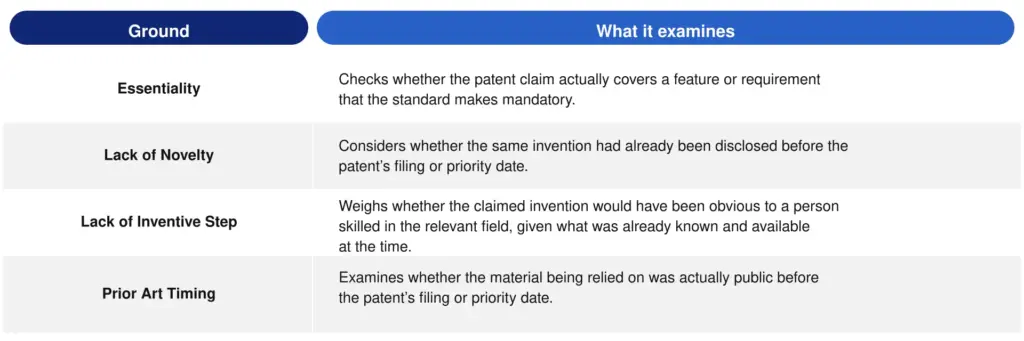
These grounds can sometimes overlap. A stronger approach is to look at both whether the patent truly covers a required part of the standard and whether the underlying invention was genuinely new.
What’s Changing the Landscape Right Now
Three forces are pushing invalidation further into the spotlight:
1. FRAND disputes are becoming more complicated.
FRAND stands for Fair, Reasonable and Non-Discriminatory. It’s the commitment companies make to license certain standard essential patents on terms that are fair and reasonable. More and more, companies are running into real questions here, what licensing should actually cost, which patents are even covered, where a dispute should be handled, and how these commitments affect enforcement down the line.
Courts are now weighing in on all of this: licensing terms, portfolio scope, jurisdiction, and how FRAND obligations tie into patent enforcement. That’s exactly why checking a patent’s strength and its relevance to the standard early on matters so much, it puts companies in a far stronger position once negotiations or disputes actually begin.
2. The European SEP landscape is changing.
The Unified Patent Court is becoming an important place for SEP disputes. The European Commission has stepped back from the proposed SEP Regulation in February 2025. As a result, companies are paying closer attention to how SEP disputes and licensing are handled under the existing rules.
3. New generations of standards are expanding future SEP risk
Standards and technologies like 5G Advanced, connected vehicles, WiFi, and IoT continue to evolve, and new patents may become essential to these emerging standards. By monitoring emerging technologies, firms can identify if one of their patents is at risk of being involved in a patent licensing dispute or lawsuit.
You May Also Like: When Should You Conduct an FTO Search?
Recent Cases of SEP Invalidation
Recent cases in the U.S. and Europe show that being connected to an industry standard does not automatically make a patent safe from challenge. Companies can still question whether an SEP is valid, whether it genuinely covers technology required by the standard, and whether it can be enforced against another company.
These cases also show that the outcome can be very different from one dispute to another. In some cases, patent claims have been found to be invalid, while in others, the patent has been upheld.
1. ZTE v. Samsung (UPC, 2026)
This ongoing dispute is about a ZTE patent covering 5G technology that Samsung was accused of infringing. The patent had been filed as a divisional application but the Unified Patent Court found that its claims covered subject matter never actually disclosed in the parent application, a gap the EPO examiner had missed at the time of prosecution. On this basis, the UPC revoked the relevant claims. ZTE has since appealed.
Why it matters: The case is a useful reminder that a patent does not earn any special protection simply by being declared part of a widely used standard. It still has to meet the ordinary requirements of validity, including that its claims are properly grounded in what was originally disclosed. For companies caught up in SEP disputes this means a patent drafting history and prosecution record equally deserve as much attention as its connection to the standard itself.
2. 3G Licensing v. Honeywell (U.S., 2024)
This case dealt with a patent related to the 3G standard. Interestingly, the conflict between the parties was not about the patent’s validity in a broad sense, but about whether it was entitled to the earlier priority date it claimed. It was found that the application did not clearly disclose the feature in question. As a result, the 3GPP standard documents became available as prior art, and the Federal Circuit affirmed the PTAB’s decision that the claims were unpatentable.
Why it matters: What this case illustrates is that a standard-essential declaration is only the starting point, not the end of the analysis. The patent’s own disclosure, what was already known in the field, and the precise timing of that knowledge all matter, and any one of them can turn out to be where an SEP’s claim to validity actually breaks down.
3. Panasonic v. OPPO (UPC, 2024)
In this case, OPPO challenged the validity of a patent from Panasonic related to 4G technology and also raised FRAND licensing issues. The Unified Patent Court was not convinced. It found the patent to be valid, essential to the standard, and infringed, thus rejecting the validity challenge.
Why it matters: This case shows the other side of the coin. Bringing an invalidity challenge does not automatically weaken a patent. If a court concludes the patent is genuinely valid and does cover what the standard requires, it remains fully enforceable. It’s a good reminder to weigh the strength of a challenge honestly before betting a defense on it.
What these cases show, taken together
None of these disputes were only about licensing terms or royalty rates. In each, the strength of the underlying patent itself became the central issue.
A patent may be closely connected to an important standard, but that does not guarantee that it will survive a validity challenge. If the court finds that the patent is valid and genuinely covers technology required by the standard, the patent can continue to be enforced. The outcome can depend on details such as what the patent originally disclosed, what technology was already known, and whether the patent actually covers technology required by the standard.
Also Read: What Is a Patent Invalidity Search and When Do You Need One?
Building a SEP Invalidation Strategy
1. Claim Chart Reconciliation
Before searching for prior art, it is essential to align the patent’s claim language with the specific standard clause it reads onto. This clarifies exactly which technical feature must be found in the prior art, narrowing the search significantly.
2. Check Whether the Patent Is Truly Essential
Not all declared-essential patents are actually essential to the mandatory portions of a standard. Some cover optional features or alternative implementations. Confirming true essentiality can itself narrow or eliminate exposure, a patent that is not essential may not need to be invalidated at all, since it can potentially be designed around.
3. Priority Date Mapping Against Standardization Timeline
Every proposal, draft, and meeting record submitted to an SSO (Standards Setting Organization — bodies like ETSI, 3GPP, IEEE, or the Wi-Fi Alliance) is dated and tracked, which means there’s a clear, verifiable record of exactly when a technical idea first came up, well before any patent is even filed. That timeline, when lined up against a patent’s filing date, is often the single most powerful piece of evidence in deciding whether a SEP actually holds up.
4. Search Across Multiple Sources
Patents alone rarely tell the full story. A thorough search should also draw on technical contributions submitted during standard-setting meetings, academic research, earlier versions of the standard, and other published material from the period. Often, the most revealing evidence turns out to be the discussions and proposals exchanged while the standard was still taking shape, the kind of record that patent databases alone won’t surface.
5. Consider the Country Where the Patent Is Being Challenged
The process of challenging a patent can vary from one country to another. A strategy that works well in the U.S. would not necessarily work in Europe, Germany, or China, because each country has its own rules for what it actually takes to prove a patent invalid. Weighing all these differences early gives a company a much clearer sense of where a challenge actually stands.
Final Thoughts
SEP-centric invalidation stays quiet because it plays out in patent offices and courtrooms, not in headlines, but its effects run deep. Courts are asking for stronger proof of essentiality and validity, and implementers are getting sharper at building invalidation strategies. Together, that’s shifting the balance of power in SEP licensing, changing not just how SEPs are litigated, but how they are drafted, licensed, and valued in the first place.
For SEP holders, robust prosecution and meticulous documentation are no longer optional. For implementers, invalidation offers a real path to reduce licensing costs and challenge overreach, but only with technical depth, legal insight, and cross-jurisdictional coordination to back it up.
At Ingenious e-Brain, our SEP analysis services combine standards intelligence, data-backed analysis, and litigation-grade claim charting to help you identify which patents can genuinely stand their ground, whether you’re strengthening a portfolio for licensing, preparing for litigation, or evaluating exposure to an invalidity challenge.
Talk to our seasoned IP experts to see where your SEP portfolio truly stands. Fill out the form below or email us at contact@iebrain.com.